
Click beetle
Corymbites
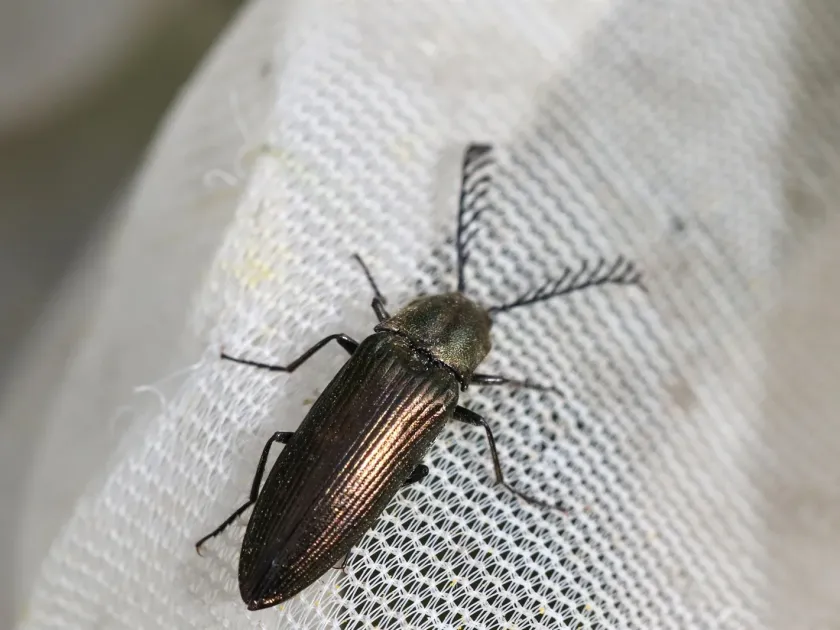
Description
How to identify
Click beetles (genus Corymbites) belong to the family Elateridae within the order Coleoptera. Adult beetles have an elongated body, typically measuring 10 to 20 mm, with dark, brown, or metallic colorations.
Their most distinctive characteristic is a clicking sound mechanism located on the thorax, which allows the beetle to flip itself upright when placed on its back.
The larval stage, commonly known as the wireworm, is the primary economic threat to agriculture. These larvae are characterized by a hard, cylindrical, wire-like body that is typically yellow or brownish in color.
The life cycle of the click beetle is unusually long, ranging from 3 to 5 years, which makes the management of their population highly complex within crop rotation cycles.
Both adult beetles and larvae hibernate in the soil, with spring activity typically beginning when soil temperatures reach 10–12°C.
What it damages
Wireworms are polyphagous pests that attack a wide range of agricultural crops, including cereals, legumes, potatoes, vegetables, and technical industrial crops.
The pests are particularly destructive during the early growth stages, as they feed on seeds, swollen embryos, and tender young seedlings before they emerge.
Injured underground plant parts become susceptible to secondary infections by fungal and bacterial pathogens, which often lead to total crop failure.
Root crops like potatoes and carrots suffer from deep, unsightly boreholes caused by larval feeding, rendering the produce unmarketable and difficult to store.
Fields infested with quackgrass are particularly vulnerable, as the rhizomes provide an abundant food source that supports high wireworm populations.
Signs of infestation
The first indicator of a wireworm infestation is typically the thinning of plant stands, where crops suddenly wilt and the stem separates easily from the root system.
Visual inspection of potato tubers or carrots will reveal small, round holes that may be superficial or extend deep into the flesh, often accompanied by rot.
Careful excavation of the soil around the root zone of affected plants will often reveal the larvae, which typically curl into a defensive ring when disturbed.
Gradual wilting of plant patches in the field, occurring without foliar disease symptoms, is a classic sign of subterranean feeding activity.
Infestations are often more noticeable following periods of high soil moisture, which encourages larvae to move toward the surface and feed on root systems.
Control measures
Effective management requires an integrated approach that combines agrotechnical, biological, and chemical strategies to reduce the overall pest pressure.
Crucial agrotechnical measures include rotating crops with less susceptible species such as mustard, canola, or certain legumes to break the pest cycle.
Consistent deep tillage and aggressive weed management, especially targeting quackgrass, are essential for reducing the population density in the topsoil.
Chemical control usually involves treating seeds with specialized insecticides or applying granular soil insecticides directly into the planting furrow.
- Setting up bait traps using germinating grain to monitor population density.
- Applying lime to acidic soils, as high acidity is favorable for wireworm development.
- Using nitrogen-based fertilizers that provide an environment unsuitable for larval survival.
- Applying biological agents containing entomopathogenic fungi to suppress larval populations.
Taxonomy
- Latin name
- Corymbites
- Order
- Coleoptera (beetles)
- Family
- Elateridae
- EPPO code
- CORMSP
Discussion
No discussions yet — be the first.