
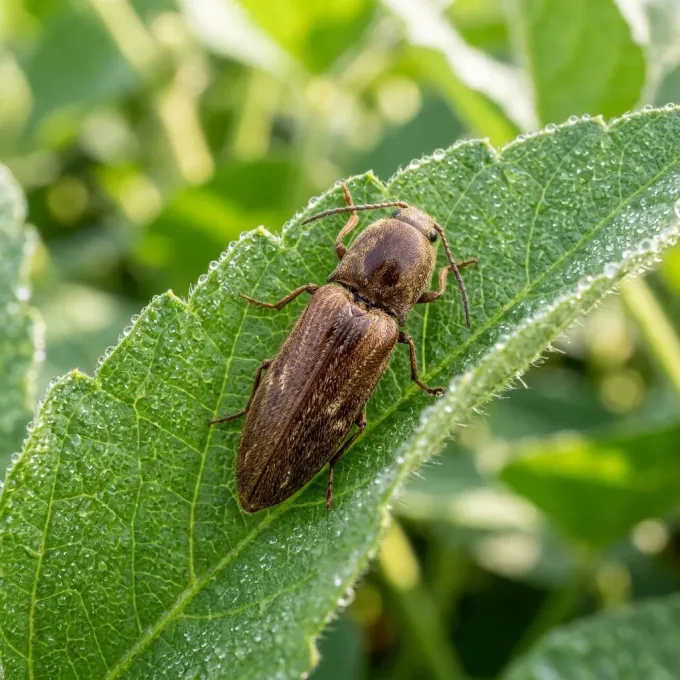
Click beetle Conoderus varians
Conoderus varians
Description
How to identify
Conoderus varians is a species of click beetle belonging to the family Elateridae (order Coleoptera). The adults are elongated, typically dark or brownish in color, and are named for the audible clicking sound they produce when they right themselves from a supine position.
The larval stage, commonly referred to as wireworms, possesses a highly sclerotized, cylindrical body. Their coloration ranges from yellow to dark reddish-brown, and they feature powerful mandibles that are perfectly adapted for feeding on tough underground plant tissues.
Identification at the species level is complex, often requiring entomological examination of the pronotal structure and genitalia. As part of a larger genus, Conoderus varians shares significant morphological characteristics with other related local species.
Adults are nocturnal and are frequently attracted to artificial light sources. Understanding their behavior is essential for accurate monitoring and timing of interventions during the adult flight period.
The larvae are highly mobile in the soil profile, moving vertically in response to temperature and moisture gradients, which is a key survival strategy that also impacts pest management efficacy.
What it damages
As a polyphagous pest, the larvae of Conoderus varians cause significant damage to a wide range of agronomic crops. They are particularly destructive to cereals, tubers, and various vegetables grown in high-moisture environments.
Initial crop damage occurs when larvae consume the seeds prior to germination or sever the roots of emerging seedlings. This often leads to severe stand reduction, forcing farmers to replant affected fields.
As the plants mature, wireworms tunnel into root systems, bulbs, and tubers. These excavations not only inhibit plant growth and reduce overall yields but also weaken the plants significantly.
Damage to storage organs like potatoes and beets creates open wounds that are highly susceptible to secondary pathogens, including fungi and bacteria, leading to rot that can persist after harvest.
In cases of heavy infestation, the damage can be catastrophic, particularly for high-value vegetable crops that require a healthy root system for rapid early-stage development.
When it appears
The seasonal activity of Conoderus varians is primarily driven by soil conditions. In the spring, as soil temperatures rise, larvae migrate to the upper soil layers to feed actively on root systems and germinating seeds.
During the peak of summer, if soil moisture drops and temperatures become extreme, the larvae migrate to deeper, more hospitable soil strata. This behavioral shift often makes them less accessible to surface-applied control agents.
Adult beetles typically emerge in late spring or early summer to mate and lay eggs. Preferred oviposition sites are moist soils with abundant organic matter or dense ground cover, which provide protection for the developing larvae.
Autumn brings a resurgence in larval activity as soil moisture increases, allowing them to continue feeding on remaining root tissues before they initiate their movement toward wintering depths.
The complete lifecycle of this pest is lengthy, often spanning multiple years. Therefore, fields remain at risk throughout the rotation cycle, necessitating consistent monitoring and management practices.
Signs of infestation
Visible signs of an infestation often appear as uneven crop emergence and patchy field areas where plants exhibit wilting or stunted growth, even under optimal moisture conditions.
Closer inspection of the root zone often reveals larvae or typical injury patterns, such as frayed roots or clean-cut punctures in the stems and tubers, which are diagnostic of wireworm activity.
In tuberous crops, the presence of small, deep entry holes followed by extensive galleries inside the produce is a clear indicator of previous or ongoing wireworm pressure.
Pre-planting site assessments are recommended to estimate larval density. Bait traps, such as buried starch-based lures or corn seeds, can be used to attract larvae, allowing for an accurate count before planting begins.
The observation of adult beetles on the soil surface or in light traps confirms the presence of the population and warns of imminent egg-laying cycles that could affect future planting seasons.
Control measures
Cultural control is a cornerstone of managing Conoderus varians. Strategic tillage, especially deep plowing in the autumn, helps expose larvae to predators and unfavorable environmental conditions, drastically reducing their numbers.
Crop rotation remains highly effective; incorporating non-host crops or those that interfere with the larval development cycle can significantly disrupt the population dynamics of the pest in the field.
Weed management, particularly targeting perennial grasses like couch grass, is vital. These weeds often serve as essential food sources for larvae in the absence of primary crop plants.
Chemical control options include the use of seed treatments with systemic insecticides. These provide a critical zone of protection around the germinating seed, guarding it during the most vulnerable stage of development.
Soil-applied insecticides are also utilized in high-pressure situations, though they must be applied with precision to ensure the active ingredient is placed effectively within the root zone of the developing crop.
Taxonomy
- Latin name
- Conoderus varians
- Order
- Coleoptera (beetles)
- Family
- Elateridae
- EPPO code
- CONOVA
Discussion
No discussions yet — be the first.