
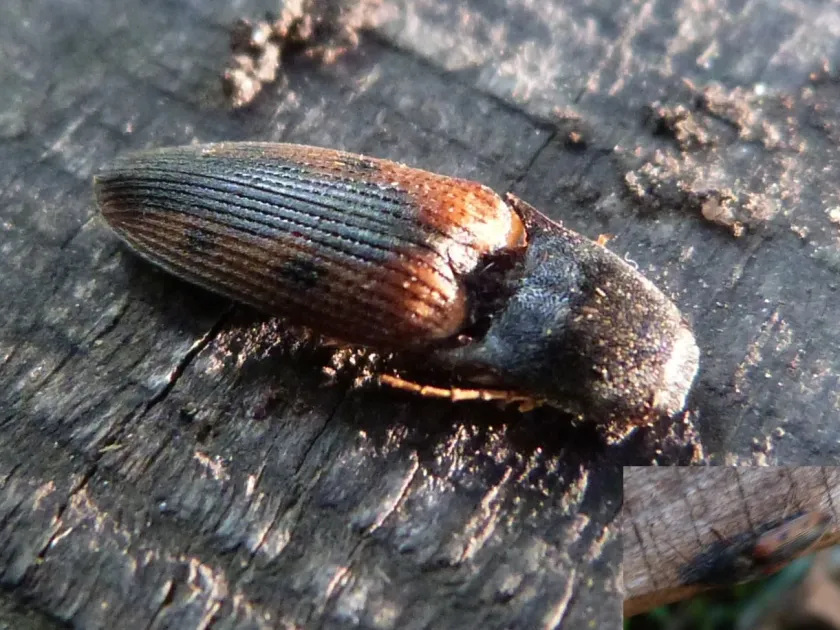
Click beetle Conoderus scalaris
Conoderus scalaris
Description
How to identify
The adult Conoderus scalaris is a species of click beetle belonging to the Elateridae family, order Coleoptera. It is recognized by its elongated shape and a unique mechanism that allows it to flip into the air with a clicking sound.
The larvae of this beetle, commonly called wireworms, possess a cylindrical, hard-shelled body with a yellowish-brown color. They are highly resilient and well-adapted to living within soil profiles.
Taxonomic identification of Conoderus scalaris relies on specific morphological traits, including the structure of the antennae, prothorax, and genital apparatus of the adult beetles.
The species undergoes complete metamorphosis, including egg, larval, pupal, and adult stages. The larval stage is the most significant in terms of agricultural damage.
Adults often maintain a cryptic lifestyle, spending significant time within soil crevices or under surface debris, making them elusive for casual observation during the day.
What it damages
Conoderus scalaris is a polyphagous pest, meaning it attacks a wide range of agricultural crops, causing significant yield losses in many parts of the world.
The larvae are particularly notorious for feeding on seeds, roots, and subterranean stems, which frequently leads to poor seedling emergence and stunted crop growth.
Crops such as maize, potatoes, tobacco, and various cereals are primary targets. The larvae bore into tubers and roots, rendering produce unmarketable and susceptible to rot.
By damaging the root systems, these wireworms disrupt the plant's ability to uptake water and nutrients, which can lead to complete plant death in severe infestations.
The economic impact is amplified by the fact that the larvae can remain in the soil for multiple years, maintaining a persistent threat to susceptible crop rotations.
When it appears
Adult Conoderus scalaris typically emerge in the spring once soil temperatures rise to a threshold suitable for their activity and mating cycles.
Females deposit eggs in moist, suitable soil conditions, typically in areas with vegetation cover or crop residues that provide humidity and protection.
The larval stage is long-lived, spanning several seasons. Their vertical movement within the soil column is governed by moisture availability and soil temperature gradients.
During the warmer months, larvae remain active in the root zones, while they migrate to deeper, more stable soil layers as winter approaches to survive the cold.
Due to the multi-year life cycle of the wireworm, fields may show varying levels of pest pressure from one growing season to the next.
Signs of infestation
The primary symptom of a Conoderus scalaris infestation is the presence of thinning crop stands and patches of withered or dying young plants.
Careful inspection of the root zone will reveal characteristic irregular feeding scars, chewed-off lateral roots, or boreholes in the basal stem tissue.
In root crops and tubers, damage manifests as deep, narrow tunnels that provide entry points for pathogenic bacteria and fungi, leading to post-harvest decay.
Soil sampling prior to planting is the gold-standard method for detecting larval density and determining the potential risk level for the upcoming season.
The use of bait stations containing starch or germinating seeds can help confirm the presence of wireworms in the topsoil layers of fields suspected of infestation.
Control measures
Managing Conoderus scalaris requires an integrated approach that focuses on reducing larval populations through both cultural and chemical means.
- Implementing diverse crop rotations to disrupt the wireworm life cycle.
- Regular and deep soil tillage to expose larvae to natural predators and desiccation.
- Consistent weed control to eliminate alternative food sources and egg-laying sites.
- Use of seed treatments and soil-applied granular insecticides for early-season protection.
- Monitoring soil pH and moisture levels to create a less favorable environment for wireworm development.
Incorporating biological control agents, such as entomopathogenic fungi or nematodes, can assist in suppressing wireworm populations in sustainable farming systems.
Finally, balancing nitrogen fertilization and optimizing planting times can help plants establish rapidly, potentially reducing the window of susceptibility to wireworm feeding.
Taxonomy
- Latin name
- Conoderus scalaris
- Order
- Coleoptera (beetles)
- Family
- Elateridae
- EPPO code
- CONOSC
Discussion
No discussions yet — be the first.