
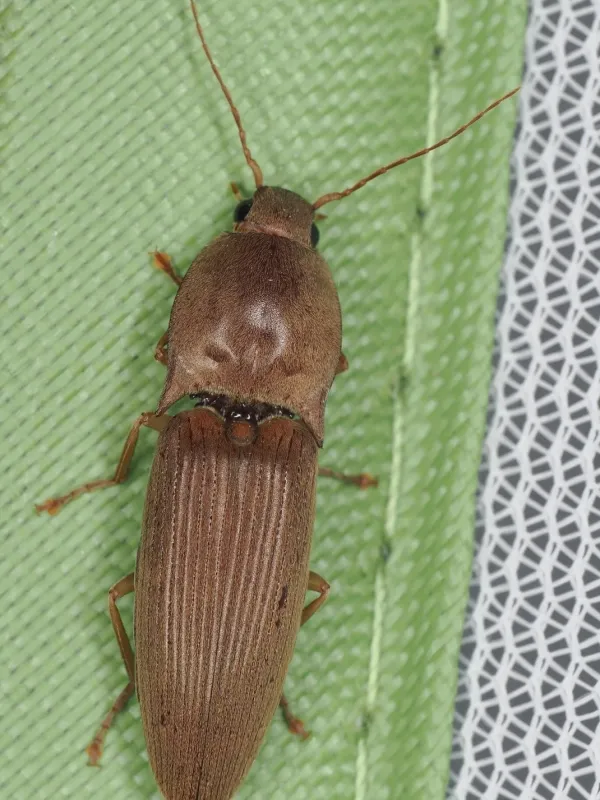
Brown click beetle
Conoderus lividus
Description
How to identify
The brown click beetle (Conoderus lividus) belongs to the Elateridae family, order Coleoptera. Adult beetles are characterized by their elongated, slender body, typically measuring 10–12 mm, with a brownish coloration.
The defining trait of these beetles is their ability to flip themselves upright when placed on their backs. They perform a sudden, audible "click" motion using a specialized structural mechanism on their thorax, which allows them to jump into the air.
The larvae, widely known as wireworms, are the primary life stage of concern for farmers. They possess hard, smooth, and cylindrical bodies that appear yellowish or brownish, resembling a small piece of stiff wire.
Their life cycle is complex and spans several years. Most of their development takes place within the soil profile, where larvae migrate vertically in response to changes in soil moisture and temperature.
Adult beetles are typically active during late spring and summer. Females select sites with dense vegetation or weeds to deposit their eggs, as these areas provide the humidity necessary for successful larval hatching.
What it damages
The economic damage is caused almost exclusively by the wireworms (larvae) residing in the soil. They are polyphagous pests that feed on roots, germinating seeds, and the underground stems of a wide variety of cultivated crops.
Host plants commonly affected by Conoderus lividus include corn, potatoes, sugar beets, and small grains. Severe infestations often result in stand loss, necessitating replanting in heavily impacted areas.
In potatoes, wireworms burrow deep into the tubers, creating narrow, circular tunnels. These injuries reduce crop marketability and serve as entry points for soil-borne pathogens, leading to tuber rot during storage.
In corn crops, larvae often target the germinating seed, destroying the embryo. This behavior creates gaps in the field, leading to reduced plant density and significant yield losses at harvest time.
The severity of damage often correlates with soil moisture levels and the presence of organic matter, which encourages larval survival and feeding activity near the root zones of target plants.
When it appears
Adult click beetles typically emerge from overwintering sites in early spring, around April and May. This is their period of peak activity, where they mate and search for suitable egg-laying substrates.
Wireworm larvae are active throughout the growing season but exhibit specific behavioral shifts based on the environment. When the surface soil becomes hot or dry, they migrate deeper into the soil profile to maintain hydration.
The highest level of larval activity in the root zone is recorded during spring and autumn. During these times, temperatures are moderate, and moisture levels in the topsoil are optimal for larval movement and feeding.
Winter survival is high, as both larvae and adults retreat to significant depths below the frost line. They remain in a state of dormancy until soil temperatures begin to rise again in the spring.
In late summer, feeding activity may increase as larvae prepare for overwintering, frequently targeting mature roots and tubers to build up energy reserves for the colder months.
Signs of infestation
One of the primary indicators of a wireworm infestation is an uneven or patchy crop stand. Young plants may wilt or die suddenly, often showing signs of root system destruction when examined.
When digging into the soil near damaged plants, farmers may find the larvae themselves. They are easily distinguishable by their firm, shiny bodies that are difficult to crush, moving slowly when exposed.
Visual damage on root vegetables or potatoes is unmistakable. Small, deep holes or irregular tunneling across the surface and into the flesh are classic symptoms of wireworm feeding activity.
- Reduced seedling emergence in corn and grain fields.
- Wilting plants that can be easily pulled out of the ground.
- Deep tunnels in potato tubers showing signs of bacterial rot.
- Presence of brownish-yellow larvae under surface debris or crop residue.
To assess population density, agronomists often use soil bait traps, such as burying soaked seeds, to attract larvae. These traps allow for accurate counting and informed decisions regarding pest management strategies.
Control measures
Effective management begins with robust crop rotation practices. Avoiding the planting of highly susceptible crops directly after perennial grasses or pastures is essential to minimize initial wireworm populations.
Strategic tillage, particularly deep autumn plowing, can disrupt the wireworm habitat. This practice brings larvae to the surface, exposing them to predators like birds and harsh weather conditions, significantly reducing their numbers.
The use of seed treatments containing systemic insecticides is a standard industry practice. These treatments offer a chemical barrier, protecting the germinating seed and early roots during the most vulnerable stage of development.
Managing weed populations is critical. Controlling grasses like quackgrass is vital, as these plants provide ideal conditions for click beetle oviposition and early larval development.
In cases of severe infestation, granular soil insecticides can be applied during planting. This targeted approach creates a protective zone around the seed furrow, effectively reducing the damage caused by soil-dwelling wireworms.
Taxonomy
- Latin name
- Conoderus lividus
- Order
- Coleoptera (beetles)
- Family
- Elateridae
- EPPO code
- CONOLI
Discussion
No discussions yet — be the first.