
Hairy click beetle
Cidnopus pilosus
Description
How to identify
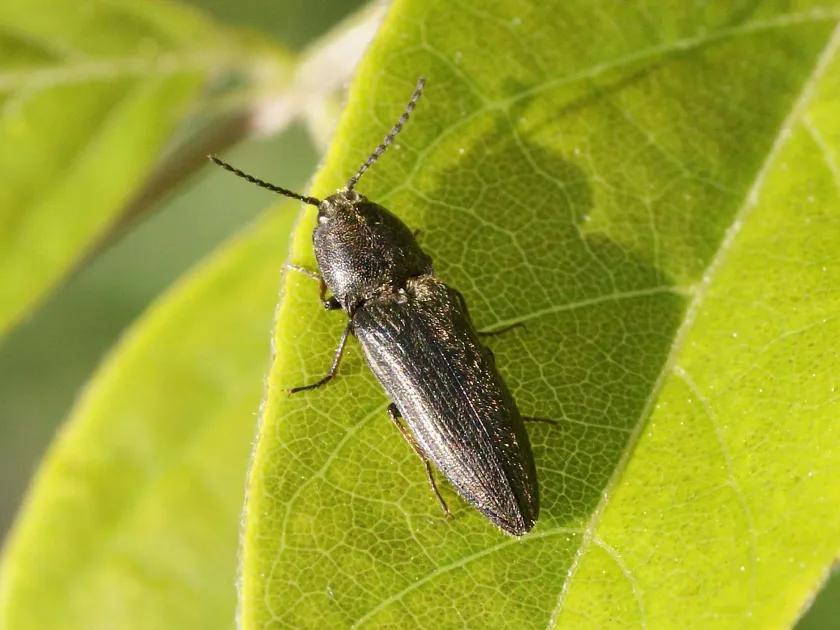
The hairy click beetle (Cidnopus pilosus) is a member of the Elateridae family. The adult beetle is characterized by a body length of approximately 8–10 mm, densely covered with short greyish or yellowish hairs, which serves as a key identification feature.
The coloration of the adult is typically dark brown or nearly black. The elytra are distinctly punctured. As with other members of the family, the antennae are serrated, which is a common diagnostic characteristic.
The larvae of this beetle, widely known as wireworms, are cylindrical, elongated, and possess a tough, sclerotized cuticle. Their color ranges from light yellow to reddish-brown, allowing them to blend into the soil environment.
The life cycle involves complete metamorphosis, consisting of the egg, larva, pupa, and adult stage. The larvae are the primary stage responsible for agricultural damage, spending several years in the soil.
The adults are famous for their unique ability to right themselves when placed on their backs by performing a sudden, audible jump, which is the origin of their common name.
What it damages
The larvae of the hairy click beetle are polyphagous, meaning they attack a wide range of agricultural crops, including cereals, root vegetables, and pulses. They feed primarily on the underground parts of plants.
The most significant damage occurs in early spring when larvae gnaw through the roots and subterranean stems of young seedlings, leading to reduced nutrient uptake and plant death.
In cereal crops, larvae frequently bore into germinating seeds, hollowing them out completely. This results in poor crop establishment and significant stand thinning.
Root crops like sugar beets and potatoes are particularly vulnerable, as larvae penetrate the roots or tubers, causing quality reduction and leaving plants susceptible to secondary soil-borne diseases.
Fields with high levels of perennial weeds, especially couch grass, are more susceptible to infestations because these weeds provide a perfect habitat and food source for the developing larvae.
When it appears
Adult hairy click beetles typically emerge in late spring, usually between May and June, depending on local climate conditions and soil temperature.
During the mating season, females deposit eggs into the soil. They favor moist, undisturbed areas, which is why fields left unplowed or heavily infested with grass are hotspots for egg-laying.
The larvae are most active in the upper soil horizons during the spring and autumn when soil moisture is optimal for their survival and feeding activities.
During the peak of summer, when the topsoil dries out, or in the deep winter months, the larvae migrate vertically into deeper soil layers to avoid desiccation or freezing temperatures.
The total developmental cycle is long, often lasting several years, meaning that an infestation can persist on a field for multiple cropping seasons without intervention.
Signs of infestation
The most common sign of infestation is the emergence of patchy, thinning crop stands. Affected plants often exhibit yellowing, wilting, and may be easily pulled out of the soil due to root loss.
Upon closer inspection, the roots of damaged plants will show visible holes, notches, or clean cuts. If a plant has failed to emerge, checking the seed usually reveals it has been hollowed out.
Finding adult beetles on the soil surface or resting on vegetation during late spring indicates an active population and the high probability of larval presence in the soil.
Soil sampling using bait traps (like potato pieces buried in the ground) is a standard method for confirming the presence and density of wireworm populations.
A correlation exists between the intensity of infestation and the presence of couch grass or other rhizomatous weeds, which serve as indicator plants for high wireworm density.
Control measures
Effective management requires an integrated approach that includes proper crop rotation to break the life cycle of the beetle and reduce soil pest density.
Deep autumn plowing is a highly recommended practice. It exposes larvae and pupae to surface conditions, where they become susceptible to desiccation and predation by birds.
Strict weed control, especially eliminating grasses, is vital to deny the larvae their food source and reduce the suitability of the field for beetle oviposition.
For high-risk areas, the use of systemic insecticidal seed treatments is the most common chemical control measure to protect crops during the critical germination phase.
- Liming of acidic soils to create a less favorable environment for wireworms.
- Application of granular insecticides at planting time for high-value crops.
- Frequent shallow soil cultivation to disrupt the larval environment and destroy eggs.
Taxonomy
- Latin name
- Cidnopus pilosus
- Order
- Coleoptera (beetles)
- Family
- Elateridae
- EPPO code
- LIMOPI
Discussion
No discussions yet — be the first.