
Striped click beetle
Athous
Description
How to identify
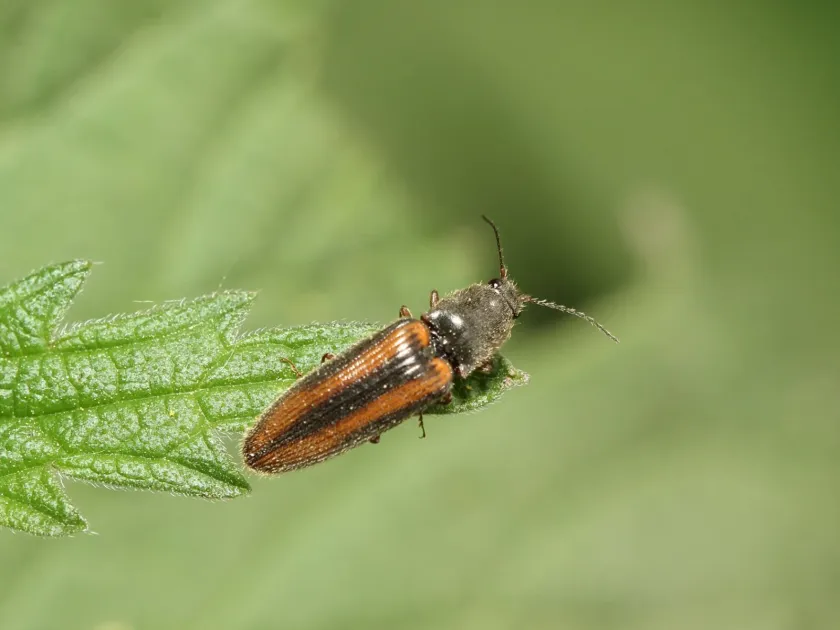
The striped click beetle (genus Athous) belongs to the Elateridae family, order Coleoptera. These beetles are easily identified by their slender, elongated bodies and their unique defense mechanism: the ability to flip themselves into the air with a clicking sound.
Adult beetles typically range from 8 to 15 mm in length. They are usually brownish or yellowish in color, often with distinct longitudinal patterns on their wing covers, depending on the specific species.
Their larvae, universally known as wireworms, are the primary cause of concern for agronomists. They have a distinct, tough, cylindrical body that is shiny and hardened, resembling a piece of wire.
The life cycle of the click beetle is notably long, typically spanning 3 to 5 years. Most of this time is spent in the larval stage, living underground and feeding on organic matter or plant roots.
Adults are generally harmless to crops, as they feed on nectar or pollen, but they are responsible for egg-laying, which dictates the future population density of wireworms in the field.
What it damages
Wireworms are notorious polyphagous pests that cause extensive damage to various agricultural crops, including cereals, maize, potatoes, and sunflowers.
The larvae feed on germinating seeds, roots, and underground stems, often destroying the plant before it can fully establish itself in the soil.
In high-density infestations, wireworms can cause significant stand loss, forcing farmers to perform costly reseeding of the affected fields.
By consuming roots, they impair the plant's ability to uptake water and nutrients, which results in stunted growth and eventual wilting of the crop.
Wounds created by wireworm feeding provide entry points for secondary infections such as fungal pathogens and bacterial rots, further damaging the crop health.
When it appears
Adults emerge in late spring or early summer, depending on regional temperature and moisture conditions, to begin their mating and reproductive cycle.
Wireworms are highly sensitive to soil moisture and temperature. They exhibit vertical migration throughout the soil profile, moving deeper during dry, hot periods to find moisture.
During the spring, as soil temperatures rise, wireworms become highly active in the top layers of the soil where germinating seeds and young roots are located.
Feeding activity is highest when the soil is warm and moist, as this matches the active growth stage of the crops they infest.
As winter approaches and soil temperatures drop, wireworms migrate deeper into the subsoil to successfully survive the dormant winter months.
Signs of infestation
The presence of a click beetle infestation is often signaled by irregular patches of dying or stunted plants throughout the field early in the growing season.
- Sudden wilting of seedlings in the field, despite adequate irrigation or rainfall.
- Small, clean holes or tunnels visible in the stems near the soil line.
- Complete destruction of germinating seeds found during soil inspections.
- Detection of the distinctive, hardened, yellow-to-brown larvae near root zones.
- Poor emergence density, which is often mistakenly attributed to seed quality issues rather than soil pests.
Control measures
Effective management begins with robust crop rotation, avoiding susceptible crops like cereals after grasses or set-aside land where wireworm populations often build up.
Tillage operations, particularly deep autumn plowing, help disrupt the larval cycle by exposing them to birds and desiccation on the soil surface.
Weed management, especially the control of perennial grasses like couch grass, is essential, as these plants provide food and shelter for wireworm larvae.
Seed treatment with systemic insecticides is the most common and effective preventive measure to protect emerging seedlings during their most vulnerable stage.
Soil-applied insecticides at planting can also serve as an effective management tool when wireworm population densities are high, protecting the root zone.
Taxonomy
- Latin name
- Athous
- Order
- Coleoptera (beetles)
- Family
- Elateridae
- EPPO code
- ATHOSP
Discussion
No discussions yet — be the first.