
Chestnut click beetle
Anostirus castaneus
Description
How to identify
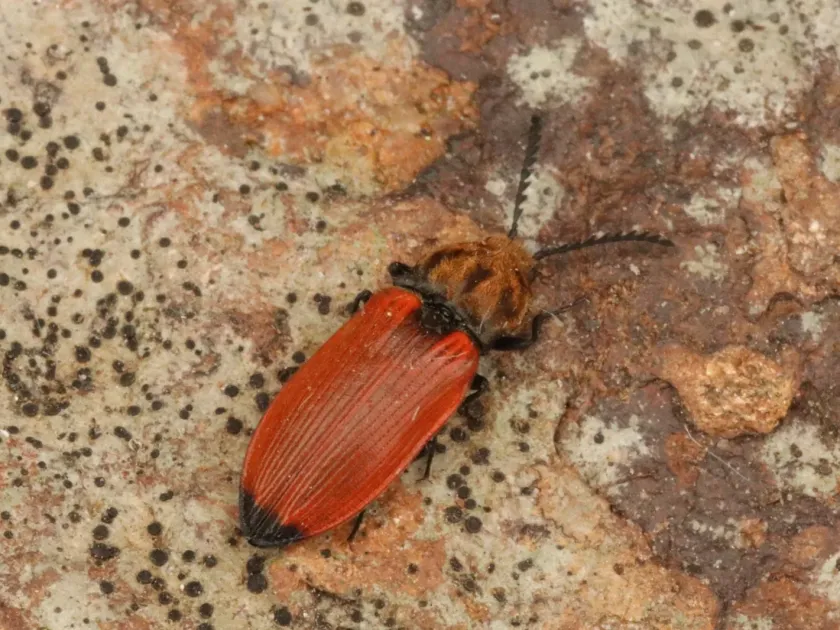
The chestnut click beetle (Anostirus castaneus) belongs to the order Coleoptera and the family Elateridae. Adult beetles have an elongated body, measuring 9–12 mm, with a distinctive chestnut-brown to reddish-brown coloration.
A key identification feature of this species is its ability to perform a sudden, clicking jump when placed on its back, which allows the insect to right itself. The body surface is covered in fine hairs, giving the beetle a matte appearance.
The larvae, widely known as wireworms, are characterized by their cylindrical, hard-shelled bodies, which are typically yellow or dark brown. They possess strong mandibles adapted for feeding on underground plant structures.
The life cycle involves a complete metamorphosis including the egg, larva, pupa, and adult stages. This cycle is typically long, lasting between 3 to 5 years depending on environmental conditions.
Overwintering occurs mainly in the larval stage or as adults within the soil at depths of up to 50 cm, protecting them from extreme seasonal temperature fluctuations.
What it damages
The larval stage is responsible for the economic damage caused to agricultural crops. Wireworms are generalists and feed on the roots, tubers, and underground stems of a wide variety of plant species.
Susceptible crops include cereals (wheat, barley, oats), corn, sugar beets, potatoes, sunflower, and various vegetable crops. They cause significant reduction in plant density and yield.
Larvae chew through the roots and the base of the stem, often leading to stunted growth, wilting, or complete death of the plant, especially in the early stages of development.
In root crops such as potatoes or carrots, wireworms bore deep tunnels. This not only impairs the marketable quality of the produce but also facilitates secondary infections by pathogens.
The damage is most severe in fields recently converted from grasslands or pastures, where wireworm populations are naturally high due to the stable soil environment.
When it appears
Adult flight activity typically occurs during late spring, primarily in May and June. During this time, the beetles mate and females deposit eggs into the top layers of the soil.
Wireworm activity in the soil is heavily influenced by moisture and temperature. During spring and autumn, they migrate to the upper 0–15 cm of soil, where they are most active in the root zone.
During hot and dry summer months, larvae move deeper into the soil to seek cooler, more humid environments, which helps them survive unfavorable conditions until moisture levels improve.
Because the development period spans several years, different larval stages are present in the soil simultaneously, ensuring that crops are under constant pressure throughout the growing season.
Pupation occurs in specialized earth cells at the end of the summer, and the resulting adults remain in the soil until the following spring, completing the cycle.
Signs of infestation
The primary sign of infestation in a field is the emergence of uneven patches of crops, characterized by wilting or dying plants amidst healthy vegetation.
Careful inspection of the roots of affected plants reveals deep grooves or holes. In severe cases, the entire root system may be destroyed, causing the plant to be easily pulled from the soil.
For potato tubers and root vegetables, the hallmark sign is the presence of small, round, and often deep entry holes that lead to internal tunnels within the flesh.
Soil sampling (digging pits or using soil cores) is the most reliable way to confirm the presence and density of larvae, which are distinguishable by their hard, shiny segments.
An increased presence of crows or other insectivorous birds foraging in freshly plowed fields can often be a telltale sign of a high wireworm population in the soil.
Control measures
Effective management relies on a combination of cultural and chemical strategies. Crop rotation is essential, specifically avoiding planting susceptible crops after perennial grasses.
Tillage practices, such as deep autumn plowing, are highly effective as they expose larvae to environmental extremes and natural predators, leading to significant mortality.
- Maintaining proper soil pH through liming, as wireworms prefer acidic soil conditions.
- Using insecticide-treated seeds to protect young seedlings during the critical germination phase.
- Incorporating green manure crops like mustard, which can act as a natural deterrent.
- Applying granular insecticides directly into the seed furrow during planting for targeted control.
- Strict weed management, particularly removing couch grass, which serves as an alternative host and food source.
Chemical control should be implemented based on population density monitoring to ensure cost-effectiveness and minimize the environmental impact of soil-applied treatments.
Taxonomy
- Latin name
- Anostirus castaneus
- Order
- Coleoptera (beetles)
- Family
- Elateridae
- EPPO code
- CORMCA
Discussion
No discussions yet — be the first.