
Red click beetle
Ampedus sanguineus
Description
How to identify
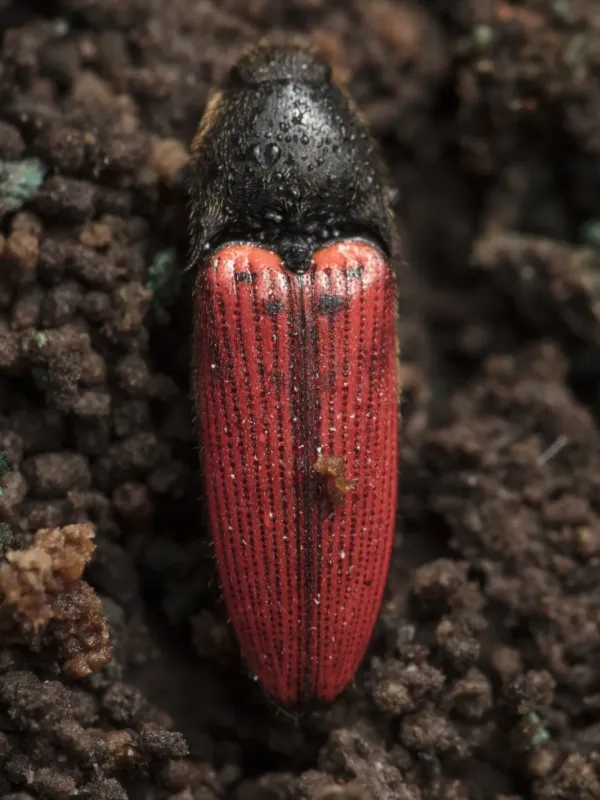
The red click beetle (Ampedus sanguineus) is a member of the Elateridae family, known for its striking red and black coloration. The pronotum and elytra are bright red, providing a vivid contrast to the black head and body.
Adult beetles typically measure between 12 and 18 millimeters in length. They possess the unique anatomical ability to snap their bodies to leap into the air, a mechanism used to right themselves if they land upside down.
The larvae, commonly referred to as wireworms, have elongated, cylindrical bodies with a hard, yellow-brown chitinous exoskeleton. They are well-adapted for burrowing into woody substrates.
The life cycle undergoes complete metamorphosis, including egg, larva, pupa, and adult stages. This beetle is primarily found in coniferous and mixed woodlands.
Adults lead a cryptic life, usually residing under the bark of decaying trees or within rotting wood, which makes them less visible to the casual observer.
What it damages
The primary damage is caused by the larvae, which feed on decaying pine and other coniferous wood. They are considered saproxylic insects that assist in the decomposition of dead timber.
While they generally prefer decaying wood, in forestry nurseries, larvae may cause damage to the root systems of young seedlings, leading to reduced growth or plant mortality.
The beetles facilitate the degradation of wood, often creating pathways that allow wood-decay fungi to colonize the interior of the tree more rapidly.
High densities of larvae in forest soil can become a threat to reforestation efforts, as they may shift their feeding habits if the supply of decaying wood is exhausted.
The economic impact is mostly related to the degradation of stored timber or the loss of young planting stock in nurseries situated near infested forest remnants.
When it appears
The flight period for adult beetles generally occurs from late spring to early summer, particularly during the months of May and June.
Larval stages last for several years, as they grow slowly while feeding on the nutrient-poor wood, undergoing multiple molts before reaching the pupal stage.
Pupation takes place inside specialized pupal chambers carved out by the larvae within the decaying wood, usually sheltered from external environmental threats.
Overwintering occurs in both the larval and adult stages, with insects remaining deep within the logs or tree stumps until the return of warmer spring temperatures.
Activity within the wood is highly dependent on humidity levels, as the larvae require a moist environment to thrive and continue their feeding cycles.
Signs of infestation
One of the first signs of infestation is the presence of small, round exit holes in the bark, accompanied by wood dust or "frass" near the base of the tree.
Removing loose bark often reveals the presence of larvae or empty pupal chambers, which confirm that the tree has been colonized by the beetle.
In nurseries, wilting or stunted growth of seedlings, combined with visible damage to the root collar or roots, indicates a potential wireworm infestation.
Visible sightings of the bright red adults resting on tree trunks during sunny days in late spring serve as a clear indicator of the local population's activity.
An increase in tree-decaying fungal fruiting bodies on a stump often points to secondary colonization enabled by the boring activity of these insects.
Control measures
Sanitation is the most effective management strategy, which includes removing deadwood and stumps from nurseries and reforested areas to eliminate breeding sites.
Crop rotation in forest nurseries, moving away from areas with high wood debris content, helps minimize the risk of larval populations attacking young trees.
Trapping adults using fresh logs as lures during the flight period can significantly reduce the number of beetles laying eggs on valuable timber.
Biological control, using specific entomopathogenic fungi, is an emerging strategy to manage larval populations in the soil without chemical interference.
In cases of severe nursery outbreaks, the strategic use of insecticides may be considered, though this is generally reserved for high-value planting stock.
Taxonomy
- Latin name
- Ampedus sanguineus
- Order
- Coleoptera (beetles)
- Family
- Elateridae
- EPPO code
- AMPDSA
Discussion
No discussions yet — be the first.