
Black-collared click beetle
Ampedus nigricollis
Description
How to identify
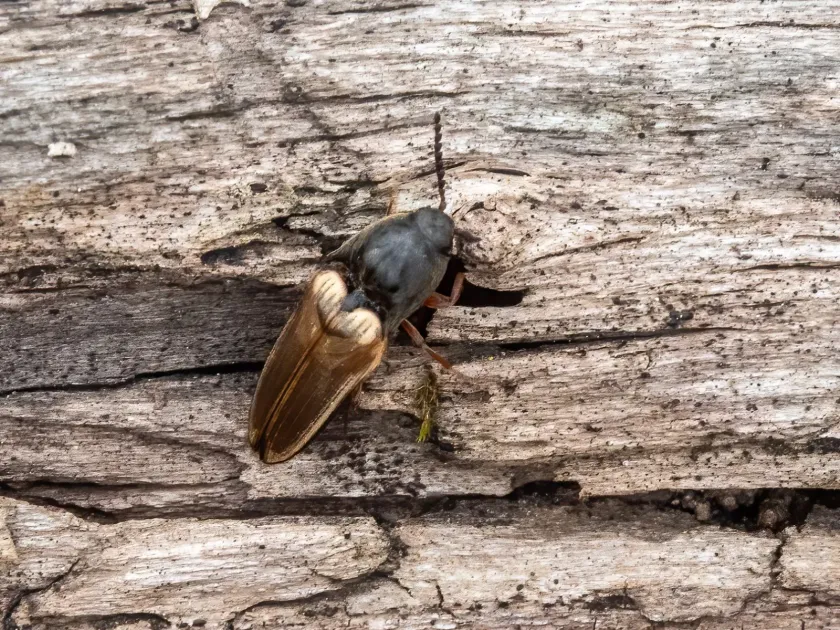
The black-collared click beetle (Ampedus nigricollis) belongs to the Elateridae family, order Coleoptera. The adult beetle is easily identified by its distinctive black pronotum, which contrasts with the reddish-brown or yellowish elytra.
Adult beetles have an elongated body, typically measuring 10–15 mm in length. They are famous for their unique defensive mechanism: when placed on their back, they snap their body with an audible click, launching themselves into the air to right themselves.
The larvae, commonly known as wireworms, are characterized by their cylindrical, heavily sclerotized (hardened) bodies. Their coloration ranges from yellow to dark brown, and their smooth texture allows them to move efficiently through soil and decaying wood.
The species undergoes complete metamorphosis, passing through egg, larval (several instars), pupal, and adult stages. The larval stage is the longest and causes the most significant impact on agricultural and forest ecosystems.
While primarily found in wooded areas and decaying timber, this species can become a pest in gardens and orchards when its natural habitat is disturbed, leading to interactions with cultivated crops.
What it damages
The damage is primarily caused by larvae that dwell in the soil and decaying wood. Unlike some agricultural wireworms, this species is strongly associated with wood-decay, but it also attacks the roots of various plants.
In orchard settings, the larvae often damage the root systems of weakened fruit trees. By tunneling into roots and the base of tree trunks, they disrupt water and nutrient transport, which can lead to tree decline or death.
Vegetable crops, particularly root crops like potatoes, beets, and carrots, are highly vulnerable. Larvae bore deep holes into the tubers and roots, causing significant cosmetic damage and creating pathways for secondary fungal and bacterial decay.
The tunnels created by the larvae serve as entry points for various pathogens, leading to rotting and disease outbreaks. This significantly reduces both the yield and the marketable quality of the produce.
Heavy infestations result in sparse stands of crops. Young plants are particularly sensitive, as the destruction of their primary root system often causes them to wither and die shortly after germination or transplanting.
When it appears
Adult black-collared click beetles become active in the spring, typically from May through June, depending on local temperature conditions. This is the period when they emerge from overwintering sites for mating.
Females deposit eggs in moist environments, typically in rich soil or inside cracks in decaying wood. Moisture is essential during this stage, as eggs are highly sensitive to desiccation in dry conditions.
Larvae remain active throughout the growing season, adjusting their position within the soil profile based on moisture levels and temperature. As temperatures drop in the autumn, they move deeper into the soil to overwinter.
The life cycle is quite prolonged, often spanning multiple years. This makes the population resilient, as multiple generations of larvae in different development stages are usually present in the soil at any given time.
The period of greatest agricultural harm occurs during the spring, when larvae move to the upper soil layers in search of emerging roots and seeds, coinciding with the critical early stages of crop development.
Signs of infestation
A primary indicator of infestation is the presence of small, circular holes in the surface of root crops. These holes often lead into deep, irregular tunnels carved by the larvae throughout the interior of the plant.
In trees, an unexpected wilting of branches or premature yellowing of leaves, despite adequate irrigation, may indicate root damage caused by wireworm activity at the base of the plant.
During soil cultivation or garden maintenance, finding smooth, hard-bodied larvae in the soil is a direct indication of their presence and a warning that further preventative actions may be necessary.
A high density of old stumps, decaying logs, and weeds on or near the plot serves as a strong indicator that the area is likely to harbor these pests, as these provide ideal breeding and feeding conditions.
In fields or garden beds, patches of poor plant growth or missing plants in a row are signs that larvae may be consuming the roots or seeds before they can establish themselves.
Control measures
Deep autumn plowing or tilling is a highly effective control measure. This practice exposes larvae to the soil surface, where they become easy targets for predatory birds and succumb to cold winter temperatures.
Sanitation is key to prevention. Removing old stumps, decaying logs, and clearing weeds helps eliminate the preferred nesting and feeding sites for the black-collared click beetle.
Crop rotation helps break the life cycle of the pest. Alternating susceptible crops with those that are less favored by wireworms can effectively reduce the larval population density over several seasons.
Monitoring can be performed using bait traps. Pieces of potato or other root vegetables buried in the soil act as attractants; checking these traps regularly allows for the manual collection and destruction of the pests.
If the damage threshold is exceeded, application of approved soil-applied insecticides during planting may be necessary to protect the root zone during the most vulnerable period of plant establishment.
Taxonomy
- Latin name
- Ampedus nigricollis
- Order
- Coleoptera (beetles)
- Family
- Elateridae
- EPPO code
- AMPDNI
Discussion
No discussions yet — be the first.