
Red click beetle
Ampedus
Description
How to identify
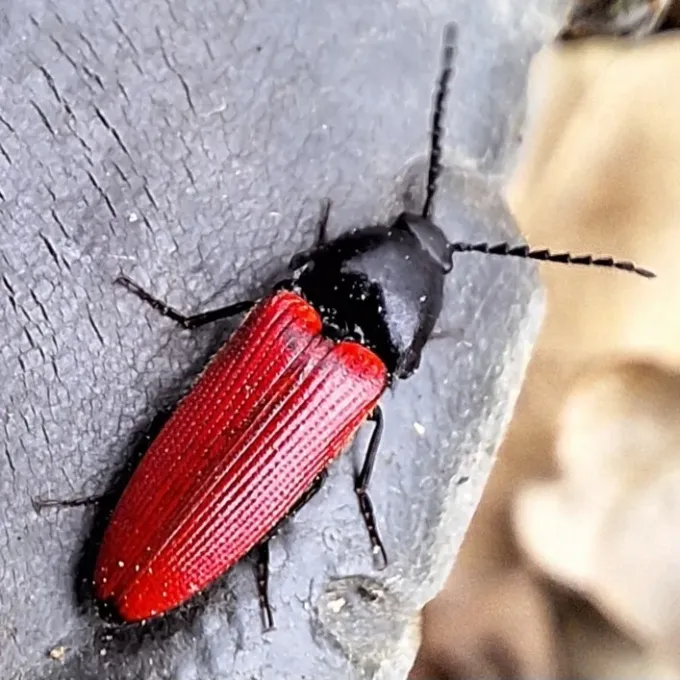
The red click beetle (genus Ampedus) belongs to the family Elateridae, order Coleoptera. Adult beetles are characterized by an elongated body, typically ranging from 8 to 12 mm, with a reddish-brown or dark brown coloration.
The primary identification feature of this genus is the specialized "click" mechanism located on the prosternum. When placed on its back, the beetle can perform a rapid, audible snapping motion to flip itself upright, a behavior from which the family name is derived.
The larvae, commonly referred to as wireworms, possess a cylindrical, rigid body with highly sclerotized plates. They are typically yellow or brown, and their structure allows them to move efficiently through compacted soil.
Development proceeds via complete metamorphosis. The life cycle spans several years, during which the larvae undergo multiple molts, increasing in size and feeding intensity throughout their various developmental stages.
Adults lead a relatively secretive lifestyle, often found in decaying wood, forest litter, or the upper soil horizons. They are active during the warmer months and exhibit mobility for mating and dispersal purposes.
What it damages
The primary damage is caused by the larval stage, which feeds on the underground parts of plants. While many Ampedus species favor decaying organic matter, they can frequently attack the roots and crown of young nursery stock and garden seedlings.
In nurseries and orchards, larvae chew into the root system and the root collar of seedlings. This damage weakens the plant, significantly reducing its vigor and increasing susceptibility to secondary pathogens like fungal rots and bacteria.
High population densities in the soil can result in significant losses of young plants. Seedlings injured by wireworms often show signs of chlorosis, stunted growth, and failure to thrive, leading to high mortality rates in young plantings.
The economic impact is particularly pronounced in professional nurseries where high-density planting provides an abundant and stable food supply, allowing the pest to propagate effectively.
Beyond nursery stock, wireworms may feed on potatoes, root vegetables, and other herbaceous crops. They create deep tunnels within tubers and roots, which renders the produce unmarketable and susceptible to rot during storage.
When it appears
Adult emergence typically occurs in late spring to early summer. During this timeframe, beetles mate, and females seek out suitable soil or crevices in decaying wood to lay their eggs.
Larvae remain active throughout the warm growing season. As soil temperatures drop in the autumn, they descend to deeper, more stable soil layers where they remain in diapause until the following spring.
Optimal conditions for Ampedus involve moderate soil moisture and an abundance of organic matter. Extreme dryness or saturation can temporarily hinder activity, but these conditions rarely eliminate established populations.
Activity throughout the season is highly dependent on temperature fluctuations in the topsoil. Warm, damp springs trigger earlier emergence and heightened feeding activity among the larval population.
Because the life cycle spans several years, different larval instars are often present simultaneously. This temporal overlap ensures a continuous presence of the pest, posing a persistent threat to horticultural activities.
Signs of infestation
The most common sign of infestation is the unexplained wilting or death of seedlings during the growing season. Digging up the affected plants usually reveals characteristic tunneling or destruction of the root system.
The presence of golden-brown, hard-bodied larvae in the root zone is a definitive indicator of a wireworm infestation. These larvae are easily distinguished from other soil insects by their "wire-like" appearance.
Reduced establishment rates of young transplants are another common symptom. If plants fail to root properly or show signs of delayed development, soil inspection for wireworms is highly recommended.
The discovery of adult beetles or larvae in old tree stumps, rotting logs, or woody debris near cultivation areas serves as a primary warning sign of potential infestation in nearby crops.
Secondary symptoms, such as the sudden yellowing of foliage and poor plant growth, are frequently tied to the physiological stress caused by significant root damage inflicted by the larvae.
Control measures
Tillage and deep cultivation are fundamental cultural practices. These actions disturb the soil, exposing larvae to surface-level predators such as birds and subjecting them to extreme temperature fluctuations.
Crop rotation is essential for long-term management. Avoiding the cultivation of preferred host crops consecutively on the same plot helps to break the life cycle of the pest population.
Chemical control involving soil-applied insecticides (such as granular formulas) can be effective when high larval counts are detected. These should be applied at planting time to protect the vulnerable root zones.
- Using bait traps (e.g., sliced potatoes) buried in the soil to monitor population levels.
- Liming acidic soils, as many wireworm species prefer lower pH environments.
- Sanitation, including the removal of decaying stumps and debris that provide breeding habitats.
Biological control options, such as the application of entomopathogenic nematodes, offer an effective and eco-friendly method to reduce larval populations without negatively impacting beneficial soil organisms.
Taxonomy
- Latin name
- Ampedus
- Order
- Coleoptera (beetles)
- Family
- Elateridae
- EPPO code
- AMPDSP
Discussion
No discussions yet — be the first.