
Eastern eyed click beetle
Alaus oculatus
Description
How to identify
The Eastern eyed click beetle (Alaus oculatus) is a prominent member of the Elateridae family, known for its distinctive appearance and unique defense mechanisms.
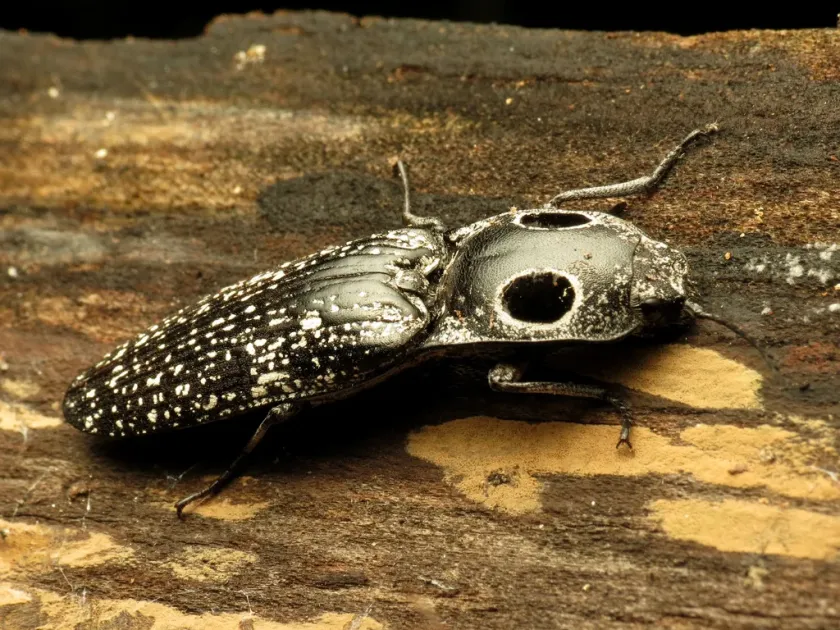
Adults typically measure between 25 and 45 mm in length, featuring a black or dark gray body covered in speckled white scales.
The most iconic feature is the pair of large, black, eye-like spots on the pronotum, which serve to deter predators by mimicking the eyes of a much larger animal.
The larvae, often called wireworms, possess a robust, elongated body with a hardened exoskeleton that allows them to navigate through decaying wood effectively.
When placed on their back, adult beetles use a specialized thoracic mechanism to snap their body and "click," launching themselves into the air to right themselves.
What it damages
The primary damage is caused by the larvae, which inhabit decomposing wood, such as old logs, stumps, and the interior of stressed or dying deciduous trees.
While they are primarily predatory, consuming other wood-boring insect larvae, they can cause secondary damage to the host tree's structure as they tunnel.
By excavating galleries within the wood, they accelerate the breakdown of timber, which can be detrimental if the tree is still considered valuable for its shade or structure.
Damage is almost exclusively restricted to trees that are already unhealthy or dying, making them more of a symptom of forest decline than a primary killer.
In managed orchards or landscapes, their presence is often viewed as a sign that old, rotting wood needs to be removed for the health of the remaining trees.
When it appears
Adult eyed click beetles are most commonly observed during the spring and summer months when they emerge for mating and dispersal.
During warm, sunny days, they can often be found resting on the bark of trees, where their camouflage allows them to blend in with the surroundings.
The larval stage is continuous throughout the year, as they remain hidden within the protective environment of damp or rotting wood, shielded from external fluctuations.
The life cycle is long, often requiring multiple years for the larvae to reach full maturity, depending on the availability of food and environmental conditions.
As winter approaches, the beetles and larvae retreat deeper into the woody debris or soil to survive the cold temperatures until the following spring.
Signs of infestation
Evidence of their presence includes small, circular exit holes on the surface of old, weathered logs or the bark of decaying trees.
Frass, or wood shavings produced by the larvae during their tunneling, may be found accumulating in crevices or at the base of affected trees.
Sighting the adult beetle with its characteristic "eyes" on its back is a clear indicator that the species is active in the vicinity.
The softening or structural failure of wooden posts or old tree trunks often hints at the internal colonization by click beetle larvae.
- Circular exit holes in bark or wood.
- Accumulation of wood dust (frass) at the base.
- Adults visible on tree trunks in summer.
- Signs of advanced decay in structural wood.
Control measures
Effective management focuses on sanitation: removing old stumps, rotting logs, and dead standing trees that act as breeding grounds for the species.
Proper landscape maintenance, including ensuring trees are healthy and well-watered, helps prevent the conditions that attract these beetles.
Chemical control is rarely recommended or necessary, as the larvae are well-protected deep within the wood where contact insecticides cannot reach.
Promoting natural predators, such as woodpeckers and various insectivorous birds, is an excellent way to maintain a natural balance in the garden.
For ornamental trees, ensuring physical integrity and preventing wounds in the bark can help stop larvae from gaining entry to the inner wood layers.
Taxonomy
- Latin name
- Alaus oculatus
- Order
- Coleoptera (beetles)
- Family
- Elateridae
- EPPO code
- ALAUOC
Discussion
No discussions yet — be the first.