
Alaus click beetle
Alaus
Description
How to identify
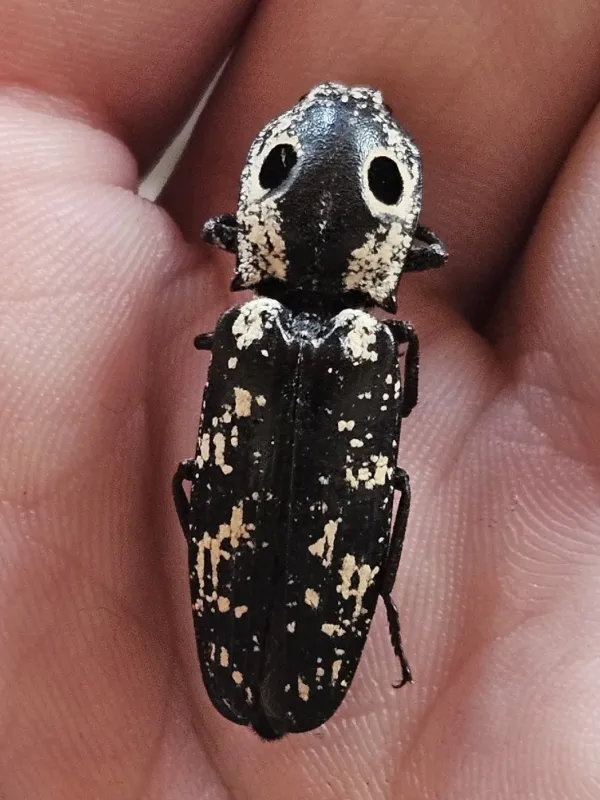
The Alaus click beetle belongs to the family Elateridae (order Coleoptera). These insects are known for their large size and a distinctive eye-like pattern on the pronotum.
Adult beetles possess a unique defense mechanism: when threatened, they snap their body with an audible click, launching themselves into the air. This behavior disorients predators and helps them flip over if they land on their backs.
The beetle's body is covered by a rigid, often scaly exoskeleton that provides effective camouflage. The head is held tight against the pronotum, a key taxonomic feature of this genus.
Larvae, commonly known as wireworms, feature a long, cylindrical body that is notably firm and hard to the touch. Their color ranges from yellow to dark brown, with clearly visible segments.
Development involves complete metamorphosis, moving through egg, larva, pupa, and adult stages. Adults are primarily nocturnal, while larvae typically inhabit soil or decaying timber.
What it damages
Alaus larvae are primarily predatory and thrive in the decaying wood of old or fallen trees. Unlike other click beetle species, they rarely attack the living roots of agricultural crops.
In natural habitats, they feed on the larvae of other insects residing in wood, such as longhorn beetles or jewel beetles, helping to regulate the populations of wood-boring pests.
Economic damage may occur in forest nurseries if high larval populations coincide with a shortage of decaying wood, causing them to feed on the tender root systems of young seedlings.
Adult beetles feed very little or subsist on small amounts of plant sap, causing no significant damage to agricultural crops during their active flying season.
The species is generally considered neutral or beneficial within forest ecosystems; however, monitoring is advisable in intensive gardening to prevent accidental damage to nursery stock.
When it appears
The active flight of adult Alaus beetles typically occurs in late spring and early summer when ambient temperatures become consistently warm.
During this period, adults mate and deposit eggs in tree bark crevices or directly into the soil near decaying woody debris.
The larval stage is the most prolonged phase, potentially lasting several years depending on environmental conditions and the availability of food resources.
Overwintering of both adults and larvae usually occurs within wood cavities, under loose bark, or in the upper layers of leaf litter, which provides protection from extreme temperatures.
Pupation generally occurs in spring within specialized cells inside the wood, followed by the emergence of new adults to restart the life cycle.
Control measures
The primary control measure is sound horticultural sanitation, which involves the timely removal of dead, dying, or heavily rotted trees from orchards and managed forests.
Regular inspection of plantings helps identify breeding sites associated with the accumulation of dead wood, allowing for the quick removal of waste material.
Chemical intervention is justified only in nursery environments when larval density reaches a threshold that threatens the integrity of seedling root systems.
Biological methods, such as fostering populations of natural predators like woodpeckers and insectivorous birds, are the most effective management tools in forest settings.
Using pheromone traps for adult monitoring allows for precise scheduling of protective measures, ensuring minimal disturbance to the local ecological balance.
Taxonomy
- Latin name
- Alaus
- Order
- Coleoptera (beetles)
- Family
- Elateridae
- EPPO code
- ALAUSP
Discussion
No discussions yet — be the first.