
Click beetle Agriotes sparsus
Agriotes sparsus
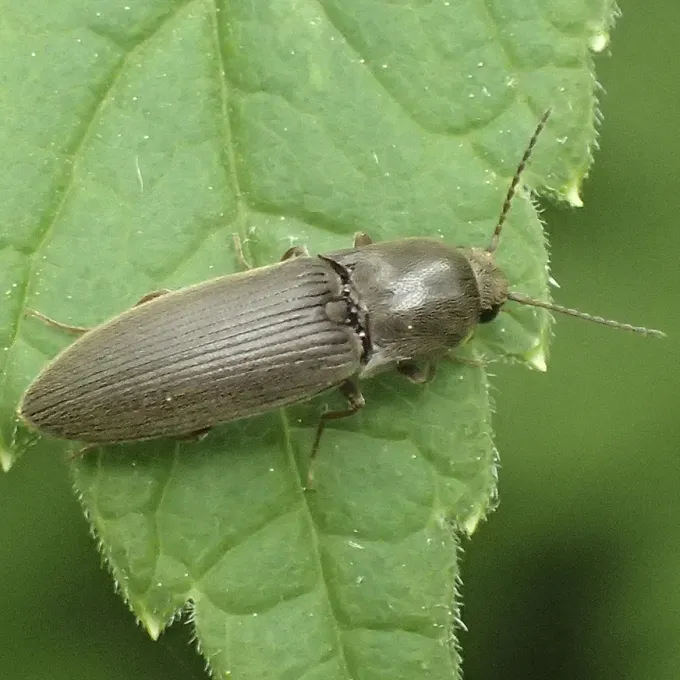
Description
How to identify
The adult Agriotes sparsus belongs to the Elateridae family, order Coleoptera. The beetles are elongated, typically 7-10 mm long, and have a dark brown or blackish color with a slight metallic sheen.
The larvae, widely known as wireworms, are characterized by a cylindrical, hard-bodied appearance. They are yellow to light brown in color and possess a tough, sclerotized cuticle that makes them resilient to soil environments.
Identification often requires examination of the abdominal segments of the larvae under a microscope to distinguish Agriotes sparsus from other click beetle species.
The life cycle involves a complete metamorphosis: egg, larva, pupa, and adult. The larval stage is long-lived, lasting several years as the larvae undergo multiple molts.
Adult beetles possess a specialized mechanism on their thorax that allows them to flip themselves into the air with an audible click if placed on their backs.
What it damages
Agriotes sparsus is a polyphagous pest that attacks the roots, tubers, and seeds of various crops, including wheat, corn, potatoes, and vegetables. Larval feeding is the primary cause of damage.
Young larvae feed on small roots, while older larvae often bore into the base of stalks, severing the plant's connection to its root system and causing wilting or death.
In potato cultivation, wireworms drill deep tunnels into the tubers, drastically reducing their commercial value and quality while increasing susceptibility to decay.
Crop stands can become severely thinned, leading to significant yield losses. These pests are particularly damaging in fields converted from grasslands or long-term pastures.
The secondary damage is often caused by pathogens that enter the plant through the wounds created by wireworms, leading to secondary fungal or bacterial infections.
When it appears
Adult beetles emerge in the spring, usually when soil temperatures reach 10-12 degrees Celsius. The mating and egg-laying period typically occurs in late spring.
Females prefer moist, undisturbed soil with dense vegetation or organic matter to lay their eggs. This often results in higher infestations in fields with poor weed management.
Larval activity is highly dependent on soil temperature and moisture. They move vertically through the soil profile to stay within their optimal temperature zone, often moving deeper during extreme cold or drought.
Wireworms cause the most significant damage to newly germinated crops in the early spring, coinciding with their peak activity in the upper soil layers.
The long duration of the larval cycle means that populations are often overlapping in age, making control efforts complex and sustained over several seasons.
Signs of infestation
The most common sign of infestation is the presence of wilted or yellowing seedlings in a patch-like pattern across the field, leading to gaps in the rows.
Plants affected by wireworms can often be pulled from the ground with ease due to the roots being pruned or the lower stem being bored through.
Excavating the soil near the base of damaged plants usually reveals the presence of larvae. Systematic soil sampling is used to estimate the population density.
Potato tubers showing small, distinct, circular entry holes followed by irregular tunnels are a hallmark of wireworm presence.
- Patchy crop emergence.
- Wilting seedlings in warm weather.
- Bored holes in germinating seeds and roots.
- Adult beetles trapped in soil pitfall traps.
Control measures
Cultural control is essential; deep and frequent cultivation can disrupt wireworm populations by exposing them to desiccation and predators such as birds.
Crop rotation remains the most effective long-term strategy. Rotating sensitive crops with less attractive varieties can help starve out localized populations.
Seed treatment with systemic insecticides is the standard practice for providing early-season protection to germinating seeds and roots.
At-planting application of granular insecticides in the seed furrow provides a localized toxic zone that protects the crop during the most vulnerable period of development.
Weed management is critical, as controlling weeds like couch grass (Elymus repens) reduces the availability of oviposition sites and food sources for the larvae.
Taxonomy
- Latin name
- Agriotes sparsus
- Order
- Coleoptera (beetles)
- Family
- Elateridae
- EPPO code
- AGRISA
Discussion
No discussions yet — be the first.