
Southern wireworm
Agriotes sordidus
Description
How to identify
The Southern wireworm (Agriotes sordidus) is a beetle belonging to the family Elateridae, order Coleoptera. Adult beetles measure between 7 and 10 mm in length and feature a dark brown or blackish-brown coloration.
Adults are known for their ability to flip themselves into the air with a clicking sound if they are placed on their backs, which is a classic diagnostic feature of the click beetle family.
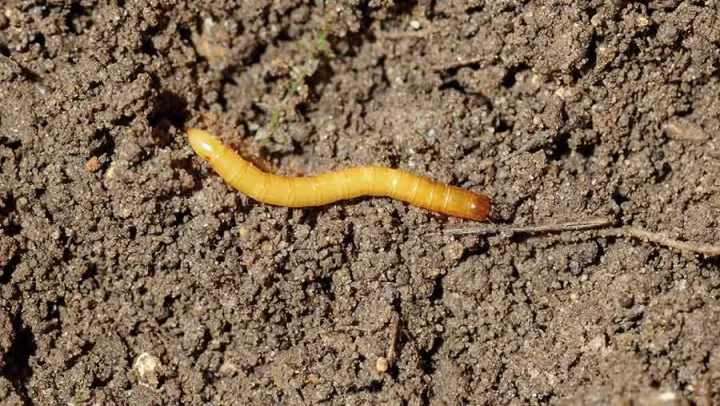
The larval stage, commonly referred to as a wireworm, is characterized by a firm, cylindrical, and strongly sclerotized body, typically yellow or brown in color.
The larva has a well-developed chewing mouthpart that allows it to feed on underground plant structures with high efficiency, maintaining a rigid body structure that protects it from predation.
Eggs of Agriotes sordidus are small, oval, and whitish, usually deposited by females in moist soil layers near the base of host plants during the warmer months.
What it damages
The Southern wireworm is a polyphagous pest causing significant damage to various agricultural crops, including corn, sunflowers, potatoes, and several grain cereals.
Larvae cause the most severe economic damage by feeding on germinating seeds and roots. They can tunnel into the underground stems of young plants, leading to widespread seedling mortality.
In cereal fields, wireworm infestation often results in patches of thinning crops, significantly reducing the overall plant population density and potential yield.
Root and tuber crops, such as potatoes, are particularly susceptible, as larvae bore deep, narrow holes into the tubers, which lowers market quality and creates entry points for fungal pathogens.
Secondary infections that follow wireworm feeding often lead to soft rot and other soil-borne diseases, causing further degradation of the crop's health and storage viability.
When it appears
Adult activity begins in the spring when soil temperatures reach the threshold required for emergence, which usually occurs from late April through June.
The life cycle of Agriotes sordidus is long, typically taking several years to complete, with larvae remaining in the soil throughout the year.
Larval mobility within the soil profile is strictly regulated by moisture levels and soil temperature; they move vertically to maintain optimal survival conditions.
During dry and hot summer months, larvae typically migrate to deeper soil layers to avoid desiccation, making them less accessible to surface-applied pesticides.
The primary period of larval damage occurs in the early spring, coinciding with the germination phase of most agricultural crops when seedlings are most vulnerable.
Signs of infestation
The most evident sign of a wireworm infestation is the unexpected wilting or death of seedlings in localized patches within a field, often appearing shortly after emergence.
Excavating the soil around wilted plants often reveals the larvae feeding near the roots or underground stem, often accompanied by visible damage tracks.
In harvested root crops, the presence of distinct, clean-cut, and narrow tunnels into the flesh of the tuber is a hallmark indicator of wireworm activity.
Farmers may observe gaps in row spacing where seed failed to germinate due to wireworms devouring the germ, leading to incomplete plant stands.
Monitoring the soil using starch-based baits or potato traps can confirm the presence and density of wireworm populations before planting operations commence.
Control measures
Managing Agriotes sordidus requires an integrated pest management (IPM) approach that combines cultural practices with chemical or biological interventions.
Deep autumn tillage is a highly recommended practice, as it exposes larvae to the soil surface, leading to increased mortality due to natural predators and environmental stressors.
- Use of insecticidal seed treatments to protect young plants during the most vulnerable early growth stages.
- Effective weed management, particularly the control of perennial grasses that harbor wireworm populations.
- Implementation of crop rotation patterns that disrupt the life cycle of the pest.
- Application of soil-incorporated insecticides at the time of planting for immediate protection of the seed furrow.
Biological control agents, including entomopathogenic fungi and nematodes, are increasingly being tested as sustainable options for wireworm population suppression.
Decision-making should be based on threshold counts obtained from soil sampling, ensuring that chemical treatments are used only when the potential economic loss justifies the expense.
Taxonomy
- Latin name
- Agriotes sordidus
- Order
- Coleoptera (beetles)
- Family
- Elateridae
- EPPO code
- AGRISO
Discussion
No discussions yet — be the first.