
Dusky wireworm
Agriotes obscurus
Description
How to identify
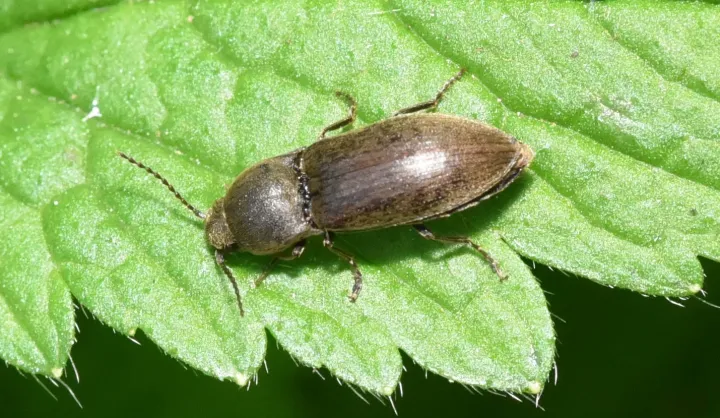
The dusky wireworm (Agriotes obscurus) belongs to the order Coleoptera and the family Elateridae. The adult beetles are elongated, measuring 7–10 mm in length, and have a dark brown or blackish appearance covered with fine yellowish hairs.
Their larvae, universally known as wireworms, are characterized by a cylindrical, firm-bodied shape with a hard exoskeleton. They range in color from pale yellow to reddish-brown, resembling a piece of wire, which gives them their common name.
Adult beetles possess a unique biomechanical ability: if placed on their backs, they can flip into the air with an audible clicking sound to right themselves. This trait is a key identification feature for the Elateridae family.
The lifecycle of the dusky wireworm is complex and extended, typically lasting 3 to 5 years depending on environmental conditions. Most of this lifespan is spent underground, where larvae feed on plant roots and seeds.
Larval development is highly dependent on soil moisture and temperature. They thrive in undisturbed soil, which makes crop fields with high organic content and moisture-retaining soil the most vulnerable environments for infestation.
What it damages
The dusky wireworm is a significant polyphagous pest affecting a broad range of crops, including cereals (wheat, barley, oats), maize, sugar beets, and potatoes. Its impact is primarily felt during the early stages of plant growth.
Larvae cause damage by feeding on seeds, germinating embryos, roots, and underground stems. This feeding behavior often leads to reduced plant stands, significant thinning of crops, and the necessity for replanting in heavily infested areas.
In cereals, wireworms often bore into the base of the stem or the crown, causing the plant to wither and eventually die. In root crops like potatoes, larvae create deep, narrow tunnels, rendering the produce unmarketable and susceptible to rot.
The damage caused by these pests facilitates the entry of secondary pathogens, such as soil-borne fungi that cause root rots. This interaction further complicates the overall plant health and yield loss assessment.
Economic losses are often severe in the years following the conversion of pastures or grassy fallows into arable land, as these areas often harbor large, established populations of wireworms that immediately attack the new crops.
When it appears
Adult beetles emerge from the soil in spring, usually from April to May, as the ground begins to warm. During this time, they feed on leaves and flowers, though they cause minimal economic damage compared to their larval stages.
Larvae are most active in the topsoil (top 15 cm) during the spring and autumn months when soil moisture is optimal. During the heat of summer, they retreat deeper into the soil profile to avoid desiccation and higher temperatures.
The period between seed germination and the establishment of seedlings is the most critical window for infestation. Larvae are sensitive to carbon dioxide and root exudates, which act as beacons, guiding them toward emerging plants.
As temperatures drop in autumn, larvae prepare for hibernation. They continue to feed on the root systems of winter cereals until the soil temperature becomes too low, after which they migrate to deeper soil horizons to overwinter.
Field monitoring is best conducted in late autumn or early spring through soil sampling. This practice allows agronomists to determine the larval density per square meter and assess the potential risk to upcoming seasonal crops.
Signs of infestation
The most visible sign of an infestation is the appearance of bare patches or gaps within crop rows. Affected plants often appear stunted, exhibit yellowing foliage, and may fail to establish a healthy root system.
When inspecting the roots of suspicious plants, one can often find larvae present in the soil near the plant base. The subterranean parts of the stem or root crown will show signs of being chewed, torn, or bored into.
In potatoes, the signature signs are circular or narrow entry holes that penetrate deep into the tuber flesh. These tunnels are often associated with soft rot or other bacterial infections that darken the surrounding tissue.
Wilting of the central shoot in young maize or cereal plants is a classic symptom of wireworm feeding. Such plants are usually very easy to pull out of the soil because their anchoring root systems have been partially or entirely consumed.
Excessive presence of rhizomatous weeds, such as couch grass (Elymus repens), is a strong indicator of potential dusky wireworm pressure, as these weeds provide a stable food source and habitat for the larvae.
Control measures
Integrated Pest Management (IPM) for wireworms involves a combination of mechanical, cultural, and chemical strategies. Frequent tillage is an effective mechanical method, as it exposes larvae to predators like birds and reduces their survival rate.
Crop rotation is fundamental; avoiding consecutive years of susceptible crops or including crops that are less preferred by wireworms can help stabilize population levels. Proper weed management is also essential to eliminate larval food sources.
Seed treatment with systemic insecticides is the most widespread and effective method for protecting seeds and seedlings during the critical germination phase. This provides a localized zone of protection around the seed.
In cases of extremely high pest density, soil-applied granular insecticides or bait-trapping techniques may be necessary. Adjusting soil pH through liming can also be beneficial, as many wireworm species prefer slightly acidic conditions.
- Deep plowing to disturb larval habitats before sowing.
- Elimination of grassy weeds during fallow periods.
- Use of insecticidal seed dressings (neonicotinoids or others).
- Biological control using entomopathogenic fungi or nematodes.
Taxonomy
- Latin name
- Agriotes obscurus
- Order
- Coleoptera (beetles)
- Family
- Elateridae
- EPPO code
- AGRIOB
Discussion
No discussions yet — be the first.