
Click beetle Agriotes meticulosus
Agriotes meticulosus
Description
How to identify
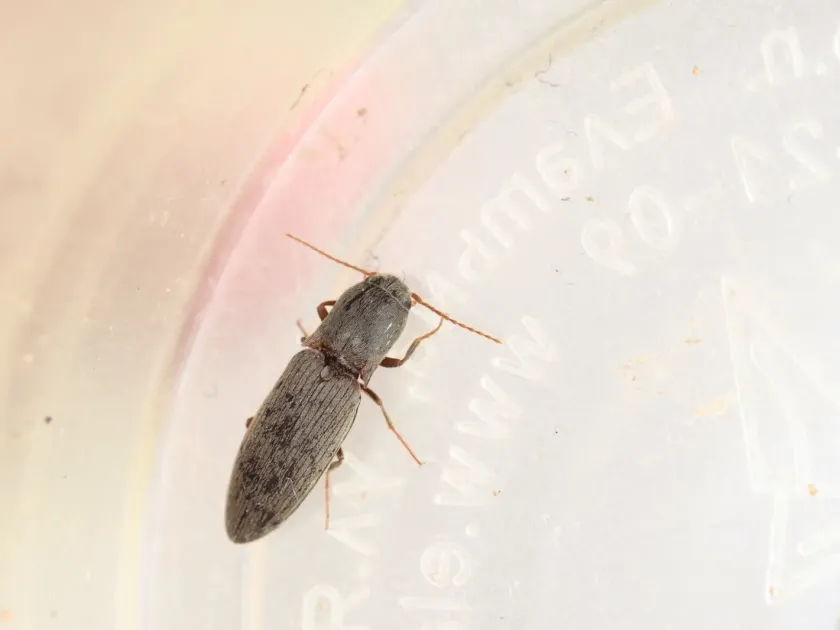
The adult insect, known as a click beetle, belongs to the Elateridae family. Agriotes meticulosus is characterized by an elongated body shape, typically brownish in color, covered with fine, dense hairs.
The larvae, widely recognized as wireworms, possess a rigid, cylindrical, and highly sclerotized body. Their appearance and hard shell provide significant protection against environmental stressors and soil pressures.
Systematically, this species is classified under the order Coleoptera. The species is highly adapted to subterranean life, which is where the vast majority of its multi-year life cycle occurs.
Accurate identification of the species requires laboratory examination of the genitalia in adults and the anal segment structure of the larvae. This is essential for precise diagnostic purposes in agricultural research.
Eggs are small, white, and fragile. They are highly susceptible to desiccation and are deposited by females in moist soil layers to ensure the survival of the neonate larvae upon hatching.
What it damages
Agriotes meticulosus is a polyphagous pest capable of causing extensive damage to various crops. It primarily targets the root systems and underground stems of seedlings in agricultural fields.
The larval stage causes the most damage by feeding on seeds, germinating sprouts, and young roots. This activity results in thin, uneven stands and the total loss of plants in heavily infested areas.
Cultivated crops such as corn, sunflower, sugar beet, and potatoes are particularly susceptible. Wireworm feeding can lead to significant yield reductions, sometimes necessitating total replanting of the fields.
Beyond direct feeding, the wounds inflicted by the larvae facilitate the entry of soil-borne pathogens, including bacteria and fungi, which trigger secondary infections and root rot.
Adult beetles feed on plant foliage and pollen; however, their impact on crop yields is negligible compared to the severe subterranean destruction caused by the larval stage.
When it appears
The life cycle of this species spans several years, often requiring 3 to 5 years to complete. The most significant portion of this time is spent in the larval stage beneath the soil surface.
Larval activity begins in early spring as soil temperatures rise above 10-12°C. During this time, they migrate toward the upper soil horizons where young roots provide a readily available food source.
Adult flight activity typically occurs during the spring and summer. This period is dedicated to mating and searching for suitable sites for oviposition in moisture-retaining soil.
During the peak of summer, if soil moisture levels drop, the larvae retreat deeper into the soil profile to avoid drought. They re-emerge toward the surface when conditions become more favorable in autumn.
Overwintering occurs in both the adult and larval stages. This flexible strategy allows the species to survive harsh seasonal shifts and maintain a stable population density across different years.
Signs of infestation
The most evident sign of infestation is the irregular appearance of crop stands, often characterized by localized patches of wilting or dead plants. Young plants may be easily pulled from the soil due to root loss.
Careful excavation around damaged plants usually reveals the presence of larvae or evidence of feeding, such as chewed roots or stems. Often, the central portion of the stem is found to be severed.
If seeds are excavated shortly after sowing, they may appear partially consumed or hollowed out, which explains the lack of germination in affected sections of the field.
In root crops, such as potatoes, infestation is signaled by deep, circular tunnels that penetrate the tubers, rendering them unsalable due to poor quality and secondary rots.
Monitoring is conducted using manual soil sifting or bait traps filled with germinating cereal seeds. These traps are placed in the soil to attract and identify the presence of wireworms before planting.
Control measures
Effective management relies on a combination of cultural and chemical strategies. Crop rotation is the primary method to disrupt the life cycle, especially by avoiding susceptible crops after permanent grasslands.
Good agricultural practices, such as deep autumn plowing, are highly effective. This process exposes the larvae to environmental hazards and natural predators like birds.
- Application of insecticide seed treatments to protect seeds and seedlings.
- Use of soil-applied granular insecticides during the planting of susceptible crops.
- Rigorous weed control to eliminate alternative food sources for developing larvae.
- Deployment of pheromone traps to monitor adult population levels and flight timing.
- Biological control using entomopathogenic fungi or nematodes to reduce soil populations.
Chemical intervention should be strictly guided by established economic thresholds. Applying systemic insecticides correctly ensures protection of the root zone during the most vulnerable early growth stages of the crop.
Taxonomy
- Latin name
- Agriotes meticulosus
- Order
- Coleoptera (beetles)
- Family
- Elateridae
- EPPO code
- AGRIME
Discussion
No discussions yet — be the first.