
Agriotes litigiosus
Agriotes litigiosus
Description
How to identify
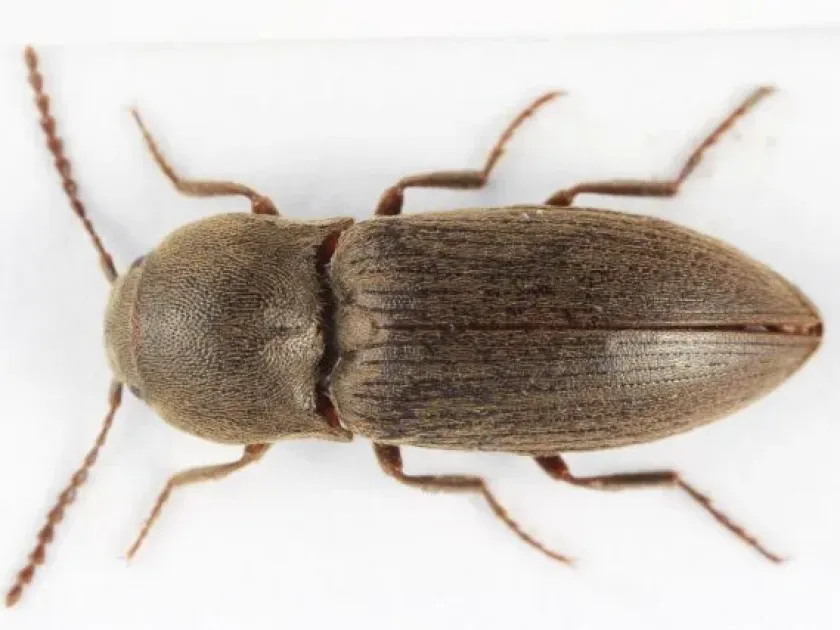
Agriotes litigiosus is a species of click beetle (Elateridae family, order Coleoptera). The adult beetle is typically 7 to 10 mm long with an elongated body.
The coloration of the adult ranges from dark brown to black, often appearing matte. The pronotum fits snugly against the elytra, which feature distinct longitudinal grooves.
The larvae, widely known as wireworms, are characterized by a cylindrical, heavily chitinized body. Their coloration is usually yellowish-brown, and their body structure is very tough.
Unlike other species, A. litigiosus is highly adapted to specific soil types and humidity levels, making it a persistent inhabitant of agricultural soils.
Correct identification of the larvae requires examining the anal segment and spiracles, distinguishing it from other closely related Agriotes species.
What it damages
This pest infests a wide range of crops, including cereals (wheat, barley, oats), maize, sunflowers, and sugar beets.
The primary damage is caused by the larvae, which reside in the soil and feed on the underground parts of plants, such as roots and seeds.
By chewing through stems and roots, wireworms cause wilting and the death of young plants, leading to a significant reduction in stand density.
In root crops and tubers, the larvae bore deep tunnels, which not only ruin the product but also invite secondary bacterial and fungal infections.
Severe infestations can result in total crop failure, necessitating costly replanting efforts in the affected field areas.
When it appears
The flight of adult beetles typically occurs in the spring, once soil temperatures reach 10-12 degrees Celsius, and continues into mid-summer.
The larvae live in the soil for 3 to 4 years, moving vertically through the soil profile based on temperature and moisture gradients.
Activity is most pronounced in the upper soil layers (10-15 cm) during the spring and autumn, when moisture levels are optimal for their survival.
During hot and dry summers, the larvae migrate to deeper soil layers to avoid desiccation, becoming less accessible to surface-level control methods.
The long developmental cycle ensures that the soil remains a reservoir for future pest populations, especially in fields with high organic matter.
Signs of infestation
The first sign of an infestation is the appearance of patches of stunted or wilting plants in the field that gradually fail to thrive.
Excavating the affected area will reveal mechanical damage on roots and stems, often characterized by holes or completely eaten sections.
A high density of weeds, particularly couch grass (Elymus repens), is a strong indicator of an environment favorable for wireworm reproduction.
Monitoring should be conducted using soil traps baited with sprouted seeds or potato slices placed before the primary sowing season.
Unexpected thinning of crops in rows without symptoms of leaf diseases is a clear indicator of underground pest activity.
Control measures
Integrated Pest Management (IPM) is essential for control, beginning with crop rotation to break the life cycle of the beetle.
Aggressive weed management is vital, as wild grasses provide essential food sources for larvae in the absence of cultivated crops.
Mechanical soil cultivation, such as deep plowing, during peak larval activity periods helps bring the pests to the surface, exposing them to birds and predators.
- Use of insecticidal seed treatments to protect germinating plants.
- Application of granular insecticides directly into the planting furrow.
- Liming acidic soils, as A. litigiosus prefers low pH conditions that do not support healthy crop growth.
Monitoring thresholds are critical; treatment is usually recommended when larval counts exceed 5-10 individuals per square meter during pre-sowing checks.
Taxonomy
- Latin name
- Agriotes litigiosus
- Order
- Coleoptera (beetles)
- Family
- Elateridae
- EPPO code
- AGRILT
Discussion
No discussions yet — be the first.