
Striped click beetle
Agriotes lineatus
Description
How to identify
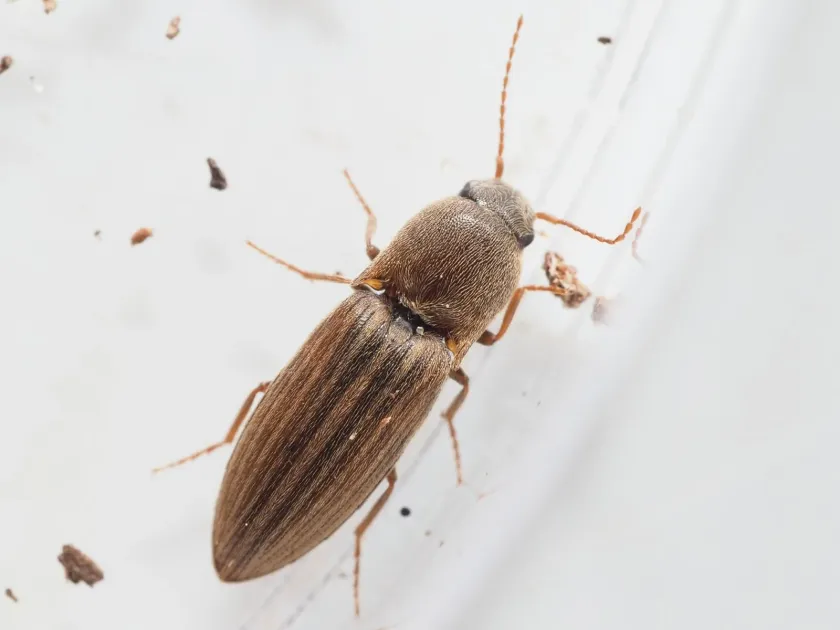
The striped click beetle (Agriotes lineatus) is a beetle species belonging to the family Elateridae. The adult beetle is characterized by its brownish-black body, measuring approximately 7–10 mm in length, and is covered with fine, yellowish hairs that form distinct longitudinal stripes.
The larval stage, commonly known as the wireworm, is the most destructive phase of this insect. It possesses a long, cylindrical, and highly sclerotized body that is firm to the touch and yellowish-brown in color, providing excellent protection against environmental stress.
The lifecycle of the striped click beetle is complex and prolonged, typically lasting between 3 and 5 years. During this period, the larvae undergo several molts while living underground, where they are protected from most environmental threats.
Adult beetles are famous for their ability to flip themselves into the air with a clicking sound when placed on their backs. This unique mechanism is an evolutionary trait used for both protection and orientation in their natural habitat.
Correct identification of the larvae is crucial for effective pest management, as several related species share similar habits. Entomologists often rely on the specific morphological features of the final abdominal segment to distinguish A. lineatus from other wireworms.
What it damages
Wireworms are polyphagous pests, meaning they feed on a wide variety of plant species. They pose a significant threat to cereals, potatoes, sugar beets, and various vegetable crops, causing economic losses globally.
The primary damage occurs when larvae feed on sown seeds, preventing germination. As the plants sprout, larvae chew through the stems and roots, causing the seedlings to wither, turn yellow, and ultimately die off, leading to thin plant stands.
In potato cultivation, wireworms bore deep, meandering tunnels into the tubers. These injuries not only reduce the quality and market value of the potatoes but also facilitate the entry of secondary pathogens, such as bacteria and fungi, causing rot.
Root crops like sugar beets are particularly vulnerable to root pruning, which stunts plant growth and significantly reduces total biomass and sugar content. In severe infestations, the cumulative damage can result in total crop failure on specific field areas.
The damage severity is directly correlated with larval density in the soil. High populations, often found in fields transitioning from perennial grasses, can cause irreversible damage to sensitive crops in the first years of cultivation.
When it appears
Adult beetles emerge from the soil in early spring, typically during April and May, when soil temperatures consistently exceed 10 degrees Celsius. This period is dedicated to mating and searching for suitable oviposition sites.
Females prefer to lay eggs in moist soil covered with vegetation, such as grasslands or weedy field margins. The eggs hatch into small, fragile larvae that grow steadily over several years by feeding on humus and plant roots.
Larval activity is highly dependent on soil moisture levels. During dry periods, wireworms migrate deeper into the soil profile to find suitable humidity, which explains the temporary decrease in crop damage observed during hot summers.
With the arrival of autumn rains or irrigation, larvae migrate back toward the upper soil horizons to feed before winter. They are highly resilient and can withstand freezing temperatures by moving to deeper soil layers during the winter months.
The development cycle is continuous, meaning that at any given time, a field may contain larvae of different ages and sizes, making persistent management strategies necessary over multiple seasons.
Signs of infestation
One of the earliest signs of a wireworm infestation is the appearance of bare patches in cereal fields. If young plants are wilting without visible foliar pathogens, checking the roots often reveals the presence of tough, yellow wireworms.
The presence of circular, clean-edged entry holes in potato tubers is a definitive sign of wireworm damage. These holes often lead to extensive internal cavities that make the potato undesirable for consumption or storage.
On sugar beet and vegetable crops, stunted growth accompanied by root damage is a telltale sign. Infected plants appear nutrient-deficient because their root systems have been compromised, preventing proper uptake of water and minerals.
Fields infested with couch grass (Elymus repens) are high-risk zones. Wireworms thrive in the root zones of this weed, and when the field is plowed and planted with a crop, these pests quickly shift their feeding focus to the new seedlings.
Pre-planting monitoring is essential. Using bait traps buried in the soil, which contain germinating seeds or potato pieces, allows farmers to estimate the larval population and decide if insecticidal intervention is required.
Control measures
Crop rotation is the cornerstone of wireworm management. Avoiding planting susceptible crops directly after perennial grasses or long-term pastures significantly reduces the probability of a population explosion.
Strategic tillage, particularly deep autumn plowing, disrupts the habitat of the larvae. This exposes them to avian predators and desiccating conditions, which significantly lowers their survival rate during the off-season.
Effective weed management is vital, as weeds provide alternative food sources and refuge for wireworms. Maintaining clean, weed-free fields throughout the season makes the environment less hospitable for the pest.
In cases of high infestation, soil-applied insecticides or seed treatments containing systemic active ingredients are used to provide immediate protection to the vulnerable germinating seedlings.
Amending soil pH through liming can create an environment that is less favorable for wireworm development, as many species prefer slightly acidic soil conditions to thrive and complete their lifecycle.
Taxonomy
- Latin name
- Agriotes lineatus
- Order
- Coleoptera (beetles)
- Family
- Elateridae
- EPPO code
- AGRILI
Discussion
No discussions yet — be the first.