
Black click beetle
Agriotes aterrimus
Description
How to identify
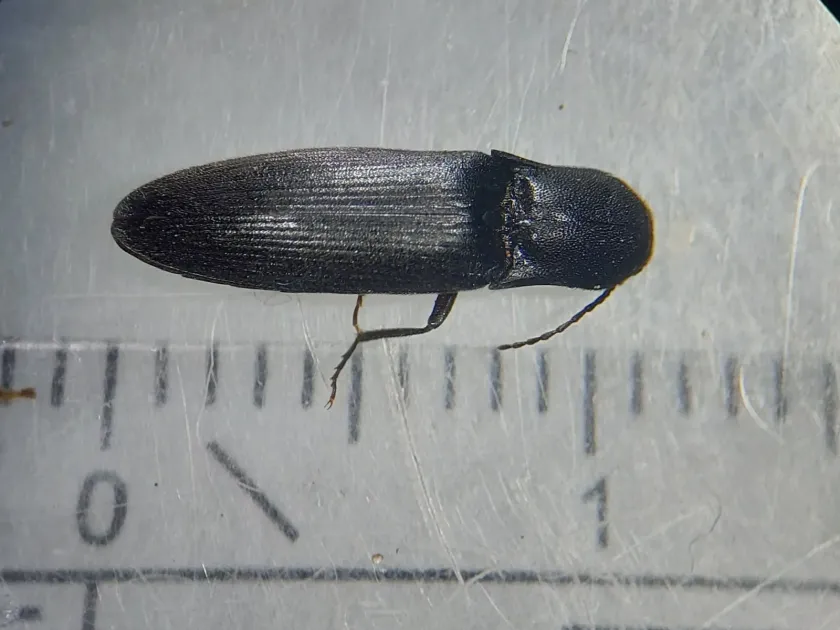
The black click beetle (Agriotes aterrimus) belongs to the order Coleoptera and the family Elateridae. Adult beetles are 12–16 mm long with an elongated, flattened body that is typically a solid, glossy black color.
These insects are named for their unique defensive mechanism: a specialized hinge between the prothorax and the mesothorax. If the beetle lands on its back, it snaps its body to flip upright, producing a distinct clicking sound.
The larvae, known globally as wireworms, are the primary damaging stage of this pest. They have a cylindrical, hard, and smooth body, ranging in color from yellow to dark brown, which helps them move easily through compact soil.
The life cycle of the black click beetle is long and complex, typically lasting three to four years. Most of this time is spent in the soil stage, where the larvae feed on the underground parts of plants.
Due to their secretive lifestyle, both adults and larvae are rarely seen until significant damage has already occurred, making early scouting and soil monitoring essential for any integrated pest management plan.
What it damages
The black click beetle is a polyphagous pest, meaning it attacks a wide range of crops. Cereals, corn, sunflowers, and sugar beets are particularly susceptible to larval feeding, which can devastate entire fields.
The most significant damage occurs when wireworms feed on germinating seeds. By boring into the kernel and consuming the embryo, they prevent germination or destroy the seedling immediately after it breaks the seed coat.
As the plant grows, larvae feed on the roots and the base of the stem. This disrupts the plant's nutrient and water uptake, leading to yellowing, stunted growth, or the total collapse of the young plant.
Wireworm feeding creates wounds that provide entry points for soil-borne pathogens. This secondary infection often leads to root rot or stem rot, which can cause further losses beyond the initial mechanical damage.
High populations of wireworms in a field often result in uneven stands and significant yield reduction, requiring proactive management strategies before planting, especially in fields recently converted from permanent pasture.
When it appears
Adult black click beetles become active in early spring, usually as soil temperatures rise. They emerge to mate and lay eggs in moist, vegetated soils, which are ideal for the survival of the neonate larvae.
Throughout the growing season, larvae move vertically in the soil profile in response to moisture and temperature. In spring and autumn, they are typically found in the upper soil layers where they find food.
During the peak of summer, when the topsoil becomes hot and dry, wireworms migrate to deeper, cooler soil layers. This behavior makes them difficult to target with surface-applied insecticides during the mid-season.
The larvae are very hardy and can survive in the soil for several years. They spend the winter in deeper soil layers, protected from freezing temperatures, and resume feeding activity as soon as conditions allow in the spring.
Effective scouting needs to consider these seasonal migrations. Soil sampling should be performed when wireworms are near the surface, typically during the spring or autumn months, to get an accurate count of the population.
Signs of infestation
The first visual sign of a wireworm infestation is a thinning crop stand. Patches of dead or dying seedlings, often referred to as "missing plants," are a hallmark of larval activity in the root zone.
Upon closer inspection, the roots and the lower stem of the affected plants will show clear signs of chewing. Wireworms leave ragged holes or shredded tissues, which distinguish their damage from other soil-borne diseases.
To detect the presence of the pest, farmers use bait stations. By burying pieces of raw potato or soaked grains in the soil and covering them with a mound of dirt, wireworms can be attracted and counted after a few days.
Monitoring the adult population is also possible using pheromone or light traps, although this provides less information about the potential larval pressure than direct soil sampling in the field.
When scout counts show a population density exceeding the economic threshold, immediate preventative action is required to save the upcoming crop from severe damage.
Control measures
Integrated control is the most effective approach to managing the black click beetle. Cultural practices, such as deep tillage, help disrupt the soil environment and expose larvae to predators like birds and extreme surface conditions.
Crop rotation is essential for long-term population reduction. Avoiding the planting of highly susceptible crops after grass or perennial pastures can significantly reduce the risk of infestation.
Maintaining good field hygiene by controlling weeds, especially grasses, removes alternate food sources for the larvae. Improving soil drainage and liming acidic soils can also make the environment less favorable for the wireworms.
Chemical control focuses on seed treatments. Applying systemic insecticides directly to the seed provides a localized zone of protection that kills or repels larvae as they attempt to feed on the sprouting plant.
For high-risk fields, soil-applied granular insecticides can be used at planting to provide a broader protective barrier. These methods should be chosen based on local infestation levels and economic considerations.
Taxonomy
- Latin name
- Agriotes aterrimus
- Order
- Coleoptera (beetles)
- Family
- Elateridae
- EPPO code
- AGRIAT
Discussion
No discussions yet — be the first.