
Click beetle
Agriotes
Description
How to identify
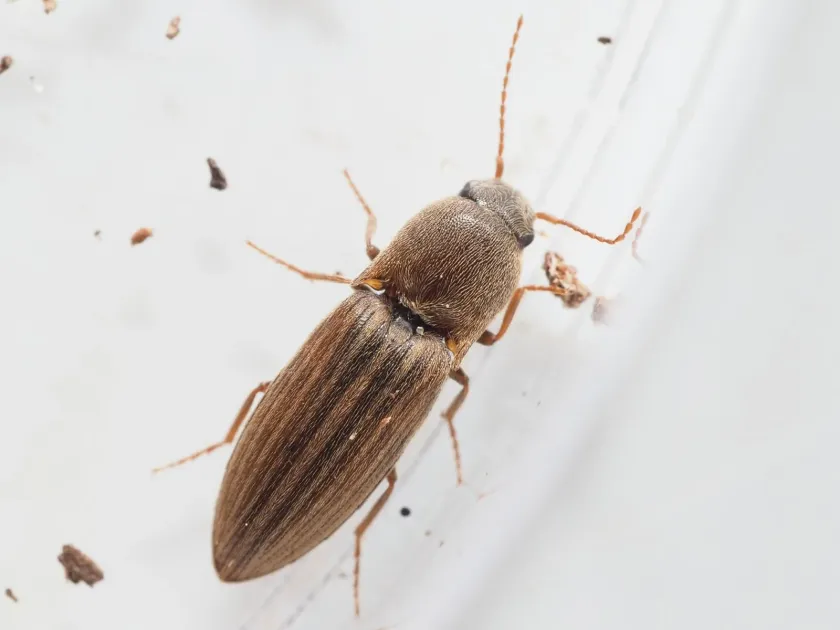
Adult click beetles (Elateridae) are distinguished by their elongated, flattened bodies, usually ranging from 7 to 20 mm in length. They are famous for their ability to snap their thoracic segments to flip upright when turned on their backs.
The primary concern for agronomists is the larval stage, known as the wireworm. These larvae possess a slender, cylindrical, and heavily sclerotized body, often resembling a piece of copper wire, with a tough, yellowish-brown exoskeleton.
Taxonomically, click beetles belong to the family Elateridae within the order Coleoptera. The most significant agricultural pests belong to the genus Agriotes, which includes several widely distributed species.
The life cycle of the click beetle is notably long, typically lasting between 3 to 5 years. Most of this time is spent underground in the larval phase, which makes them highly elusive and resilient to environmental changes.
Females deposit eggs in soil that is rich in organic matter or covered with dense vegetation. They prefer moist conditions, which are critical for the survival of the neonate larvae after hatching.
What it damages
Wireworms are extreme polyphages, meaning they feed on a vast range of crops including cereals, maize, potatoes, sugar beets, and various vegetables. They cause damage by feeding on seeds, roots, and underground stems.
By severing the root systems and tunneling into stems, wireworms cause reduced stand establishment, patchy fields, and sometimes complete plant mortality during the early vegetative stages.
For tuber and root crops, wireworms inflict significant economic loss by boring deep tunnels into the flesh. This damage ruins the marketability of the product and exposes the crop to secondary pathogens.
The feeding activity creates wounds that serve as entry points for fungi and bacteria, leading to rot and further degrading the quality of the harvested produce.
When populations are high, wireworms can cause devastating losses, sometimes necessitating the complete reseeding of crops, which significantly increases input costs for the producer.
When it appears
Adult activity begins in the spring as soil temperatures reach approximately 10–12 degrees Celsius. During this time, beetles emerge from the soil to mate and lay their eggs in favorable host areas.
Larvae are most active in the topsoil during the spring and early summer when soil moisture levels are optimal for movement and feeding. They migrate vertically in response to changes in temperature and humidity.
During the peak of summer, if the upper soil layers dry out, wireworms typically migrate deeper into the soil profile to stay within a favorable moisture environment until conditions improve.
In the autumn, as temperatures cool and moisture levels increase, larvae return to the upper soil layers to feed intensely, accumulating nutrient reserves before entering their winter diapause.
Wireworms hibernate in the soil, often at significant depths. They are exceptionally tolerant of freezing conditions, making them a persistent challenge throughout the winter months in many agricultural regions.
Signs of infestation
The most visible sign of an infestation is the appearance of wilting plants in isolated patches, which often results in irregular plant spacing and poor stand density in the field.
Careful inspection of the root zone often reveals chewed roots or stems with clean-cut edges, which is a classic symptom of wireworm feeding activity near the soil surface.
In potato fields, the presence of small, deep, and circular holes in the tubers is a hallmark sign of wireworm infestation that directly correlates with the population density in the soil.
Agronomists often utilize soil core sampling to identify the presence and density of wireworms. A population density of 3 to 5 larvae per square meter is usually the threshold for remedial intervention.
The use of bait stations consisting of buried starchy materials, such as potato chunks or sprouted grain, can help monitor activity levels and pinpoint areas of the field with high infestation.
Control measures
Managing click beetles and wireworms requires an integrated pest management (IPM) strategy that focuses on cultural practices combined with strategic chemical control.
- Implement crop rotation patterns to disrupt the long life cycle of the wireworm.
- Perform deep tillage to bring larvae to the surface, where they become vulnerable to predation and desiccation.
- Maintain soil pH through liming, as wireworms favor acidic soil conditions.
- Control weeds, especially grasses like couch grass, which act as a reservoir for wireworm populations.
- Use systemic insecticide seed treatments or soil-applied granules at planting to protect the young crop from early damage.
Taxonomy
- Latin name
- Agriotes
- Order
- Coleoptera (beetles)
- Family
- Elateridae
- EPPO code
- AGRISP
Discussion
No discussions yet — be the first.