
Click beetle Aeolus livens
Aeolus livens
Description
How to identify
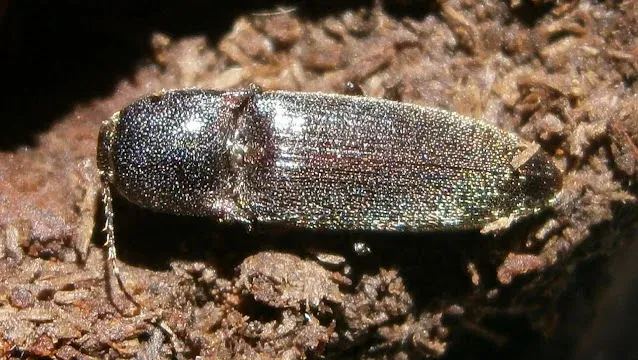
The click beetle Aeolus livens belongs to the family Elateridae, order Coleoptera. Adult beetles are characterized by an elongated body shape and their unique ability to flip over with a clicking sound when placed on their backs.
The larvae, commonly referred to as wireworms, are cylindrical with heavily sclerotized, tough bodies. They range in color from light yellow to brown, allowing them to blend into the soil environment effectively.
The larvae possess strong mandibles adapted for gnawing through plant tissues, roots, and seeds, which makes them highly destructive in underground agricultural settings.
Adults are capable of active flight, which aids in dispersal across fields during the spring and summer months, potentially leading to widespread infestations.
The life cycle is holometabolous, including egg, larva, pupa, and adult stages. The larval stage is the primary concern for agricultural producers due to its feeding habits.
What it damages
The pest attacks a wide range of agricultural crops, with a particular affinity for young seedlings of maize, wheat, barley, and sorghum, which are essential for food security.
Wireworms feed on germinating seeds by consuming the embryo and endosperm, causing thin or patchy plant stands and leading to significant yield losses early in the season.
In addition to seed damage, the larvae attack the root systems and the underground portions of stems, often severing them or creating tunnels that hinder nutrient uptake.
Damaged roots become entry points for soil-borne pathogens, leading to secondary infections such as root rot, which further exacerbates plant stress and mortality.
Severe infestations can lead to complete stand failure, requiring fields to be replanted if the population density of the larvae is sufficiently high.
When it appears
Adult activity peaks in the spring when rising soil temperatures trigger their emergence for mating and oviposition, where eggs are deposited directly into the soil.
Larval activity continues throughout the growing season, though they move vertically within the soil profile in response to moisture levels and temperature fluctuations.
Feeding damage is most intense during the early growth stages of crops, when seeds are germinating and the initial roots are developing and highly vulnerable.
As autumn arrives and soil temperatures drop, the larvae retreat into deeper soil horizons to overwinter, becoming less active until the following spring.
Because the life cycle of Aeolus livens can span multiple years, populations can persist in the soil if management practices are not consistently applied.
Signs of infestation
Initial detection often involves observing thin or uneven crop emergence in fields, characterized by areas with missing seedlings or wilting plants.
Examining damaged seedlings often reveals characteristic damage at the base of the stem or hollowed-out seeds that fail to produce a viable plant.
Soil sampling is the most reliable method for identifying the pest, as manual digging within the root zone frequently exposes the larvae during peak activity periods.
The presence of adult click beetles on soil surfaces or weed foliage in the spring can serve as an indicator of potential larval pressure for upcoming plantings.
- Hollowed seeds and damaged roots
- Wilting or yellowing of young seedlings
- Presence of wireworms in soil samples
- Reduced seedling density in fields
Control measures
Strategic crop rotation is a fundamental management practice, avoiding crops that encourage population buildup and favoring ones that disrupt the life cycle of the beetle.
Proper tillage, especially deep plowing, can significantly reduce populations by exposing larvae to surface conditions, natural predators, and environmental stress.
Seed treatment with systemic insecticides is a highly effective preventative measure, ensuring that the critical early stages of crop growth are protected from wireworm attack.
Managing weeds, especially perennial grasses, is crucial as these serve as alternative hosts and food sources for the larvae during periods when crops are not present.
Integrated monitoring using soil-based bait traps allows farmers to assess population thresholds and determine if soil-applied insecticides are necessary for protection.
Taxonomy
- Latin name
- Aeolus livens
- Order
- Coleoptera (beetles)
- Family
- Elateridae
- EPPO code
- AEOLLI
Discussion
No discussions yet — be the first.