
Dark click beetle
Adrastus rachifer
Description
How to identify
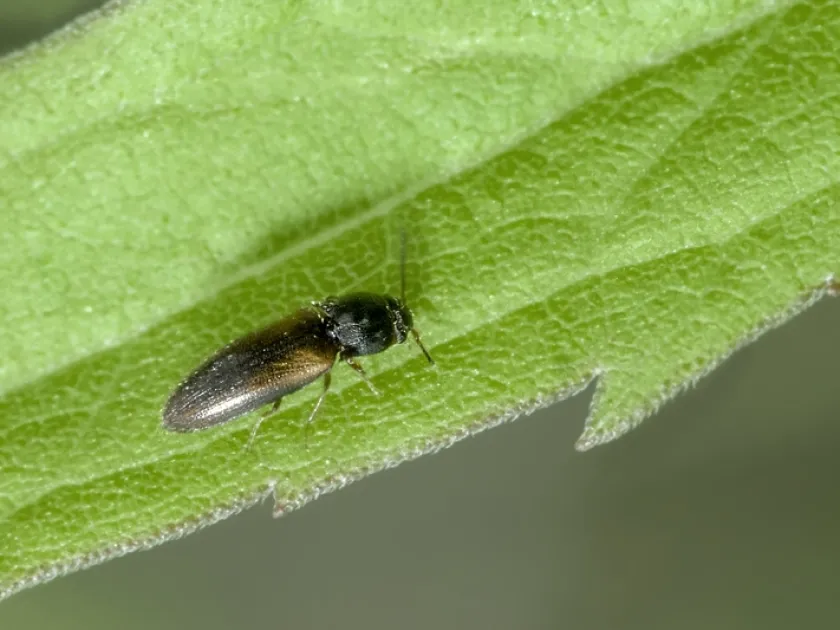
The dark click beetle (Adrastus rachifer) belongs to the Elateridae family, order Coleoptera. Adult beetles are small, dark brown or black insects, typically measuring 5 to 7 millimeters in length, characterized by their ability to flip into the air with an audible click when turned onto their backs.
The larvae, commonly known as wireworms, are the primary life stage causing agricultural damage. They possess hard, sclerotized bodies, cylindrical in shape, and typically exhibit a brownish-yellow color, resembling thin pieces of wire.
The life cycle involves complete metamorphosis, consisting of the egg, larva, pupa, and adult stages. Larvae can remain in the soil for several years, gradually growing and becoming highly resistant to environmental stressors and conventional treatments.
Biological development is heavily dependent on soil moisture and temperature. Wireworms are extremely sensitive to desiccation, which causes them to migrate vertically in the soil profile depending on the moisture content of the surface layer.
Reproduction occurs in the spring, with females laying eggs in the upper soil layers, particularly in fields with high weed cover or cereal crops. High fecundity allows populations to establish and spread rapidly across agricultural landscapes.
What it damages
As polyphagous pests, dark click beetle larvae inflict severe damage on a wide range of crops, including cereals, maize, potatoes, sunflowers, and various vegetables. The damage is primarily root and seed destruction.
Wireworms feed on planted seeds, germinating sprouts, and young roots. They can tunnel into the underground stems of seedlings, leading to high seedling mortality rates and significant thinning of plant stands across large fields.
In root and tuber crops like potatoes, larvae create deep galleries and tunnels. This infestation not only destroys the marketable yield but also creates entry points for fungal and bacterial pathogens, leading to secondary rot.
The most critical damage period coincides with germination and early seedling development. Early season attacks can lead to total crop failure in localized areas, often requiring replanting efforts and causing significant economic losses.
The economic threshold of infestation varies depending on soil type and crop sensitivity, but high larval populations can drastically reduce total yield volume and quality, complicating post-harvest storage and processing.
When it appears
Adult beetle activity begins in the early spring, typically April to May, when soil temperatures reach sufficient levels for emergence and mating. Monitoring for adult activity is crucial during this window.
Larval feeding is most intense during spring and autumn when soil moisture levels are optimal. During the heat of the summer, larvae typically retreat to deeper soil horizons to avoid dehydration and extreme temperatures.
Larvae hibernate in the soil, often at significant depths to survive winter freezing. As spring approaches, they migrate upwards toward the root zone of emerging crops to resume feeding on new plant tissues.
The multi-year nature of their life cycle means that populations in the soil consist of larvae of varying ages simultaneously. This necessitates a long-term management strategy rather than a one-time treatment approach.
Agricultural monitoring programs should be scheduled before sowing to assess larval density. Identifying high-risk fields allows for the implementation of precision protective measures before the crop is exposed to damage.
Signs of infestation
The most prominent sign of a wireworm infestation is the presence of thinning plant stands and wilted or dying seedlings in fields that otherwise have adequate soil moisture levels.
- Deep, ragged tunnels or boreholes observed in potatoes or root crops at harvest.
- Yellowing of the central leaves in cereal crops, indicating damage to the root system.
- Direct observation of larvae during soil excavation or bait trap sampling.
- Reduced germination percentage due to larvae feeding on the embryo of the seed.
- Patches of dead or stunted plants scattered randomly across the field.
Control measures
Effective management begins with proper crop rotation. Avoiding susceptible crops, particularly cereals or grasses, following long-term pasture or meadow land helps to break the pest's breeding cycle.
Agronomic practices, such as deep fall tillage, are highly effective as they bring larvae to the surface, exposing them to bird predation and desiccation. Consistent weed control, especially of couch grass, is vital to limiting larval food sources.
Soil management includes the application of lime to acidic soils, as wireworms prefer slightly acidic environments and struggle to thrive in neutral to alkaline soil conditions. Proper fertilization with ammonium-based fertilizers can also deter larvae.
Chemical protection is primarily achieved through seed treatments with systemic insecticides. This creates a protective zone around the seed and the young root system, shielding the crop during the most vulnerable early growth stages.
For high-pressure infestations, soil-applied granular insecticides during planting can provide additional protection. Biological control options using entomopathogenic fungi or nematodes are also becoming increasingly viable for integrated pest management programs.
Taxonomy
- Latin name
- Adrastus rachifer
- Order
- Coleoptera (beetles)
- Family
- Elateridae
- EPPO code
- ADRSRA
Discussion
No discussions yet — be the first.