
Adelocera murina
Adelocera murina
Description
How to identify
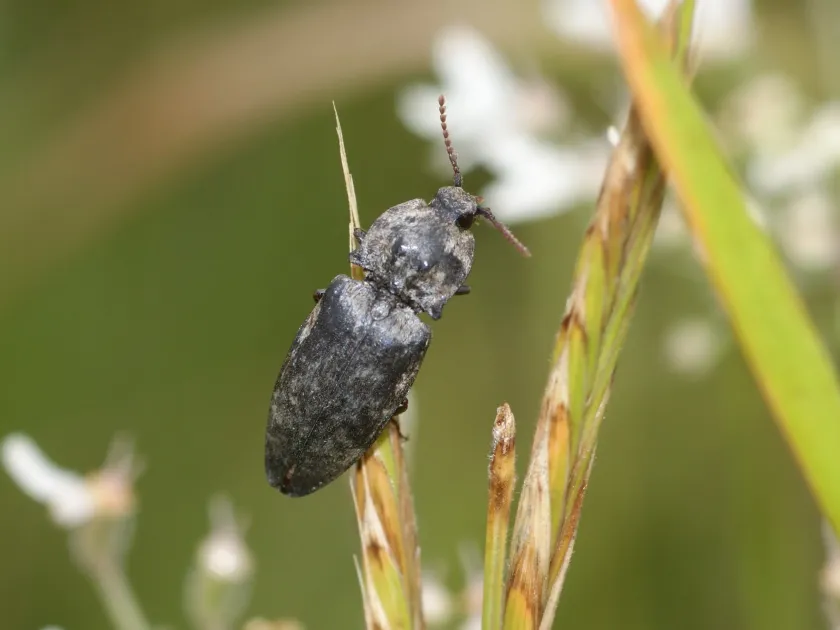
Adelocera murina is a species of click beetle belonging to the Elateridae family. Adult beetles typically measure between 10 and 15 mm in length and are characterized by a dense covering of greyish-brown scales over their body.
The larval stage, commonly referred to as wireworms, has a cylindrical and heavily sclerotized body. They are typically yellow-brown or dark brown in color, which provides them with high resistance to soil pressure.
A key diagnostic feature of this species' larva is the structure of the last abdominal segment, which possesses a specific pointed or bifurcated process that distinguishes it from other Elateridae species.
The insect undergoes a complete metamorphosis, passing through egg, larva (with several instars), pupa, and adult stages. This complex cycle contributes to its persistence in agricultural ecosystems.
Adults are known for their unique ability to right themselves when placed on their backs by performing a jump that produces a distinctive "click" sound, which is a classic behavior of the click beetle family.
What it damages
Adelocera murina is a significant polyphagous pest capable of causing substantial damage to a wide range of crops, including cereal grains, maize, sunflower, and sugar beet.
The larvae primarily attack seeds and young roots. They feed on the embryo of germinating seeds, which often leads to poor emergence and the need for expensive reseeding of affected fields.
In later stages of plant development, larvae may bore into the underground stems of young seedlings, causing them to wilt and eventually die, leading to patchy crop density.
Feeding damage often serves as an entry point for various secondary fungal and bacterial infections, such as root rot, which further exacerbates the decline of plant health.
Under favorable conditions, high populations of these wireworms can cause severe economic losses by significantly reducing crop stands, especially in moisture-retentive soils.
When it appears
Adult beetles emerge from their overwintering sites in the soil during spring when temperatures consistently rise above +10...+12°C. Mating and egg-laying typically occur throughout May and June.
Females prefer to lay eggs in moist, undisturbed soils or areas with dense vegetation, which provide an ideal microenvironment for the neonate larvae to thrive upon hatching.
The larval development period is prolonged, often lasting from 3 to 5 years depending on the availability of food and regional climatic conditions in the soil strata.
Larval activity is most pronounced during spring and autumn when soil moisture is optimal. During the heat of summer, larvae retreat deeper into the soil profile to avoid desiccation.
Overwintering occurs in the soil, where both larvae of various ages and adults bury themselves at depths of 20 to 30 cm to survive cold winter temperatures.
Signs of infestation
The most visible sign of infestation is the emergence of uneven patches in the field immediately after crop germination, characterized by yellowing or stunted plant growth.
When examining damaged plants, one may find seeds with missing embryos or stems that have been severed below the soil line. Manual excavation of the soil around affected areas usually reveals the presence of larvae.
A reduction in plant density that does not correlate with seeding rates or abiotic factors is a strong indicator of wireworm activity in the field.
If a plant is easily pulled from the ground and the base of the stem or root shows clear signs of gnawing, it is highly likely that wireworms are present and actively feeding.
High levels of rhizomatous weeds, such as couch grass, in the field serve as an indirect indicator, as these weeds support wireworm populations during non-crop intervals.
Control measures
Cultural control measures, such as deep autumn plowing, are highly effective as they disturb the soil, bringing larvae to the surface where they are exposed to predators and adverse weather.
Maintaining clean fields by controlling weed populations, particularly perennial grasses, is essential to deprive the larvae of their primary food source and breeding grounds.
Implementing strategic crop rotation using crops that are less favorable for wireworm development can help suppress their population levels over several seasons.
Chemical protection via insecticidal seed treatments is the standard practice for ensuring early-season protection, creating a localized toxic zone around the germinating seed.
In instances of high population pressure, the application of granular soil insecticides during sowing is recommended to mitigate damage to the roots of susceptible crops.
Taxonomy
- Latin name
- Adelocera murina
- Order
- Coleoptera (beetles)
- Family
- Elateridae
- EPPO code
- LACOMR
Discussion
No discussions yet — be the first.