
Zealand click beetle
Actenicerus siaelandicus
Description
How to identify
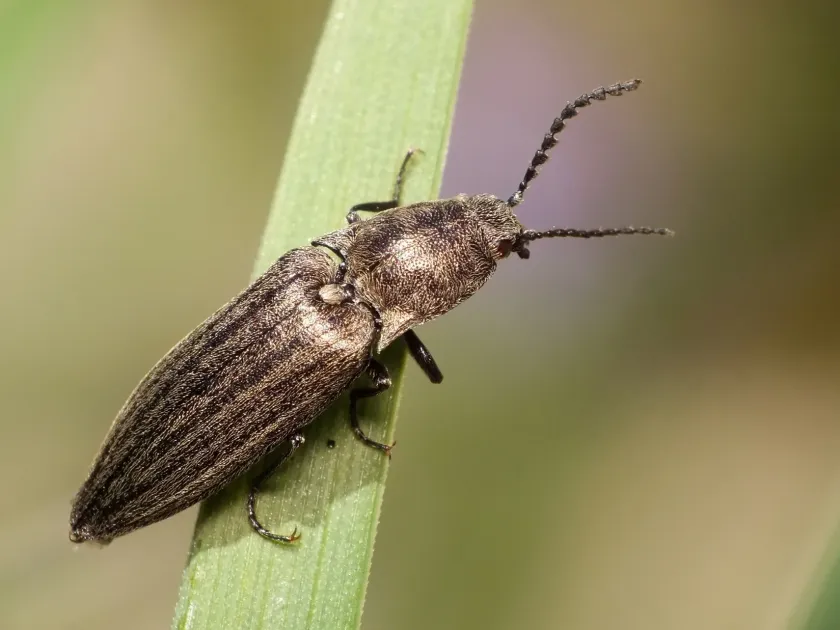
The Zealand click beetle (Actenicerus siaelandicus) is a member of the Elateridae family, order Coleoptera. Adult beetles are elongated, measuring about 9–11 mm in length, and possess a dark brown to black body with a characteristic bronze metallic sheen.
The larvae, commonly known as wireworms, are cylindrical, rigid, and yellowish-brown in color. They are highly mobile and thrive in moist soil environments, moving vertically depending on moisture levels.
This species is biologically adapted to moist habitats, frequently occupying meadows, river floodplains, and poorly drained agricultural lands where soil moisture remains consistently high.
The life cycle of the Zealand click beetle spans several years, involving multiple larval instars. Females lay eggs in the soil near preferred host plants, providing immediate food sources for the emerging larvae.
To distinguish this species, experts examine the antennae, which exhibit a serrated structure. This trait is a key identification marker for the genus Actenicerus within the diverse click beetle family.
What it damages
The primary damage is caused by the wireworm larvae, which live underground and feed on roots, rhizomes, and germinating seeds of a wide range of agricultural crops.
Cereal crops like winter wheat and barley are particularly susceptible during the seedling stage. Wireworms burrow into the seeds or cut off the roots, causing stand thinning and plant death.
Root vegetables, especially potatoes, suffer significant losses. Larvae bore deep into the tubers, creating tunnels that render the produce unmarketable and provide entry points for pathogens and rot.
Pastures and perennial grasses are also affected as wireworms prune the root system of the turf. In severe cases, this reduces the vigor of the meadow and lowers the overall forage yield.
High populations of wireworms in the soil can result in complete crop failure in specific spots, necessitating replanting or intensive chemical intervention to preserve the yield.
When it appears
Adult beetles typically emerge in late spring and remain active through early summer. While they feed on foliage, their impact on crop health during this adult phase is generally considered minor.
Oviposition (egg-laying) occurs during the summer months. Soil moisture is critical during this stage, as eggs and neonate larvae require damp conditions to survive and develop successfully.
In spring, wireworms rise from deeper soil layers as the soil temperature reaches 8–10 degrees Celsius at a 10 cm depth, signaling the start of the primary feeding season.
During the peak of summer, if the soil becomes excessively dry, wireworms migrate deeper into the soil profile to access cooler, more humid environments, effectively halting damage to surface roots.
In autumn, as temperatures decline, wireworms return to the upper soil layers to feed on crop residues and roots of winter crops before entering a period of overwintering.
Signs of infestation
A classic sign of wireworm infestation is the patchy emergence of crops. Plants may appear stunted, wilt suddenly, or turn yellow because their root systems have been partially or fully destroyed.
Inspecting the soil around affected plants usually reveals the presence of hard, wire-like larvae. Digging in damaged spots often uncovers larvae feeding directly on the plant crowns.
On harvested produce like potatoes, the presence of small, round boreholes indicates wireworm activity. These tunnels often remain invisible from the surface until the produce is cut or stored.
Adult click beetle sightings in the field during May and June serve as an early warning for potential larval issues in future growing cycles, indicating an established local population.
Using bait traps made of germinating seeds or wheat soaked in water and buried 10–15 cm deep is the most reliable way to monitor wireworm density before sowing the main crop.
Control measures
Strategic crop rotation is the cornerstone of control. Avoiding planting highly susceptible crops in fields previously used for perennial grasses or abandoned meadows prevents large-scale wireworm buildup.
Deep autumn plowing is a highly effective mechanical control. It exposes wireworms to the surface, where they become vulnerable to desiccation, avian predators, and other natural enemies.
Soil pH management is essential. Since wireworms prefer acidic soil conditions, applying lime to neutralize pH can make the environment less favorable for their development and larval survival.
Chemical control usually involves treating seeds with systemic insecticides. This provides a protected zone around the developing seed, ensuring the young seedling is shielded during its most vulnerable phase.
In cases of high pest pressure, soil-applied insecticides can be used at planting. Monitoring with pheromone traps for adults can also help manage the population by reducing the number of eggs laid.
Taxonomy
- Latin name
- Actenicerus siaelandicus
- Order
- Coleoptera (beetles)
- Family
- Elateridae
- EPPO code
- CORMSJ
Discussion
No discussions yet — be the first.