
Yola beetle
Yola
Description
How to identify
The genus Yola belongs to the Dytiscidae family, commonly known as diving beetles, which are part of the Coleoptera order. These beetles are highly adapted for an aquatic lifestyle.
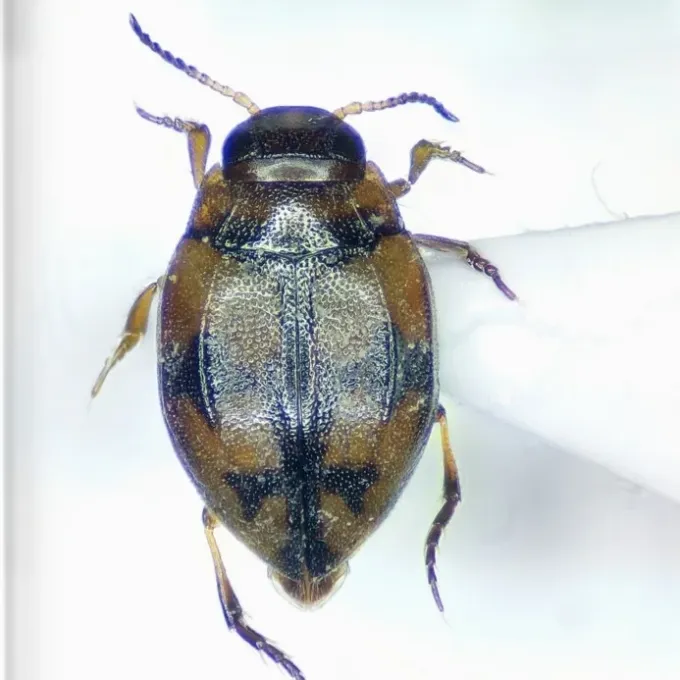
The beetles are characterized by a compact, streamlined body shape, which allows them to maneuver efficiently through the water. Their coloring is typically cryptic, blending in with substrate or vegetation.
The larvae are active aquatic predators with well-developed, sickle-shaped mandibles designed for grasping and feeding on prey. They undergo several larval stages before pupation.
Adults are capable of flight, allowing them to disperse between different water bodies to find suitable breeding grounds or escape unfavorable environmental conditions.
Identification of the genus is based on specific morphological traits, including body proportions and the structure of the ventral side, distinguishing them from other aquatic Coleoptera.
What it damages
Damage caused by Yola beetles is generally observed in systems where aquatic or semi-aquatic plants are cultivated, such as rice paddies or hydroponic installations.
While the larvae are primarily predators, they can cause incidental damage to young roots and stems while searching for prey or creating resting spots within the plant's root zone.
This mechanical damage to the root system can compromise the plant's structural integrity and serve as an entry point for various secondary fungal or bacterial pathogens.
In aquaponic systems, the presence of these predatory larvae can disrupt the local ecosystem by reducing populations of beneficial microorganisms or small invertebrates.
Adult beetles may occasionally feed on leaf tissues, causing holes or frayed edges on floating foliage, which reduces the photosynthetic capacity of the plant.
When it appears
Activity levels are highly dependent on water temperature, with beetles becoming most active during the warmer months, typically from late spring through early autumn.
Spring marks the period of increased dispersal, as overwintering adults emerge to locate suitable breeding sites and lay eggs on submerged plant parts.
Summer provides optimal thermal conditions for rapid larval development, leading to potentially high population density in stagnant or slowly moving water systems.
As temperatures drop in autumn, beetles seek protected areas, such as buried substrates or crevices, to enter a period of dormancy or diapause until the following season.
The number of generations per year can vary significantly depending on the regional climate, with warmer environments supporting multiple lifecycles within one season.
Signs of infestation
Signs of infestation include the visual observation of small beetles in water tanks and the presence of egg clusters attached to the stems or leaves of submerged vegetation.
Evidence of larval activity can often be found by examining the roots of stunted plants, which may show signs of tissue stripping or unnatural mechanical fraying.
A sudden decline in the density of small non-target aquatic organisms is a strong biological indicator that a predator like a diving beetle has entered the system.
The presence of adult beetles near light sources at night near the hydroponic site can also be an indicator of a nearby population seeking to colonize the area.
- small, dark-colored beetles observed in water;
- damaged roots and base of stems;
- egg clusters on aquatic plant leaves;
- reduced diversity of beneficial aquatic invertebrates;
- stunted plant growth due to root compromise.
Control measures
The use of fine-mesh screening over water inlets is an effective preventative measure to stop adult beetles from entering and colonizing controlled aquatic environments.
Mechanical removal using fine-netting during regular system inspections can significantly reduce the number of adult beetles and larvae in smaller reservoirs.
Maintaining high water quality and removing excess vegetative debris can minimize the number of suitable sites for egg-laying and larval development.
Biological control agents that specifically target aquatic insect larvae, while maintaining safety for plant health, can be used if populations reach damaging levels.
In highly sensitive hydroponic or aquaculture systems, full water turnover and sanitization of the reservoir equipment remain the most reliable methods for total eradication.
Taxonomy
- Latin name
- Yola
- Order
- Coleoptera (beetles)
- Family
- Dytiscidae
- EPPO code
- YOLASP
Discussion
No discussions yet — be the first.