
Rhantus grapii
Rhantus grapii
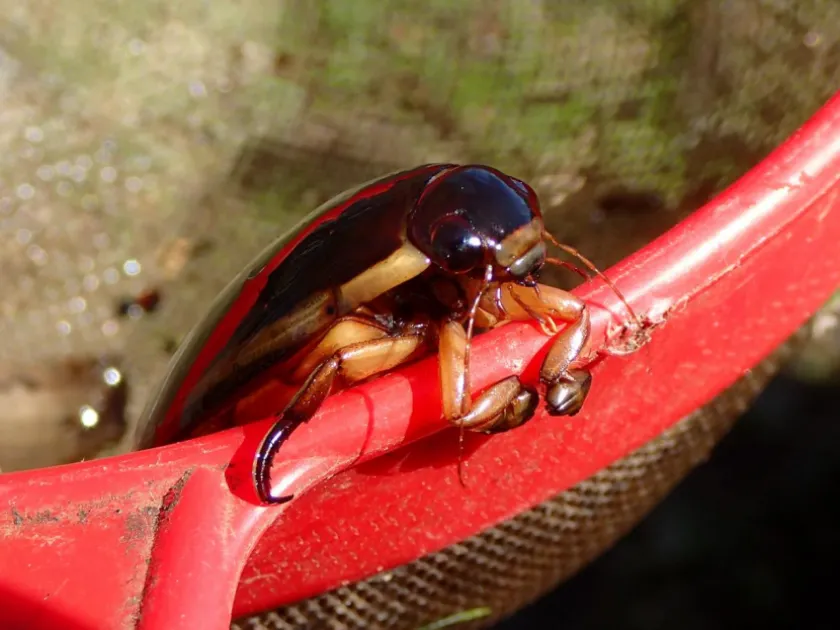
Description
How to identify
Rhantus grapii is an aquatic beetle belonging to the family Dytiscidae (diving beetles) within the order Coleoptera. Adults have an oval, slightly flattened body measuring approximately 10–12 millimeters in length.
The coloration ranges from yellowish-brown to dark brown, often featuring a distinct mottled pattern on the elytra. The head and pronotum are usually darker, frequently displaying clear, defined spots.
The larvae of this species are voracious predators, similar to all diving beetles. They possess a spindle-shaped body, massive sickle-shaped mandibles, and long legs adapted for rapid movement underwater.
A hallmark of the adult Rhantus grapii is the presence of swimming legs fringed with dense hairs, enabling the insect to perform agile maneuvers while hunting or evading threats.
This species is commonly found in stagnant or slow-moving water bodies, preferring areas with abundant shoreline vegetation, which provides essential cover from predators.
What it damages
Rhantus grapii causes significant economic damage in fish farms, particularly those specializing in the rearing of fry in nursery ponds.
The larvae are highly aggressive predators that attack fish larvae, fish eggs, and small invertebrates, directly contributing to high mortality rates in fish stocks.
Adult beetles also inflict damage by attacking young fish, especially during periods when fish density is high within the confined space of incubation or brood ponds.
When the beetle population explodes within a farm, losses of fish stocking material can reach critical levels, severely undermining the profitability of the operation.
In addition to direct predation on fish, these beetles can act as mechanical vectors for various parasites and pathogens that threaten the health of cultured fish species.
When it appears
Activity of adult Rhantus grapii begins in early spring as soon as the water temperature in the ponds rises, leading to mass flight and mating activity.
The peak abundance of larvae occurs during late spring and early summer, coinciding with the developmental period of fish fry in ponds, making them highly vulnerable.
By mid-summer, many adults may abandon drying water bodies, migrating to deeper, more permanent sites suitable for the development of the next generation.
A second, though usually less intense, breeding cycle can occur in late summer or early autumn, depending on environmental conditions.
The insects overwinter in the adult stage, burrowing into the shoreline soil or hiding among submerged plant debris at the bottom of ponds, where they can tolerate freezing temperatures.
Signs of infestation
The primary indicator of Rhantus grapii presence is the observation of numerous beetles while inspecting the shoreline or utilizing a dip net for sampling.
Larval infestation can be confirmed through controlled sampling, where predatory larvae with characteristic sickle-shaped mandibles are identified in water samples.
Unexplained mortality or injury among fish fry, characterized by distinct bite wounds inflicted by aquatic predators, serves as a strong indirect sign of beetle presence.
Observing increased bird activity near the pond surface, as they often hunt for diving beetles, can also suggest a high population density of the pest.
In cases of massive infestations, the pond water may develop a peculiar odor due to the defensive secretions produced by the insects, particularly in small, stagnant basins.
Control measures
The primary control method involves draining ponds during the autumn-winter season followed by thorough disinfection of the pond bed to eliminate adults overwintering in the soil.
Installing fine-mesh screens at water intake points for nursery ponds is essential to prevent the entry of adult beetles from natural water sources.
Regular maintenance, including the removal of excessive aquatic vegetation, reduces available cover for larvae and simplifies overall population monitoring.
On a small scale, adult beetles can be managed using light traps installed around the perimeter of the ponds during the night hours.
Industrial fish farms should maintain optimal fish stocking densities and implement consistent monitoring programs to detect and address localized breeding hotspots rapidly.
Taxonomy
- Latin name
- Rhantus grapii
- Order
- Coleoptera (beetles)
- Family
- Dytiscidae
- EPPO code
- RHNTGR
Discussion
No discussions yet — be the first.