
Diving beetle
Rhantus
Description
How to identify
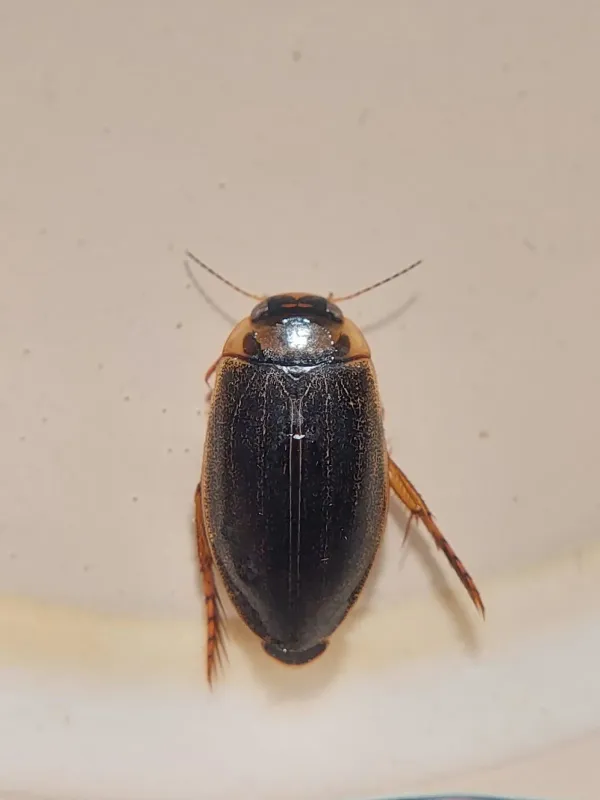
The genus Rhantus belongs to the family Dytiscidae, commonly known as diving beetles, within the order Coleoptera. These are aquatic beetles with a streamlined, oval-shaped body designed for efficient swimming in aquatic environments.
Adult beetles are generally brownish or yellowish in color, often featuring speckled patterns on their elytra. Their larvae, frequently referred to as "water tigers," possess elongated bodies and powerful sickle-shaped mandibles used for predation.
Unlike many other aquatic insects, adult diving beetles are capable of flight, allowing them to migrate between various water bodies, irrigation canals, and rice paddies in search of food or suitable breeding grounds.
Their lifecycle undergoes complete metamorphosis: egg, larva, pupa, and adult. Females deposit eggs into the tissues of aquatic plants or onto submerged surfaces, making the presence of aquatic vegetation a key factor in their local population density.
It is important for agronomists to distinguish Rhantus from other aquatic insects, as their role in the ecosystem can vary from being beneficial predators of other larvae to potentially harmful pests when their natural prey is insufficient.
What it damages
The primary crop impacted by Rhantus diving beetles is rice, particularly during the initial stages of plant growth. When larvae populations are high, they can cause significant damage to young rice seedlings.
While larvae are primarily carnivorous, they may consume young rice tissues, cutting through stems and roots during periods of food scarcity. This leads to reduced stand density and potential crop loss in early growth phases.
Physical injuries caused by larvae feeding provide entry points for secondary infections, such as fungal or bacterial pathogens, which can severely compromise the health of the entire rice stand.
The most substantial damage is typically observed in flooded fields with stagnant water and dense weed populations, which provide optimal cover and breeding sites for the beetles.
While usually considered a minor threat, high densities of diving beetle larvae in newly flooded paddies can necessitate management actions to prevent significant thinning of the young rice crop.
When it appears
The activity of diving beetles typically begins in early spring as water temperatures in irrigation systems rise above 10-12 degrees Celsius, signaling the end of their winter diapause.
The peak of larval activity usually occurs in late spring and early summer, directly overlapping with the critical emergence and establishment period of the rice crop.
During the summer months, adult beetles are highly mobile and may engage in migratory flights to colonize new areas, ensuring that different sections of the paddies can be infested throughout the growing season.
As temperatures drop in the autumn, adult beetles seek refuge in the silt at the bottom of water bodies or along the banks, where they remain in a state of hibernation until the following spring.
The severity of an infestation is often dictated by the hydrological regime; stable, shallow water with abundant vegetation tends to support the largest and most persistent beetle populations.
Signs of infestation
The most visible sign of diving beetle damage is the presence of "pruned" or bitten rice seedlings, where stems appear severed or shredded near the water level.
A simple visual survey of the paddy surface can reveal the presence of adult beetles, which periodically surface to breathe or can be seen swimming rapidly upon disturbance of the water.
The presence of larvae can be confirmed using a fine-mesh aquatic net. Larvae are easily identifiable by their active, predatory behavior, elongated bodies, and distinctive jaw structures.
Floating fragments of damaged plant tissue near patches of suspicious insect activity can serve as a strong indicator that larvae are feeding on the young crops.
If field patches show unexpected thinning without other apparent causes, a focused sampling of the water column is necessary to determine if diving beetle larvae are responsible for the damage.
Control measures
Cultural control is the primary method of management, including the periodic drainage of rice paddies to disrupt the larval development cycle and kill individuals through desiccation.
Maintenance of irrigation infrastructure is crucial; regular removal of aquatic weeds from canals prevents beetles from finding suitable egg-laying substrates, significantly reducing subsequent population spikes.
Maintaining a steady flow of water through the paddies can make the environment less hospitable for larvae, encouraging them to migrate elsewhere and reducing local pressure on the rice plants.
In cases where damage thresholds are exceeded, the use of selective insecticides approved for aquatic environments may be considered, provided they have minimal impact on non-target aquatic organisms.
- Periodic drainage of fields.
- Mechanical removal of aquatic vegetation.
- Maintaining water circulation.
- Monitoring with aquatic nets.
Taxonomy
- Latin name
- Rhantus
- Order
- Coleoptera (beetles)
- Family
- Dytiscidae
- EPPO code
- RHNTSP
Discussion
No discussions yet — be the first.