
Oreodytes davisii
Oreodytes davisii
Description
How to identify
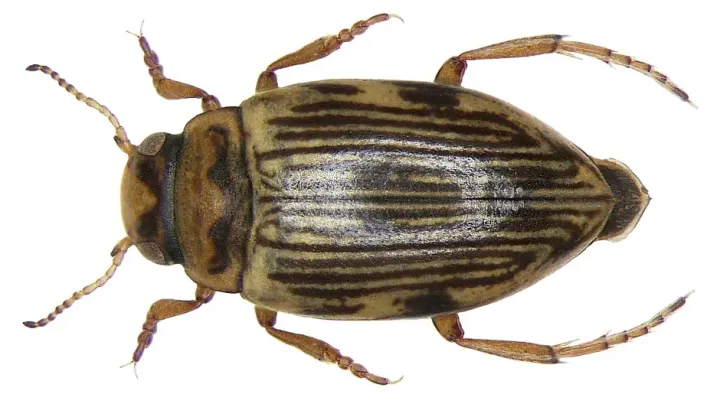
Oreodytes davisii is a species of predatory water beetle belonging to the family Dytiscidae, order Coleoptera.
It is specifically adapted to clean, flowing water habitats, such as streams and brooks, unlike many other diving beetles that favor stagnant ponds.
The adult beetle has a streamlined body shape that allows for efficient swimming and navigation in moving water environments.
The coloration of the elytra features distinctive yellow markings on a dark background, providing excellent camouflage against gravel-strewn stream beds.
The larvae are also aquatic and possess a segmented body with highly developed mandibles suited for a predatory lifestyle.
What it damages
Oreodytes davisii is not considered a pest of agricultural crops, as it does not consume plant material or impact field vegetation.
Any perceived harm associated with these beetles is limited to their role in aquatic ecosystems and their interaction with irrigation water supplies.
As predators, they consume small aquatic organisms, which may disrupt the natural balance in artificial reservoirs or irrigation canals.
While they do not damage crops directly, their presence in high densities could potentially indicate changes in water quality within a water system.
There is no record of economic loss attributed to this species in large-scale agriculture or horticulture.
When it appears
Adult beetles begin their active phase in early spring as water temperatures rise and ice melts from their habitats.
Breeding and egg-laying typically occur throughout the late spring and early summer months, coinciding with peak water warmth.
Larval development takes place during the summer, where they actively prey on small invertebrates found in the stream sediments.
Pupation occurs on land, usually within the damp soil or under debris located along the riverbanks, protected from predators.
The beetles overwinter as adults, seeking refuge in the sediment of the stream bed to survive until the following spring season.
Signs of infestation
Detection of the species is primarily achieved through sampling stream environments using a standard hydrobiological net.
Adults may be observed resting on the bottom of clear, shallow streams, particularly during the active foraging hours.
Larvae can be found by examining stones and gravel in the benthic zone of flowing water bodies where they hide.
A notable sign of their presence is a localized reduction in the population of smaller aquatic crustaceans that they typically hunt.
Given their non-pest status, there are no specific trap systems or monitoring protocols developed for agricultural management purposes.
Control measures
No chemical pesticides are directed at Oreodytes davisii, as they do not threaten crop production or cause agronomic damage.
Management of these insects in an agricultural context focuses on maintaining clean irrigation infrastructure to prevent ecosystem disruption.
Keeping water canals free of excessive sediment and debris reduces the habitat suitability for their colonization.
Installing appropriate filtration systems at water pumping stations prevents aquatic fauna from entering irrigation pipes.
- Regular dredging and cleaning of irrigation canals.
- Implementation of fine-mesh filtration at water inlets.
- Monitoring of aquatic biodiversity in proximity to irrigation sources.
Taxonomy
- Latin name
- Oreodytes davisii
- Order
- Coleoptera (beetles)
- Family
- Dytiscidae
- EPPO code
- ORDYDA
Discussion
No discussions yet — be the first.