
Nebrioporus elegans
Nebrioporus elegans
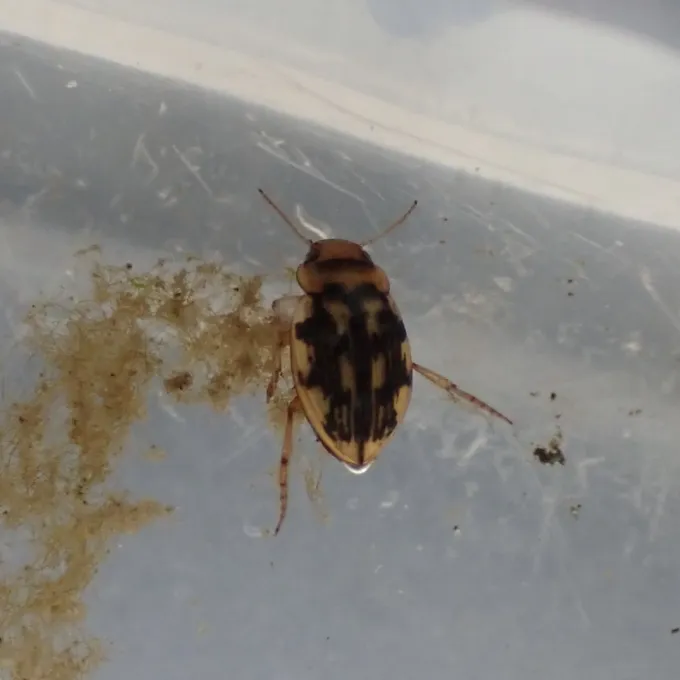
Description
How to identify
Nebrioporus elegans is a species of diving beetle belonging to the Dytiscidae family, commonly found in freshwater environments throughout Europe.
These beetles are small, usually ranging from 3.5 to 4.5 mm in length, with a streamlined, oval-shaped body optimized for swimming.
The elytra (wing covers) typically display a characteristic pattern of dark brown and yellowish markings, providing excellent camouflage in their aquatic habitat.
They possess specialized hind legs with fringes of hair, which function like oars for efficient movement through the water column.
Identification often requires careful examination of the male's genitalia or the specific punctation patterns on the elytra under magnification.
What it damages
Nebrioporus elegans is not an agricultural pest; it does not feed on crops, vegetables, or any terrestrial plant tissues.
As a predatory species, it feeds primarily on small aquatic invertebrates, including mosquito larvae, daphnia, and other microscopic organisms.
Its presence in irrigation ditches or flooded rice fields is ecologically benign and does not affect the health or yield of the crops.
Instead of causing damage, these beetles contribute to the natural regulation of aquatic insect populations within the farm's water systems.
Agronomists should view these beetles as neutral or beneficial components of the aquatic ecosystem rather than as targets for pest management.
When it appears
The life cycle of Nebrioporus elegans is synchronized with seasonal water temperature shifts and the availability of prey.
Adults become active as water temperatures rise in late spring, typically around April and May, initiating their feeding and mating cycles.
Larval development occurs throughout the summer months when environmental conditions are optimal for growth and metamorphosis.
As temperatures drop in autumn, adults seek shelter in the bottom substrate, such as silt or decaying plant matter, to survive the winter.
The species typically undergoes diapause during the winter, emerging again once favorable conditions return in the following spring.
Signs of infestation
There are no signs of crop damage associated with this beetle, as it has no herbivorous impact on plant growth or development.
Detection of the species in a farm's water system is purely accidental, usually occurring during routine water quality or aquatic biodiversity surveys.
In the field, one might observe small, quick-moving dark shapes darting away in irrigation channels, which is typical behavior for diving beetles.
The presence of this species is often indicative of good water quality and a balanced ecosystem, as they are sensitive to high levels of pollution.
No scouting or economic threshold levels exist for Nebrioporus elegans because it poses no threat to agricultural productivity.
Control measures
No control measures are necessary for Nebrioporus elegans, as it does not pose a threat to agricultural crops or plant health.
The application of chemical pesticides in aquatic areas to eradicate these beetles is strongly discouraged to avoid harming local biodiversity.
Standard farm maintenance, such as managing aquatic weed growth and ensuring clean water flow, is sufficient for ecosystem health.
Agrochemicals should always be used with caution to prevent drift into adjacent water bodies, ensuring that non-target organisms are protected.
Agronomists should direct their efforts toward managing genuine economic pests while allowing beneficial aquatic life to persist in farm water systems.
Taxonomy
- Latin name
- Nebrioporus elegans
- Order
- Coleoptera (beetles)
- Family
- Dytiscidae
- EPPO code
- NBPREL
Discussion
No discussions yet — be the first.