
Brown diving beetle
Liopterus haemorrhoidalis
Description
How to identify
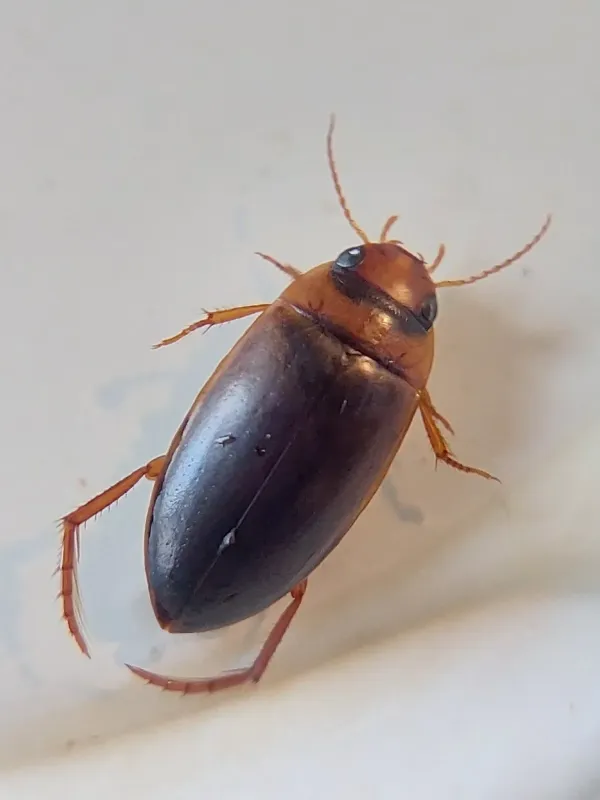
The brown diving beetle, known scientifically as Liopterus haemorrhoidalis, belongs to the order Coleoptera and the family Dytiscidae. This predatory aquatic insect is medium-sized and possesses a streamlined body shape, typical of the family, evolved for efficient swimming.
Adult specimens exhibit a dark brown to black coloration with distinct light or yellowish lateral margins on the elytra. Their body length typically ranges from 10 to 12 millimeters.
The larvae of this beetle are highly active predators, equipped with powerful sickle-shaped mandibles designed to capture and hold onto prey effectively.
Adult beetles have a specialized respiratory system that allows them to store an air bubble under their elytra, enabling them to remain submerged for extended periods before returning to the surface for ventilation.
Unlike larger diving beetle species, this beetle prefers stagnant or slow-moving water bodies with dense aquatic vegetation, which provides excellent camouflage for both larvae and adults.
What it damages
The primary economic impact of the brown diving beetle occurs in fish farms, particularly in spawning and nursery ponds, where it predates heavily on fish fry.
During periods of high stocking density, the larvae become highly aggressive, attacking fry of comparable or smaller sizes, leading to significant mortality and reduced population yields.
In addition to direct predation, both adults and larvae can cause mechanical injuries to the skin of fish, creating entry points for opportunistic fungal or bacterial infections.
In certain scenarios, the mass presence of these beetles in ponds containing valuable fish breeds necessitates additional veterinary interventions and leads to losses in marketable production.
While not a typical agricultural pest of crops, this beetle is recognized as a serious biological risk factor in intensive aquaculture and nursery pond management.
When it appears
The activity cycle of the brown diving beetle begins in early spring, immediately after the ice thaws, as adults emerge to feed and seek mating partners.
The peak egg-laying period coincides with the spring and summer months, which provide an abundance of food sources in the form of developing fish fry.
The larval stage, which poses the greatest threat to fish production, is observed throughout the warm season, reaching its highest density during the height of summer.
Adult beetles are capable of nocturnal flights between different water bodies, a behavior that complicates local control efforts and requires continuous monitoring throughout the season.
As temperatures drop, the beetles enter a overwintering phase, burrowing into bottom silt or hiding within dense vegetation until the following spring.
Signs of infestation
The first indicator of an infestation is a sharp, unexplained decline in fry population numbers, even in the absence of visible infectious disease outbreaks.
Visual inspection of the pond perimeter, if performed quietly, may reveal characteristic surface ripples or the movement of beetles near the water’s surface.
Using dip nets to sample water in dense patches of aquatic vegetation is an effective way to confirm the presence of beetle larvae in the pond.
Observations of ragged wounds or shallow skin lesions on recovered fry provide indirect evidence of attacks by predatory aquatic insects.
A noticeable decrease in the feeding activity and an increase in the nervous, skittish behavior of the fish population often accompany an influx of diving beetles.
Control measures
Draining and allowing ponds to freeze completely during the winter is a highly effective cultural control method, as it eliminates both adult beetles and larvae overwintering in the sediment.
Removing excessive aquatic vegetation from ponds deprives the beetle of necessary shelter and breeding sites, making larvae more vulnerable to fish predators and birds.
Installing fine-mesh screens on water inlets prevents adult beetles from migrating into fish ponds from external, natural sources of infestation.
- Biological control: promoting the presence of natural fish predators that feed on aquatic insect larvae.
- Mechanical control: systematic removal of adults using nets during the peak flying season.
Chemical control is generally discouraged in aquaculture, as most insecticides are toxic to fish and can cause severe disruption to the biological balance of the pond ecosystem.
Taxonomy
- Latin name
- Liopterus haemorrhoidalis
- Order
- Coleoptera (beetles)
- Family
- Dytiscidae
- EPPO code
- LIPTHA
Discussion
No discussions yet — be the first.