
Diving beetle (Laccornis)
Laccornis
Description
How to identify
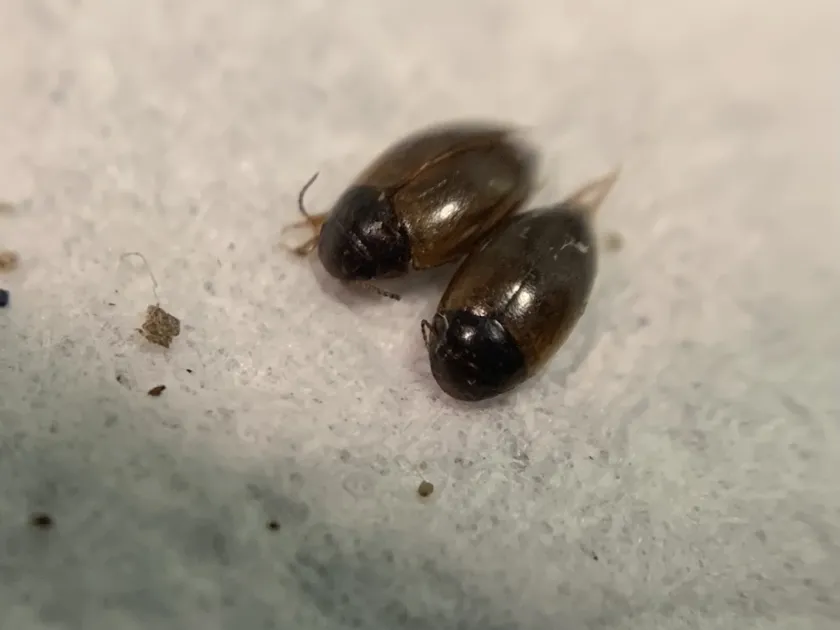
The genus Laccornis belongs to the Dytiscidae family within the order Coleoptera. These beetles are characterized by a streamlined, flattened body shape designed for efficient movement in an aquatic environment.
They typically exhibit a dark brown to brownish coloration with a glossy chitinous exoskeleton. Their hind legs are modified with long, dense hairs that function as paddles for powerful swimming strokes.
The head is closely adapted to the pronotum, ensuring hydrodynamism. Large, complex eyes allow these beetles to effectively locate prey in murky or vegetated water.
Larvae are distinctively predatory, possessing elongated bodies and sickle-shaped mandibles used to seize and inject digestive enzymes into their prey.
As strong fliers, adult Laccornis can migrate between water bodies, making them opportunistic colonizers of any suitable pond or aquaculture facility.
What it damages
In aquaculture settings, Laccornis species are considered pests because they prey on fish fry and fingerlings in nursery ponds.
Their predatory nature poses a direct threat to the survival rates of young fish, as larvae are highly aggressive and capable of attacking prey of significant size.
Beyond direct mortality, they create intense food competition by consuming the zooplankton and small invertebrates that the fish fry rely on for rapid growth.
High populations of these beetles in hatchery tanks or small ponds can lead to significant economic losses, necessitating proactive management and population control.
The impact is particularly severe in the early stages of fish development, where even a small number of larvae can cause disproportionate damage to the stock.
When it appears
The activity cycle of Laccornis begins in the spring as water temperatures rise, triggering metabolic activation and the emergence of adults from overwintering sites.
Summer is the peak period for development, with higher water temperatures accelerating the larval growth phase and the transition through multiple instars.
Adults often engage in mating and egg-laying during this time, resulting in overlapping generations that can maintain high predator pressure throughout the season.
As autumn approaches and water temperatures drop, adult beetles typically move to terrestrial overwintering areas, often burying themselves in damp soil or debris.
Monitoring the seasonal calendar is crucial for aquaculture operators to align protective measures with the periods when the beetles are most active in the water column.
Signs of infestation
Early detection of a Laccornis infestation is primarily achieved through periodic sampling of the water column using fine-mesh aquatic nets.
Visual observation is effective, especially during dawn and dusk when beetles surface for air, breaking the surface tension with the tips of their abdomens.
Damaged fry may show physical signs of attack, such as lacerations on fins, tail damage, or abnormal swimming behavior caused by stress from predator avoidance.
- Reduced fish growth rates despite adequate feed supply.
- Observation of larvae or adults in pond perimeter vegetation.
- Presence of empty larval husks trapped in filtration or screening systems.
Persistent monitoring of the pond's ecosystem helps differentiate between normal biodiversity and a harmful population explosion of predatory beetles.
Control measures
Mechanical removal through regular netting of pond surfaces is the most immediate and least toxic way to reduce the population of adult beetles before they reproduce.
Proper habitat management, including the removal of dense marginal vegetation and cleaning of pond bottoms, significantly reduces the hunting grounds for larvae.
Drying out ponds and thoroughly cleaning the substrate between production cycles is highly effective at disrupting the life cycle and eliminating overwintering stages.
Maintaining high water quality and managing nutrient inputs can discourage excessive colonization by these opportunistic predators.
Integrated pest management strategies focusing on physical and environmental controls are preferred over chemical treatments, which can harm the fish stock and pollute the water.
Taxonomy
- Latin name
- Laccornis
- Order
- Coleoptera (beetles)
- Family
- Dytiscidae
- EPPO code
- LCCRSP
Discussion
No discussions yet — be the first.