
Hyphydrus diving beetle
Hyphydrus
Description
How to identify
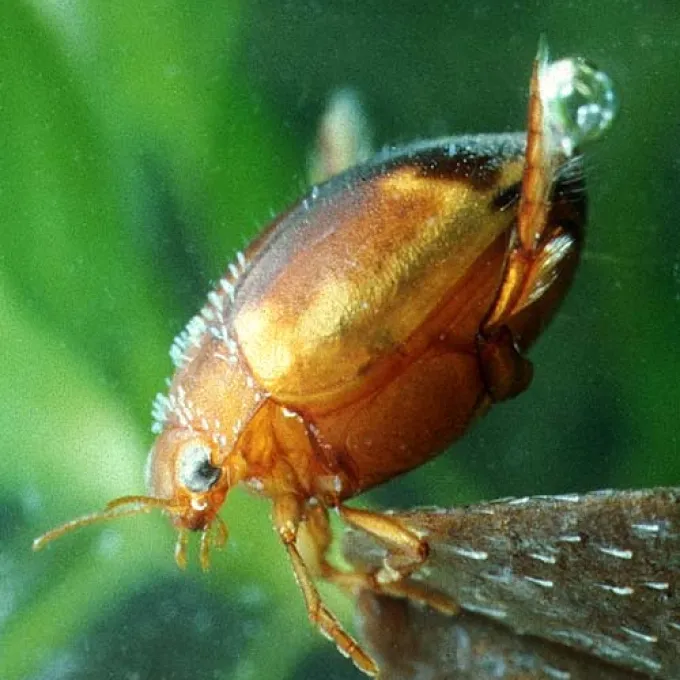
The genus Hyphydrus belongs to the Dytiscidae family, order Coleoptera. These are small aquatic beetles characterized by a convex, almost spherical body shape, which distinguishes them from flatter species within the same family.
Adult coloration usually ranges from yellowish-brown to dark brown, sometimes featuring distinct dark spots on the elytra. The head and pronotum have a smooth, shiny surface.
The insect's life cycle is entirely tied to the aquatic environment. Adults are active swimmers capable of moving between water bodies, while larvae develop underwater, leading a predatory lifestyle.
The biology of Hyphydrus includes several stages: egg, three larval stages, pupa, and imago. The beetles overwinter in the adult stage, burying themselves in bottom sediments or hiding in riparian vegetation.
Reproduction occurs in spring when water temperatures reach favorable levels. Females lay eggs directly into aquatic plant tissues or onto substrate, providing the larvae with protection and access to a food source.
What it damages
Hyphydrus causes primary damage to rice crops, especially during early growth stages when fields are flooded. Both beetles and their larvae damage seedlings and young leaves of the plants.
Hyphydrus larvae possess powerful sickle-shaped jaws designed for catching and piercing prey; in rice paddies, they can gnaw on the soft tissues of young shoots.
Serious threats arise from mass infestations, which can significantly thin out rice stands, reducing crop density at the initial stage of vegetation.
Damaged plants slow their growth and become more susceptible to pathogens and rots that enter through micro-wounds left by the insects in the stem tissues.
The economic impact of the species increases with high population numbers in irrigation systems, where a lack of natural enemies or poor agronomic timing triggers population outbreaks.
When it appears
The appearance of Hyphydrus directly depends on the seasonal flooding of rice fields. Beetle activity begins during the first warm days when water temperatures rise above 15 degrees Celsius.
Adult activity peaks in late spring and early summer, coinciding with the rice germination phase and the appearance of the first seedlings in the flooded fields.
Depending on regional climatic conditions and the duration of the warm season, one or two generations may develop per year.
By mid-summer, the larval population begins to decline as the pupation cycle ends, although adult beetles remain active throughout the period that water is maintained in the fields.
In autumn, with cooling temperatures and the draining of the fields, beetles migrate to deeper permanent water bodies or canals to prepare for winter diapause.
Signs of infestation
Visual signs of infestation include damage to young leaves, which appear as small holes or ragged edges on stems submerged underwater.
When inspecting the water surface, adult beetles can be observed periodically surfacing for air, grasping a bubble of air with the tip of their abdomen.
Larval presence can be detected by examining rice seedlings, especially if sudden wilting or lodging is observed in stagnant water areas.
A secondary sign is the yellowing of rice leaf tips, often mistakenly attributed to nutrient deficiency, whereas the real cause is mechanical damage to roots or stem bases.
- Thinning of rice seedlings in flooded areas.
- Small punctures on the basal part of the stems.
- Presence of characteristic rounded beetles in the water during field inspection.
Control measures
The primary control measure is the implementation of crop rotation and timely draining of rice paddies during critical growth periods, provided the cultivation technology allows it.
The use of insecticides is allowed only when the economic threshold of harmfulness is exceeded. Systemic action products authorized for use in aquatic environments are applied.
An important element is the eradication of weeds along field margins and irrigation canals, which serve as reservoirs for beetle populations during the off-season.
Biological control methods include encouraging natural predators, such as waterfowl and beneficial predatory insects, which actively feed on the adult and larval stages of the diving beetle.
Proper selection of sowing dates and the use of high-quality treated seed materials help reduce the risk of young plant damage during the most vulnerable life stages.
Taxonomy
- Latin name
- Hyphydrus
- Order
- Coleoptera (beetles)
- Family
- Dytiscidae
- EPPO code
- HYYSSP
Discussion
No discussions yet — be the first.