
Tessellated diving beetle
Hydroporus tessellatus
Description
How to identify
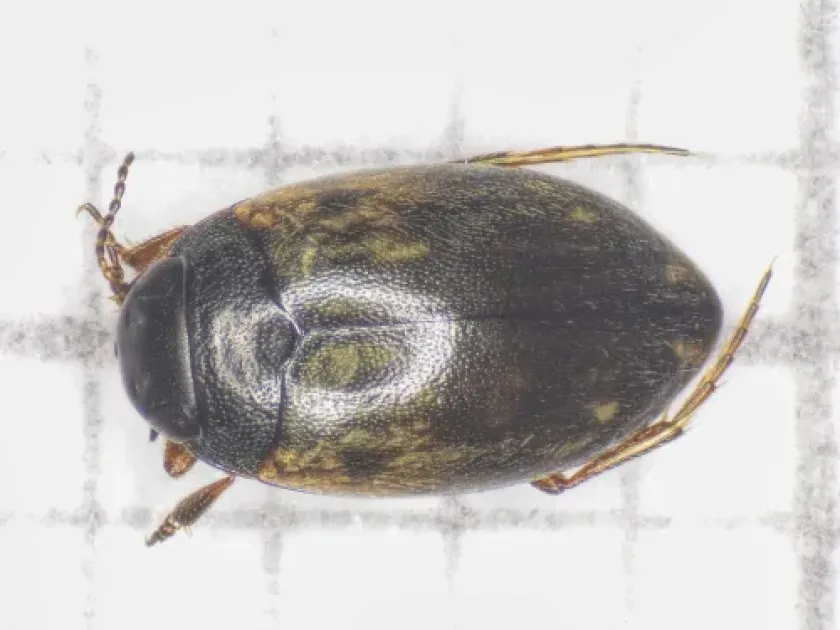
The tessellated diving beetle (Hydroporus tessellatus) belongs to the Dytiscidae family within the order Coleoptera. This small aquatic beetle typically measures between 3.5 and 4.5 mm in length.
The body is oval and slightly convex, an adaptation common to members of the genus Hydroporus. The elytra display a dark, reticulated or tessellated pattern, which serves as a key identifying feature.
Like all diving beetles, the larvae are predatory and lead an active aquatic lifestyle. They are equipped with sharp, sickle-like mouthparts designed to capture and consume small prey.
Adult beetles are proficient swimmers, utilizing their hind legs, which are fringed with swimming hairs. They prefer shallow, stagnant, or slow-moving water bodies with submerged vegetation.
The species is widely distributed across Europe and is frequently found in temporary ponds, drainage ditches, and flooded fields where moisture persists throughout the developmental stages.
What it damages
The primary concern regarding this species involves its impact on commercial fish farms and nurseries. Both adults and larvae act as predators that target fish fry.
By attacking young fish, these beetles cause physical trauma to skin and fins, which often leads to secondary infections and increased mortality rates in the fish population.
Mass infestations in spawning ponds can lead to significant economic losses as the diving beetles can consume or injure a substantial portion of the fry stock.
Additionally, these beetles may serve as mechanical vectors for various fish pathogens, facilitating the spread of diseases within an aquaculture environment.
In managed pond ecosystems, this species is considered a pest that requires monitoring to ensure the successful rearing of healthy juvenile fish.
When it appears
The active season for the tessellated diving beetle begins in early spring as soon as ice thaws and water temperatures begin to rise consistently.
Peak breeding and larval development typically occur from late spring through early summer, which often coincides with the spawning period of many valuable fish species.
During the summer months, adult beetles demonstrate high mobility and may fly to new locations to colonize suitable habitats or escape drying water bodies.
As autumn approaches and water temperatures drop, the beetles shift their behavior toward preparing for winter dormancy.
The species overwinters as an adult, burying itself in the pond substrate or hiding within decaying vegetation at the bottom or along the pond margins.
Signs of infestation
The initial sign of an infestation is often a noticeable reduction in the number of fish fry in the pond without an apparent disease outbreak.
Careful observation of the water surface on calm days may reveal adults periodically rising to the surface to replenish their air supply.
Sampling the water with a fine-mesh net to survey the invertebrate population will reveal the presence of larvae or adults, confirming an infestation.
Physical evidence of predation on fish fry includes small bite marks on fins or flanks, which may be inflamed due to secondary microbial infection.
Large numbers of beetles observed gathering near the pond shoreline during warmer periods provide a clear indication of a dense, established population.
Control measures
Effective management begins with proper pond preparation, including complete draining, liming, and disinfection of the pond bed prior to the new stocking season.
Regular maintenance, such as removing excess aquatic vegetation, is critical because dense weeds provide essential shelter for both beetle larvae and adults.
Installing fine-mesh screens on water intake pipes helps prevent adult beetles from entering spawning ponds from external water sources.
If an infestation becomes severe, the use of biological control agents that target aquatic insects while remaining safe for fish is highly recommended.
- Routine biological monitoring of nursery ponds.
- Dredging ponds to eliminate overwintering sites in the mud.
- Implementing strict biosecurity measures when transferring fry between ponds.
Taxonomy
- Latin name
- Hydroporus tessellatus
- Order
- Coleoptera (beetles)
- Family
- Dytiscidae
- EPPO code
- HDPSTE
Discussion
No discussions yet — be the first.