
Striped diving beetle
Hydroporus striola
Description
How to identify
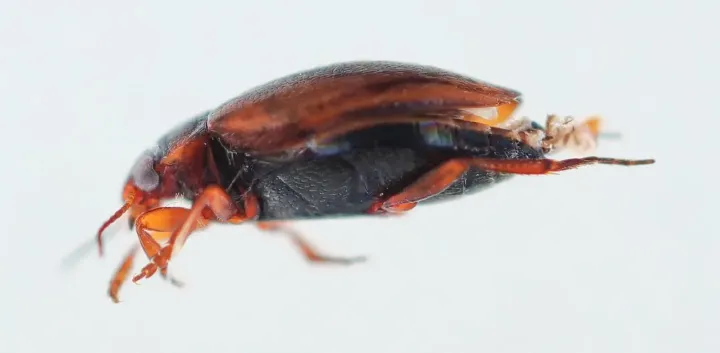
The striped diving beetle (Hydroporus striola) is a small aquatic insect belonging to the Dytiscidae family within the order Coleoptera. Adult beetles typically measure between 3 and 4 mm in length.
The body is oval and flattened, specifically adapted for life in water. Their coloration ranges from dark brown to black, featuring distinctive longitudinal yellow stripes on the elytra.
They possess specialized swimming legs equipped with dense hairs (setae), which provide the necessary propulsion and agility to navigate through aquatic vegetation.
The larvae are active aquatic predators with well-developed mouthparts designed for capturing and consuming prey. They move gracefully through the water column.
Unlike many other insects, these beetles are capable fliers, allowing them to migrate between ponds, marshes, and even fish farming facilities.
What it damages
This species is considered a pest primarily in commercial fish farming, specifically affecting fry and fingerling production ponds.
The larvae act as aggressive predators, targeting fish fry, larvae, and eggs. This can result in significant economic losses for hatcheries.
Adult beetles can also inflict damage by attacking young fish, which may lead to physical injury or secondary infections in the fish population.
High densities of these beetles in closed systems reduce overall fish productivity, as they compete for space and pose a direct threat to juvenile stocks.
The cumulative effect of larval predation in nursery ponds can lead to a measurable decrease in the survival rate of fish seedlings.
When it appears
The life cycle of the striped diving beetle is temperature-dependent. Adults emerge from hibernation as soon as the ice clears from the water in early spring.
Reproduction occurs throughout the spring and summer months. Females lay eggs on submerged aquatic plants or in the soft substrate along the banks.
Larval development takes several weeks, during which they feed voraciously on available animal protein in the water before pupating in damp soil.
A new generation of adults typically emerges by mid to late summer, often dispersing to other water bodies to continue their life cycle.
Overwintering occurs in the larval or adult stage, usually buried in the bottom silt or hidden within dense plant material at the bottom of the pond.
Signs of infestation
Due to their small size, detecting the striped diving beetle in large ponds requires specific sampling techniques rather than casual observation.
The most reliable sign is the capture of larvae or adults using a fine-mesh aquatic dip net, particularly along the overgrown margins of the pond.
An unexplained high mortality rate of fish fry or reduced success in pond stocking can be an indicator of a high infestation level by aquatic predators.
Monitoring the pond's biodiversity during the night or early morning can reveal the presence of adult beetles surfacing to breathe.
Regular biological assessment of the water quality and fauna is recommended for fish farmers to prevent population outbreaks of this insect.
Control measures
The most effective management strategy involves drying and disinfecting the pond bottom between fish production cycles to eliminate overwintering adults and larvae.
Vegetation management is crucial; regularly clearing emergent plants and bank-side weeds reduces the available oviposition sites and larval hiding spots.
Installing fine-mesh screens on water inlets can prevent adults from entering the nursery ponds during their dispersal flights.
Light traps positioned around the pond perimeter during warm nights can capture dispersing adults, thereby reducing the breeding population.
- Draining and drying ponds between cycles
- Mechanical removal of aquatic vegetation
- Monitoring with fine-mesh nets
- Light traps for adult beetle control
- Maintaining healthy ecological balance
Taxonomy
- Latin name
- Hydroporus striola
- Order
- Coleoptera (beetles)
- Family
- Dytiscidae
- EPPO code
- HDPSST
Discussion
No discussions yet — be the first.