
Marsh diving beetle
Hydroporus palustris
Description
How to identify
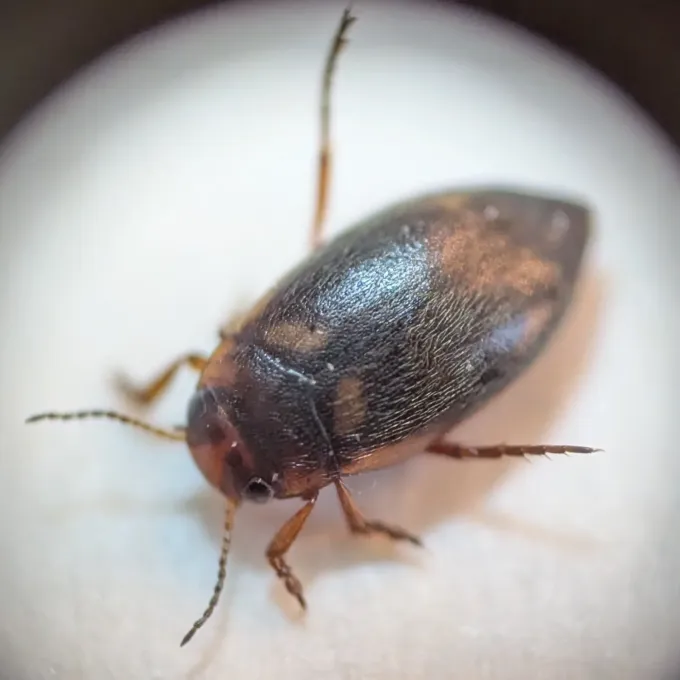
The Marsh diving beetle (Hydroporus palustris) is a small species of predaceous diving beetle belonging to the family Dytiscidae.
Adult beetles are typically between 3 and 4 mm in length, possessing a dark, mottled brown or black carapace that serves as effective camouflage in murky water.
These beetles are well-adapted for aquatic life, featuring streamlined bodies and powerful legs for swimming, as well as functional wings for migration between water bodies.
The larvae are specialized predators with elongated, segmented bodies and sharp, sickle-shaped mandibles used to grasp and pierce their prey.
They are commonly found in shallow, stagnant, or slow-moving water bodies, including ponds and drainage ditches where aquatic vegetation is abundant.
What it damages
While often overlooked in large-scale agriculture, Hydroporus palustris can be a nuisance in aquatic nurseries and professional fish hatcheries.
The larvae are voracious predators and can cause significant losses in commercial hatcheries by feeding on fish fry and fish eggs.
In ornamental and commercial water plant nurseries, both adults and larvae may graze on tender shoots, resulting in stunted growth and plant deformation.
Feeding injuries on aquatic plant stems often serve as entry points for waterborne bacteria and fungal pathogens, potentially causing rot.
In contained environments, high populations of these beetles create significant stress on aquatic life, leading to decreased yields of ornamental aquatic flora.
When it appears
Adults are most active during the spring when they emerge from overwintering sites in the mud or bank vegetation to breed and lay eggs.
The larval stage is primarily concentrated in the summer months, taking advantage of higher water temperatures and abundant prey availability.
As autumn approaches, adult beetles seek out suitable damp areas or remain in the water to enter a state of dormancy during the cold season.
The lifecycle includes complete metamorphosis, with pupation occurring in damp soil near the water's edge, away from the aquatic environment.
Depending on the climatic zone, the beetle typically completes one generation per year, although some regions may see a partial second generation.
Signs of infestation
The most noticeable sign of damage is the appearance of small, irregular holes or notches on the leaves and stems of submerged and floating aquatic plants.
In aquaculture settings, a sudden, unexplained decline in fish fry populations, especially in shallow rearing tanks, often indicates the presence of diving beetle larvae.
Visual identification can be performed by using a fine-mesh net to sample water near vegetation clusters, where these beetles prefer to hide.
Beetles can often be spotted swimming to the water surface to renew their air supply, making them relatively easy to detect during peak activity periods.
- Notches and holes on aquatic plant leaves.
- Reduced survival rates in fish nurseries.
- Presence of predaceous larvae in water samples.
Control measures
The primary control strategy involves regular maintenance of the water body, specifically the removal of dense submerged vegetation that provides habitat for the beetle.
Draining and drying the pond basin during the off-season is highly effective at killing pupae that reside in the shoreline soil.
Biological control can be implemented by stocking the pond with fish species that prey on aquatic insects, effectively keeping the beetle population in check.
Installing fine-mesh screens on inlet pipes helps prevent adult beetles from migrating into controlled ponds from nearby natural water sources.
Chemical control is generally discouraged in aquatic environments due to high risks to fish and beneficial fauna; non-chemical management remains the preferred approach.
Taxonomy
- Latin name
- Hydroporus palustris
- Order
- Coleoptera (beetles)
- Family
- Dytiscidae
- EPPO code
- HDPSPA
Discussion
No discussions yet — be the first.