
Hydroporus beetle
Hydroporus
Description
How to identify
The genus Hydroporus consists of small predaceous water beetles belonging to the family Noteridae (sometimes associated with Dytiscidae). These insects are commonly found in stagnant or slow-moving water bodies, including rice paddies.
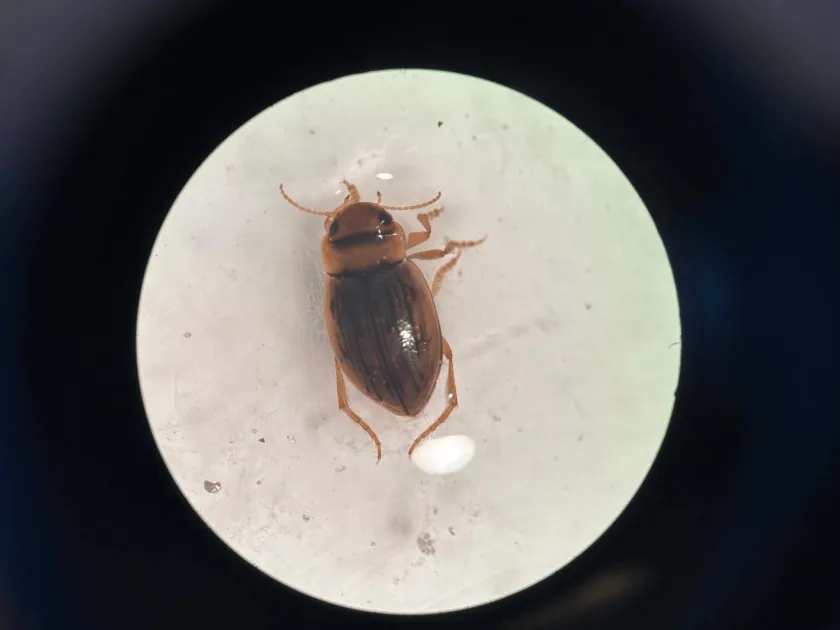
Adult beetles are small, typically ranging from 3 to 5 mm in length. They possess a streamlined, slightly convex body shape adapted for swimming. Their coloration is generally dark brown to black, sometimes with subtle patterns on the elytra.
The larvae are aquatic and characterized by an elongated body and well-developed mandibles. They are highly active predators, capable of moving swiftly through water and among dense vegetation.
These beetles are hydrobionts that invade rice fields immediately after irrigation commences. Identification is challenging due to their small size and cryptic habits, often remaining hidden at the bottom or among rice stems.
They are strictly associated with flooded environments. Outside of water, their activity is limited, which confines their potential damage strictly to irrigated agroecosystems.
What it damages
The primary damage caused by Hydroporus beetles occurs during the seedling stage of rice growth. Adults and larvae feed on the delicate tissues of young stems and roots, potentially compromising plant survival.
Damage is typically focal but can lead to significant thinning of the crop stand if population densities are high. Young seedlings are particularly vulnerable to mechanical damage, which stunts their initial growth.
Feeding injuries weaken the rice seedlings, creating entry points for secondary pathogens, including fungi and bacteria, which can further reduce the overall vigor and yield potential of the crop.
Severe infestations often result in stunted growth and plant mortality in flooded areas. In fields where rice development is slow, the duration of susceptibility to these beetles increases significantly.
While most species are predators of small invertebrates, they may switch to feeding on succulent plant tissues if their primary prey is scarce in the rice paddy environment.
When it appears
The seasonal activity of Hydroporus is directly linked to the rice irrigation cycle. As soon as fields are flooded in the spring, the beetles colonize the area to feed and reproduce.
The life cycle is temperature-dependent. During the summer, in warm, stagnant water, the beetles can complete multiple generations, leading to significant population spikes mid-season.
Adults overwinter in protected locations such as mud, aquatic vegetation, or soil near water bodies. With the arrival of favorable temperatures, they migrate to newly flooded habitats.
Seasonal decline in activity occurs when fields are drained before the harvest. The beetles then move to more permanent water bodies or seek overwintering sites in the surrounding environment.
The intensity of the infestation varies annually based on winter survival rates and the timing of the irrigation of rice paddies.
Signs of infestation
Typical signs of infestation include ragged edges on the leaves and stems of young rice plants near the water surface. These irregular feeding marks are characteristic of their mandibulate mouthparts.
Detection can be confirmed by using a small-mesh aquatic net to sample the water. Finding high numbers of these small, dark beetles is a clear indicator that the population density has reached concerning levels.
Patches of yellowing or dying seedlings are common signs of localized infestations. Damaged plants often show weakened root systems, making them easy to uproot from the saturated soil.
Secondary infections appearing as necrotic spots near the waterline often follow beetle feeding damage. These spots confirm that the integrity of the plant tissue has been compromised.
Reduced plant density compared to nearby fields is a final sign of pest impact, indicating that seedling loss has occurred during the initial establishment phase.
Control measures
Managing the water level is a key agricultural practice. Periodic draining of rice fields disrupts the beetle's life cycle and creates unfavorable conditions for larval development.
Proper soil preparation, including field leveling, prevents the formation of stagnant pools where beetles thrive. Maintaining a steady flow of water can also limit population growth.
Chemical control should be considered only when economic thresholds are met. Selective insecticides approved for rice cultivation can be applied through the irrigation system or as seed treatments.
Biological control methods focus on maintaining the ecological balance by encouraging natural predators such as fish and certain waterfowl that prey on aquatic insects.
- Implement intermittent irrigation cycles.
- Practice crop rotation when feasible.
- Maintain clean field borders to reduce overwintering sites.
- Use targeted insecticides for severe outbreaks.
Taxonomy
- Latin name
- Hydroporus
- Order
- Coleoptera (beetles)
- Family
- Dytiscidae
- EPPO code
- HDPSSP
Discussion
No discussions yet — be the first.