
Great diving beetle
Dytiscus semisulcatus
Description
How to identify
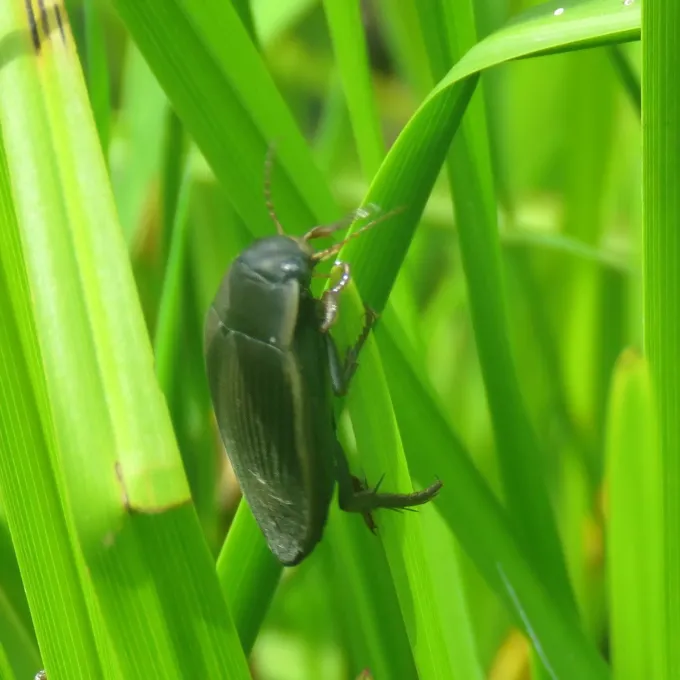
The great diving beetle (Dytiscus semisulcatus) belongs to the order Coleoptera and the family Dytiscidae. This large aquatic predatory beetle reaches lengths of 30 to 35 mm.
The body is oval and streamlined, usually dark brown or black with a yellowish border along the pronotum and elytra. Females are distinguished by longitudinal grooves on their elytra.
Adults are strong flyers, capable of migrating between water bodies, especially during the night. They breathe by storing air bubbles under their wing covers when submerged.
The larvae are aggressive predators with sickle-shaped mandibles, which they use to inject digestive enzymes into their prey, liquefying the internal tissues.
The life cycle involves complete metamorphosis: eggs are laid in aquatic vegetation, followed by three larval stages, a pupal stage in the soil, and the emergence of adults.
What it damages
Dytiscus semisulcatus is considered a significant pest in fish hatcheries and aquaculture ponds where it preys on fish fry and fingerlings.
Both the larvae and the adults are voracious predators. They can devastate populations of young fish in confined environments by feeding on them directly.
Beyond direct predation, these beetles compete with fish for food resources, as they consume aquatic invertebrates that are part of the fish's natural diet.
High densities of these beetles can cause substantial economic losses in fish farming by significantly reducing the survival rates of stocked fry.
Their predatory nature makes them a major concern for intensive pond management, requiring active monitoring and mitigation strategies.
When it appears
Adult beetles become active in early spring, soon after ice melt, beginning their mating and egg-laying cycle in submerged vegetation.
Larval development primarily occurs throughout the spring and early summer, coinciding with the peak period of fish fry production in ponds.
Pupation typically occurs during mid-to-late summer, after which the new generation of adults emerges and remains active until the onset of winter.
Wintering is spent at the bottom of water bodies, where adults remain in a state of low metabolic activity under the water surface.
Migration flights are most frequent during warm nights, facilitating the spread of the population across different ponds in the vicinity.
Signs of infestation
A primary indicator of infestation is a sudden, unexplained decrease in the fish fry population within a nursery pond, lacking symptoms of disease.
Visual observation along the pond edges, especially near aquatic plants, can reveal the presence of swimming adults or resting beetles.
During routine sampling with fine-mesh nets, both larvae and adults can be captured, confirming the presence of the pest.
Dead fish fry may show small, distinct puncture wounds, which are characteristic of larval beetle feeding attacks.
The periodic surfacing of adults to replenish their air supply is a visible sign, particularly in calm or stagnant water conditions.
Control measures
Managing the great diving beetle in aquaculture involves a combination of structural and biological control measures to minimize their impact.
Complete draining and drying of ponds during the winter season is highly effective, as it eliminates both larvae and overwintering adults.
Regular maintenance of pond banks and the removal of excessive vegetation reduce available oviposition sites for the female beetles.
Physical barriers and fine-mesh netting can prevent adult beetles from flying into and colonizing nursery ponds.
- Drain and freeze ponds for pest eradication.
- Manual removal of beetles using nets.
- Control aquatic vegetation to minimize nesting sites.
- Use light traps at night to capture dispersing adults.
Taxonomy
- Latin name
- Dytiscus semisulcatus
- Order
- Coleoptera (beetles)
- Family
- Dytiscidae
- EPPO code
- DTSCSE
Discussion
No discussions yet — be the first.