
Great diving beetle
Dytiscus marginalis
Description
How to identify
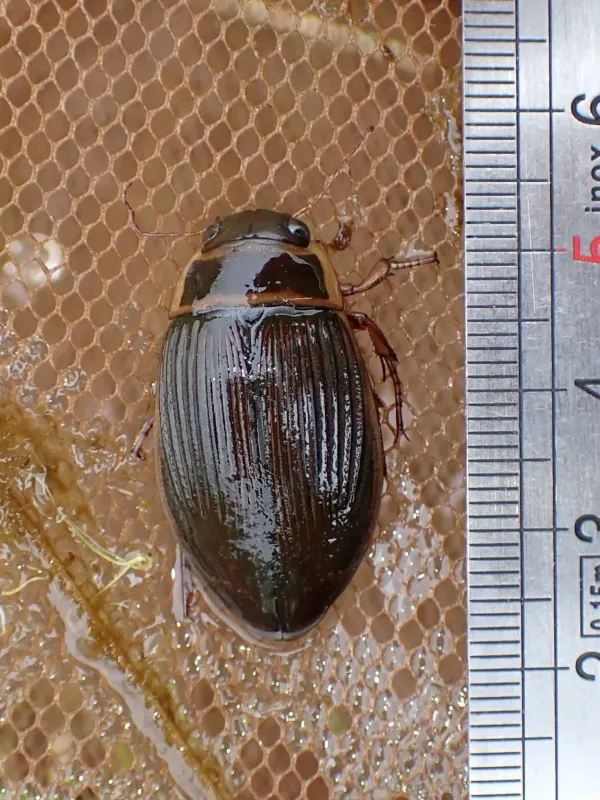
The great diving beetle, scientifically known as Dytiscus marginalis, is a large predatory aquatic insect belonging to the family Dytiscidae, typically reaching 35 mm in length.
Adults possess a streamlined, oval body with an olive-brown coloration and distinctive yellow margins along the pronotum and elytra, adapted perfectly for an aquatic lifestyle.
The larvae, known as water tigers, are voracious predators with elongated, segmented bodies and powerful, sickle-shaped mandibles used for piercing prey.
These beetles are proficient swimmers, utilizing hind legs fringed with hairs, and are also capable of strong flight, which helps them colonize new bodies of water.
They inhabit still or slow-moving freshwater environments like ponds, where they rely on aquatic vegetation for both protection and laying their eggs.
What it damages
The primary economic impact occurs in fish farming, where larvae aggressively prey on fish fry, causing significant losses in commercial pond operations.
Beyond fish, they can destabilize the ecosystem of ornamental ponds by consuming large numbers of tadpoles, small invertebrates, and other beneficial aquatic organisms.
Their predatory nature allows a single larva to consume a large volume of fish fingerlings in a very short time, making them a major nuisance for breeders.
Adult beetles, while generally less destructive than larvae, compete for food resources with other aquatic fauna, potentially reducing the biodiversity of small ponds.
Damage to aquatic plants can occur during oviposition, although this is usually secondary to the direct predatory impact on the fish population.
When it appears
Adult beetles become active in early spring, as soon as water temperatures rise, marking the beginning of their mating season and reproductive activities.
Egg-laying typically takes place in spring, with females inserting eggs into the tissues of submerged or floating aquatic plant stems.
Larval development peaks during the summer months, a period of rapid growth and high metabolic demand, which correlates with their highest predatory activity.
Pupation occurs in the soil along the banks of the water body, typically taking several weeks, after which the new generation of beetles emerges in late summer.
Wintering is spent in a state of diapause, with the beetles hiding in mud at the bottom of the pond or within dense vegetation until the following spring.
Control measures
Effective management begins with mechanical pond maintenance, specifically the removal of excessive aquatic vegetation to reduce egg-laying sites and larval cover.
The use of fine-mesh netting to remove adult beetles from fish breeding ponds in early spring is a proven strategy for reducing local populations.
In aquaculture, maintaining segregated zones for fry and managing water intake with fine screens can prevent larvae from entering the production system.
Promoting a healthy balance of predatory and prey species in natural ponds can help regulate beetle numbers without human intervention.
Chemical control is generally avoided due to the toxicity of insecticides to fish; therefore, focus is placed on habitat modification and physical removal.
Taxonomy
- Latin name
- Dytiscus marginalis
- Order
- Coleoptera (beetles)
- Family
- Dytiscidae
- EPPO code
- DTSCMA
Discussion
No discussions yet — be the first.