
Great diving beetle
Dytiscus circumflexus
Description
How to identify
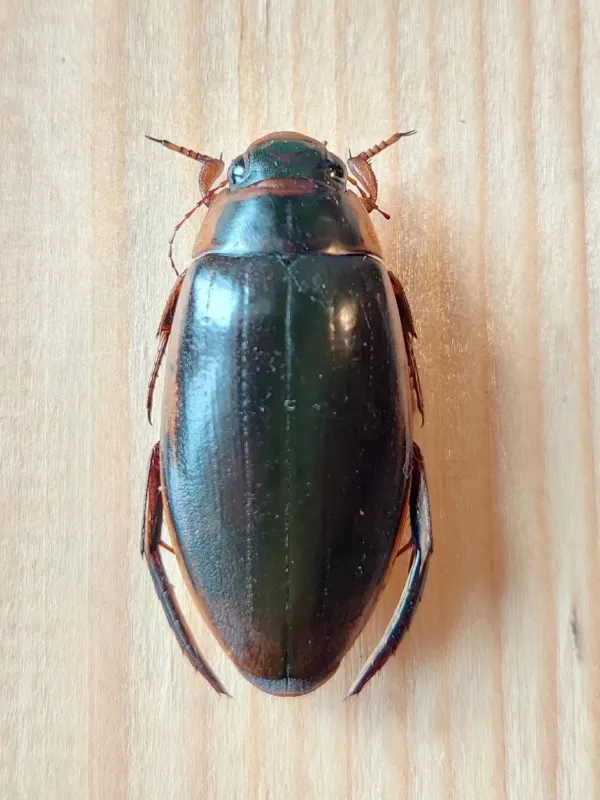
The great diving beetle is a member of the Coleoptera order and the Dytiscidae family. It is a large aquatic beetle, reaching lengths of 30–35 mm.
The insect has a streamlined, olive-brown body with a light-colored margin on the pronotum and elytra, which aids in its recognition.
The hind legs are modified into oar-like structures equipped with swimming hairs, allowing the beetle to navigate quickly through the water column.
Larvae are fearsome predators, possessing elongated bodies and sickle-shaped mandibles used to inject digestive juices into their prey.
Adults are capable of flight and frequently migrate between water bodies at night, making them highly effective at colonizing new habitats.
What it damages
The great diving beetle is considered a nuisance in fish farming, particularly in nursery and rearing ponds where it preys on fish fry.
Both larvae and adults are highly aggressive; the larvae are particularly voracious, consuming significant amounts of young fish and tadpoles.
Their predatory behavior can significantly reduce fish productivity by killing large quantities of young stock before they reach a marketable size.
Beyond direct predation, the presence of these beetles causes stress to the fish population, forcing them to congregate in limited areas and increasing the risk of disease.
In high-density aquaculture, the unchecked population of this predator can lead to substantial economic losses for the fish farm owner.
When it appears
The lifecycle begins in early spring when adults emerge from hibernation and become highly active in searching for food and mates.
Females deposit their eggs into the tissues of aquatic plants, creating small incisions that can sometimes damage the pond's vegetation.
During the summer months, larvae undergo rapid development through three distinct stages, feeding constantly to support their fast growth.
By late summer, the larvae migrate to the shore, burrowing into the soil to build a pupation chamber before transforming into adults.
The beetles overwinter as adults, finding refuge in the mud at the bottom of ponds or under riparian debris until the arrival of warmer weather.
Signs of infestation
Visual identification of adult beetles at the water surface during night or early morning is a primary indicator of their presence.
The observation of fish fry with characteristic lacerations is a clear sign that larvae are actively hunting in the pond.
Finding small, slit-like incisions on the stems of aquatic plants in the littoral zone confirms that the beetles are breeding in the area.
The use of sampling nets in aquaculture ponds often reveals the presence of larvae, indicating an urgent need for population management.
Disturbances in the water surface caused by beetles surfacing for air are easily noticeable when the water is calm, especially during the breeding season.
Control measures
Draining and disinfecting the pond bottom are the most effective strategies for eliminating both larvae and hibernating adults.
Removing excessive aquatic and bank vegetation reduces the available sites for egg-laying and provides fewer hiding spots for developing larvae.
Mechanical removal using fine-mesh nets is a practical approach for smaller ponds or to protect sensitive fish stocks during critical growth phases.
Installing netting over ponds can prevent adult beetles from flying in from nearby sources, effectively isolating the protected fish population.
Biological management, such as promoting a balanced predator-prey system, can help regulate the number of beetles by encouraging natural predators of the insects.
Taxonomy
- Latin name
- Dytiscus circumflexus
- Order
- Coleoptera (beetles)
- Family
- Dytiscidae
- EPPO code
- DTSCCI
Discussion
No discussions yet — be the first.