
Cybister lateralimarginalis
Cybister lateralimarginalis
Description
How to identify
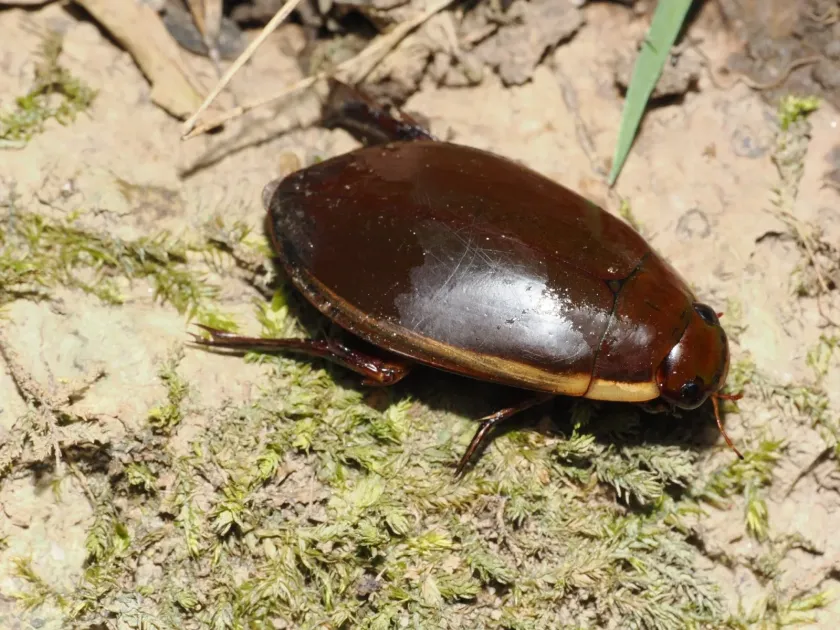
Cybister lateralimarginalis, commonly known as a large diving beetle, is a significant member of the Dytiscidae family. It typically reaches a length of 30–37 mm and has a streamlined, oval-shaped body optimized for aquatic environments.
The adult beetle exhibits a dark olive-green or black coloration, bordered by a distinct yellow-gold margin along the elytra and pronotum. Females can be distinguished from males by the fine longitudinal grooves on their wing covers.
The larvae are highly aggressive aquatic predators with elongated, segmented bodies and large, sickle-shaped mandibles. They are adapted to hunt in shallow, vegetated water where they ambush their prey.
These beetles are excellent fliers, capable of migrating between water bodies during the night, which allows them to colonize new ponds rapidly. Adults need to surface periodically to replenish their air supply stored under their elytra.
As a top invertebrate predator in many pond ecosystems, they possess a strong chitinous exoskeleton, providing excellent protection against various environmental stressors and smaller predators.
What it damages
In aquaculture, Cybister lateralimarginalis is recognized as a harmful predator rather than a crop pest, posing a direct threat to the production of fish fry in nursery ponds.
Both the adult beetles and their larvae are highly predatory. They strike at fish fry, piercing their bodies with specialized mandibles and consuming the internal tissues, leading to high mortality rates.
The presence of these beetles induces stress in surviving fish, hindering their growth rates and making them more susceptible to diseases due to constant predator pressure.
In intensive fish farming operations, an unchecked population of these beetles can lead to substantial economic losses, as a single larva can kill numerous fry throughout its development.
Because they hunt by ambush, their presence is often not immediately detected until significant damage to the fish stock has already occurred, necessitating vigilant monitoring.
When it appears
The activity of Cybister lateralimarginalis begins in early spring, as soon as water temperatures rise, prompting beetles to emerge from their overwintering sites in the mud or bank vegetation.
The breeding season occurs during the late spring and early summer. Females deposit eggs into the tissues of aquatic plants, ensuring the larvae hatch in an environment rich with potential prey.
Summer is the peak season for larval development, coinciding with the period when fish fry are most vulnerable in nursery ponds, leading to increased predation pressure in June and July.
By late summer, larvae reach maturity and crawl onto land to pupate in the soil. Adults emerge shortly after and prepare for the winter by burrowing into the pond bottom substrate.
Migration events are most frequent on warm summer nights, when adults take flight to seek new territories or more abundant food sources, thereby spreading the population.
Signs of infestation
The most common indicator of an infestation is the discovery of injured or partially consumed fish fry along the pond shoreline, often showing clear puncture marks from mandibles.
Observable disturbances in the water, such as sudden splashes or fry jumping, can indicate the presence of active hunting predators within the vegetation zones.
Targeted sampling using fine-mesh nets along the pond banks often yields larvae, confirming the reproductive success of the beetles within the pond system.
A reduction in the expected population density of fry during inventory checks, combined with signs of stress in the school, strongly suggests predator activity.
During the evenings, adults can be seen surfacing for air, providing a visual cue for management to assess the beetle density in the water.
Control measures
The primary control strategy involves draining and liming the pond basin during the off-season, which effectively eradicates larvae and pupae from the soil.
Maintaining clear margins by removing excessive aquatic and marginal vegetation is crucial, as this limits the habitat available for egg-laying and larval ambush tactics.
Mechanical control through periodic net sweeping in nursery ponds is an effective manual intervention to reduce the population of both larvae and adults.
Installing light traps near the ponds can capture migrating adults during the night, effectively preventing the colonization of new water bodies by incoming populations.
- Drain and lime ponds before stocking.
- Regularly clear vegetation from banks.
- Manual removal of adults using nets.
- Install barrier nets at water intake points.
Taxonomy
- Latin name
- Cybister lateralimarginalis
- Order
- Coleoptera (beetles)
- Family
- Dytiscidae
- EPPO code
- CYBILA
Discussion
No discussions yet — be the first.