
Brown diving beetle
Colymbetes fuscus
Description
How to identify
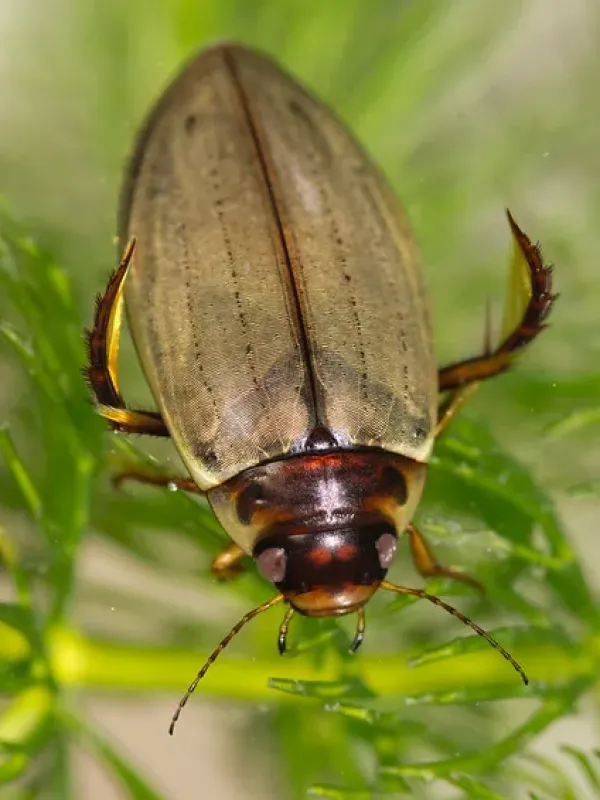
The brown diving beetle (Colymbetes fuscus) is a member of the Dytiscidae family within the order Coleoptera. Adult beetles are typically 15–18 mm long, with an oval, flattened body and a brownish coloration.
A key identification feature of this species is the fine, wavy transverse striation on the elytra, which differentiates it from other similar aquatic beetles. They possess powerful hind legs with fringes of hair, specialized for efficient swimming.
The larvae are highly predatory, possessing a slender, segmented body and prominent sickle-shaped mandibles. They are often found in shallow, vegetated areas of ponds, where they wait for prey.
Adult beetles are capable of sustained flight, enabling them to disperse across landscapes to colonize new aquatic environments, including ponds and small reservoirs.
They overwinter as adults, burrowing deep into the mud or detritus at the bottom of a pond to survive freezing temperatures in a state of diapause.
What it damages
The brown diving beetle is considered a pest in fish farming and aquaculture, specifically in nurseries and rearing ponds containing fish fry.
Both the larvae and the adults are voracious predators. They attack young fish, often killing individuals that are relatively large compared to the beetle's own size.
In intensive culture systems, where high densities of fish fry are maintained, the presence of these beetles can lead to significant mortality rates, causing substantial economic losses for fish farmers.
Furthermore, they compete with fish fry for the same food sources, primarily small zooplankton and other aquatic invertebrates, hindering the overall growth rate of the stock.
While playing a balanced role in wild ecosystems, their unchecked proliferation in managed aquatic environments necessitates active control measures.
When it appears
The life cycle begins in spring when overwintering adults emerge to mate and the females lay eggs by inserting them into the tissues of aquatic plants.
Larval development typically spans the summer months, during which time the larvae are most active and feed voraciously on available prey.
After completing their larval stages, they exit the water to pupate in damp soil along the pond banks, a process that usually occurs in the summer.
New adults emerge from pupae and begin their dispersal phase, flying to search for suitable water bodies to inhabit for the remainder of the season.
As water temperatures drop in the autumn, the adults seek out refuge at the bottom of ponds to prepare for the winter dormancy period.
Signs of infestation
A primary sign of infestation is an unexplained decline in fish fry numbers, especially in ponds where water quality is otherwise optimal.
Presence can be confirmed by using a dip net to sample the vegetation along the pond edges, where both larvae and adults are frequently encountered.
Visible damage to aquatic plant stems, where eggs have been deposited, acts as a secondary indicator of the beetle's reproductive activity in the area.
Nighttime observation near the pond surface may reveal adult beetles surfacing to breathe or swim, as they are often more active at night.
The attraction of adult beetles to artificial lights near the pond perimeter is a common behavioral trait that can highlight their presence in the immediate vicinity.
Control measures
Effective management begins with regular clearing of excessive aquatic vegetation, which reduces the beetle's egg-laying sites and larval hiding spots.
Draining and cleaning pond bottoms during the off-season is highly effective in removing overwintering populations of both larvae and adults.
Installing fine-mesh screens on water inlets prevents the migration of adult beetles from nearby natural water sources into the production ponds.
Encouraging populations of natural predators, such as larger fish species and certain birds, can assist in keeping beetle populations within acceptable limits.
Chemical control is rarely practiced in aquaculture settings due to the high toxicity of most insecticides to fish and the risk of polluting the pond ecosystem.
Taxonomy
- Latin name
- Colymbetes fuscus
- Order
- Coleoptera (beetles)
- Family
- Dytiscidae
- EPPO code
- CLMBFU
Discussion
No discussions yet — be the first.