
Diving beetle
Colymbetes
Description
How to identify
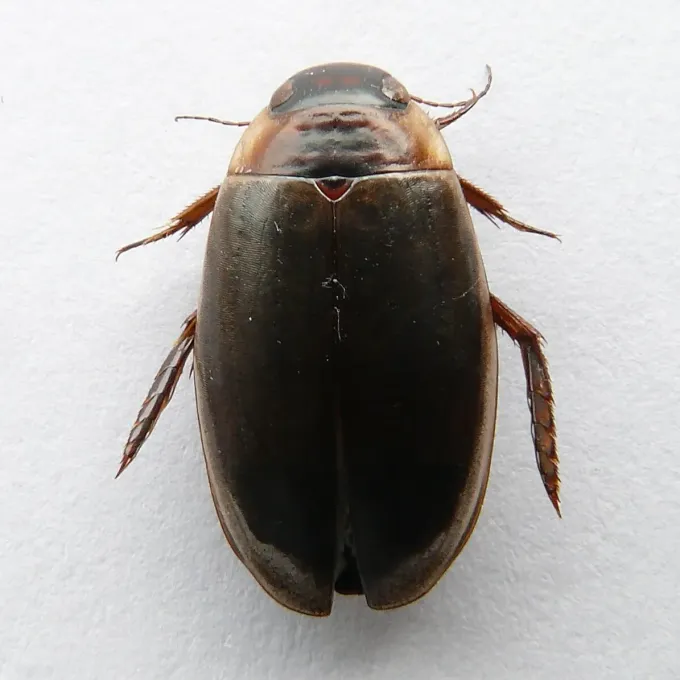
The diving beetle (genus Colymbetes) belongs to the Dytiscidae family, order Coleoptera. These beetles are perfectly adapted for aquatic life with their streamlined, oval-shaped bodies.
Adults typically feature yellowish-brown elytra with fine transverse black striations, which provide excellent camouflage in murky or vegetation-rich water.
The larvae, often called water tigers, are voracious predators. They possess long, curved mandibles that inject digestive enzymes into their prey to liquefy tissues.
These insects are commonly found in stagnant or slow-moving water bodies, including ponds and irrigation ditches, where they can easily hide among aquatic flora.
They are capable of powerful flight, allowing them to disperse to new habitats or reach favorable breeding grounds during the night.
What it damages
In the context of aquaculture and fish farming, the diving beetle is considered a harmful pest, particularly during the early stages of fish development.
The larvae are highly aggressive and specifically target fish fry, often attacking individuals of a similar size, which leads to significant mortality rates.
Adult beetles also engage in predatory behavior, causing physical injury to juvenile fish that can be fatal or lead to secondary bacterial and fungal infections.
High infestations of Colymbetes in rearing ponds can severely undermine the efficiency of production, leading to major economic losses.
By constantly disturbing the fish population, these beetles induce stress, which negatively impacts the growth and immune response of the fry.
When it appears
Activity begins in early spring as water temperatures rise, triggering the emergence of overwintering adults from the substrate.
Breeding and oviposition occur throughout the spring and early summer, as females deposit eggs into aquatic vegetation or damp areas.
Larval development takes place during the warm summer months, characterized by rapid growth cycles and high metabolic demands.
The peak presence of young adults is typically observed in late summer, following the completion of the larval stages.
As water temperatures drop in autumn, both larvae and adults prepare for overwintering, burying themselves in the silt or protected areas of the pond bottom.
Signs of infestation
A primary indicator of infestation is an unexplained decline in fish fry populations within the rearing units.
Visual observation using a sweep net can reveal the presence of both adults and larvae near the water surface or along the edges of vegetation.
Wounds on the bodies of dead or injured fish, characterized by small puncture marks, are a definitive sign of attack by predatory diving beetles.
At night, the presence of these beetles can sometimes be detected through their flight activity or by using light traps positioned near the pond margins.
Frequent agitation of the water surface in areas with dense vegetation can also indicate the presence of hunting larvae.
Control measures
The most effective strategy for managing diving beetle populations is the complete drainage and drying of ponds between production cycles.
Applying lime to the pond bottom during the drying period helps eliminate larvae and eggs hidden in the substrate.
Installing fine-mesh screens on water inlet pipes prevents adult beetles from entering fish ponds from natural water sources.
Regular maintenance, including the removal of excessive aquatic weeds, reduces the availability of suitable nesting and hunting habitats.
- Periodic pond drainage and disinfection.
- Installation of physical filtration barriers.
- Regular vegetation management.
- Monitoring of fry populations for signs of injury.
Taxonomy
- Latin name
- Colymbetes
- Order
- Coleoptera (beetles)
- Family
- Dytiscidae
- EPPO code
- CLMBSP
Discussion
No discussions yet — be the first.