
Diving beetle
Boreonectes
Description
How to identify
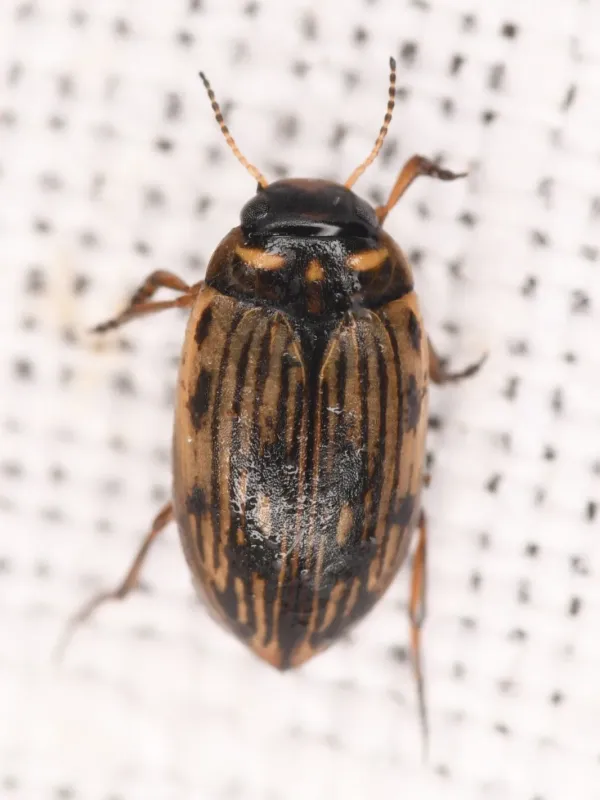
The diving beetle of the genus Boreonectes is a small predatory water insect belonging to the family Dytiscidae, within the order Coleoptera. Their bodies are perfectly streamlined for rapid movement through water, making them highly efficient predators in aquatic ecosystems.
The coloration of these beetles typically ranges from dark brown to black, providing excellent camouflage against bottom substrates and aquatic vegetation. Adult individuals usually measure between 10 and 12 millimeters, allowing them to remain hidden in pond environments.
Their hind legs are fringed with dense hairs, functioning as oars that enable high-speed swimming during predatory pursuits. The beetle's eyes are well-adapted for detecting motion, which is crucial for locating small prey in turbid or vegetative water conditions.
The life cycle includes complete metamorphosis: egg, larva, pupa, and adult. Unlike the adults, the larvae are ferocious predators possessing sickle-shaped mandibles, which they use to inject digestive enzymes into their prey to facilitate external digestion.
These beetles prefer stagnant or slow-moving waters and are commonly found in fish nurseries, aquaculture ponds, and water features containing ornamental vegetation.
What it damages
The primary damage caused by diving beetles involves the predation of fish fry, fingerlings, and fish eggs in artificial ponds. The larvae are voracious and capable of attacking prey even larger than themselves.
Beyond the direct threat to aquaculture, these beetles damage delicate parts of ornamental aquatic plants by chewing on stems and leaves. This mechanical damage weakens the plants, making them more susceptible to rot and secondary infections.
High population densities of diving beetles can significantly reduce the survival rate of fish stocks, leading to substantial economic losses for fish farming operations.
Fish fry that survive an attack often succumb to secondary bacterial or fungal infections that develop in the bite wounds. This high mortality rate makes the control of these pests essential for successful fish propagation.
Furthermore, these beetles can act as vectors for various parasites, moving between different water bodies and potentially introducing diseases into previously healthy aquaculture systems.
When it appears
The activity period for diving beetles typically begins in early spring as water temperatures rise to 8–10 degrees Celsius. At this time, adults emerge from overwintering and begin seeking mates.
Peak activity and breeding occur during May and June. This period aligns with the presence of abundant fish fry in ponds, which serves as a critical food source for the developing larvae.
During the summer, adult beetles are highly mobile and are capable of strong flight, allowing them to relocate from overcrowded or drying ponds to more suitable habitats, including well-stocked aquaculture sites.
As autumn approaches and temperatures drop, their activity levels gradually decrease. Upon the arrival of persistent cold weather, the beetles descend to the bottom and burrow into the silt to enter a state of dormancy (diapause).
Monitoring for these pests should be continuous from late spring through late summer, as the number of generations per year can vary based on the specific climatic conditions of the region.
Signs of infestation
One of the earliest signs of a diving beetle infestation is the sudden and unexplained disappearance of fish fry from rearing ponds. Sampling the water with a fine-mesh net often reveals the presence of their predatory larvae.
Characteristic bite marks appearing as small, localized ulcers on the bodies of dead fry are a strong indicator of diving beetle activity. Observers may also see adult beetles periodically surfacing for air.
Damage to aquatic vegetation, such as irregular holes or shredded leaf margins on water lilies or other plants, serves as a secondary indicator that these insects are active in the area.
The use of light traps at night is an effective way to detect the presence of adult beetles, as they are naturally attracted to artificial light sources placed near the edge of water bodies.
- Unexpected decline in fish egg or fry populations.
- Ulcer-like bite wounds on dead fish fry.
- Direct observation of adult beetles surfacing for air.
- Visible damage to the leaves of aquatic plants.
- High levels of adult beetle flight toward lights at night.
Control measures
The most effective management strategy for aquaculture ponds is the complete draining and sanitization of the pond basin after harvesting. This practice eliminates overwintering sites and reduces the population for the next cycle.
Installing fine-mesh screens on water inlets effectively prevents adult beetles from migrating from natural waterways into managed fish ponds.
Biological control can be implemented by introducing natural predators of the beetles, such as larger predatory fish species, although this must be carefully managed to avoid negative interactions with the cultured fish.
Chemical control in aquaculture is generally discouraged due to the risk of toxicity to the fish stock. Any chemical intervention must strictly follow regional safety regulations and environmental guidelines.
Routine maintenance, including the removal of excess aquatic vegetation and dredging of silt, deprives the larvae of necessary hiding places, thereby reducing their efficiency as hunters and overall population density.
Taxonomy
- Latin name
- Boreonectes
- Order
- Coleoptera (beetles)
- Family
- Dytiscidae
- EPPO code
- BONCSP
Discussion
No discussions yet — be the first.