
Agabus diving beetle
Agabus
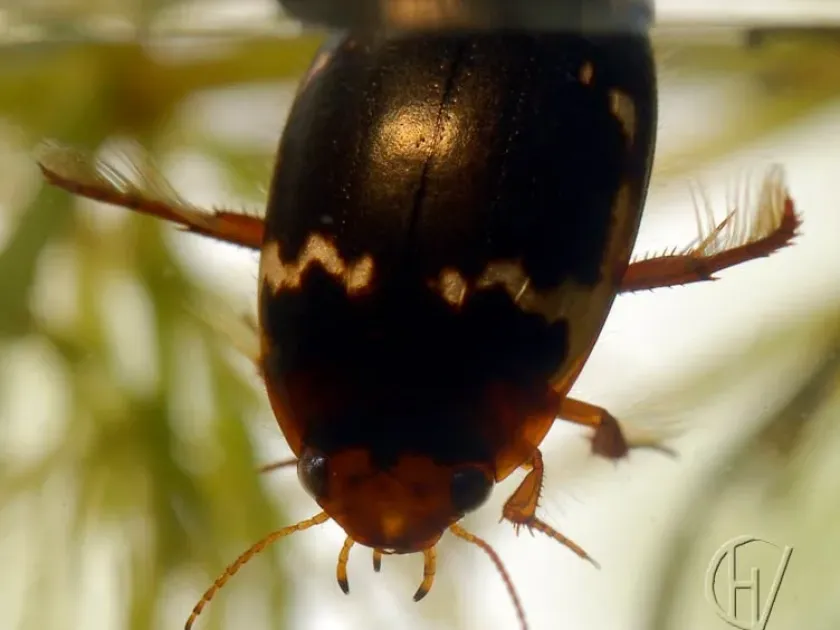
Description
How to identify
The Agabus diving beetle is a member of the Dytiscidae family within the order Coleoptera. These are specialized aquatic insects known for their streamlined, oval-shaped bodies adapted for efficient swimming.
Adult beetles possess hard wing covers (elytra) and are capable of flight, allowing them to migrate between water bodies. Their color is typically dark, ranging from brown to black, aiding in camouflage against pond substrates.
Larvae are characterized by an elongated body and sickle-shaped mandibles, which they use to capture and consume prey. They are highly active predators both as larvae and as adults.
The life cycle involves a complete metamorphosis: egg, larva, pupa, and adult. Pupation typically occurs in the soil along the banks of the water body, which is a critical stage for development.
Understanding their life cycle is crucial for effective management, as they are opportunistic predators that thrive in stagnant or slow-moving water environments.
What it damages
The primary concern regarding Agabus beetles in agricultural contexts is their impact on aquaculture and fish farming. Both larvae and adults prey upon fish fry and fingerlings.
By consuming juvenile fish, these beetles can cause significant economic losses in fish hatcheries and breeding ponds. They also deplete the population of beneficial aquatic invertebrates.
In irrigation canals, while they do not attack crops directly, their presence can disrupt the ecological balance and clog mechanical filters used for water circulation.
The predatory behavior of these beetles is particularly harmful in intensive farming systems where fry density is high. They act as significant competitors for food resources.
Large-scale infestations can lead to decreased fish yields and poor health of the stock, requiring active monitoring and intervention strategies.
When it appears
Adult activity typically begins in early spring, as water temperatures rise, triggering mating and egg-laying rituals. This is the period when colonization of new water sources often occurs.
During the summer months, larval populations reach their peak. The warm water conditions accelerate their growth, leading to increased predation rates on young aquatic organisms.
By late summer, the larvae migrate to the shore to pupate. The new generation of adults typically emerges in the autumn before moving to wintering sites.
Wintering occurs at the bottom of ponds, buried in the silt or hidden among organic debris. During this period, the beetles enter a state of reduced metabolic activity.
Effective scouting should be conducted during the late spring to identify high-density areas before the larval population expands significantly.
Signs of infestation
A major indicator of infestation is an unexplained decline in fish fry populations. Since the beetles are predators, they leave behind clear signs of physical attacks.
Visual confirmation of adults surfacing to breathe is a reliable sign of their presence. They must come to the surface periodically to replenish their air supply.
Larvae can be detected by using dip nets in the vegetation along the pond edges. They are often found hiding in submerged stems or among dense algal mats.
Physical injuries to the fry, such as jagged bites or lesions, are hallmark signs of predation by these beetles. Immediate sampling is recommended when such damage is observed.
Clogging of intake screens or filtration systems in aquaculture facilities by trapped beetles is a strong indicator of a high population density in the system.
Control measures
Mechanical removal is the most direct and effective approach. Using nets and specialized traps during the spring migration helps reduce the initial adult population.
Managing aquatic vegetation is essential, as dense plant matter provides both egg-laying sites for adults and protective cover for the predatory larvae.
Biological control methods include encouraging natural predators, such as larger fish or amphibians that may consume the beetle larvae in the pond.
Draining and disinfecting ponds after the harvest season is a highly effective way to eliminate pupae and overwintering adults from the farm environment.
- Regular dip-net sampling.
- Removal of excess vegetation.
- Water system filtration management.
- Annual pond draining and disinfection.
Taxonomy
- Latin name
- Agabus
- Order
- Coleoptera (beetles)
- Family
- Dytiscidae
- EPPO code
- AGABSP
Discussion
No discussions yet — be the first.