
Great diving beetle
Acilius sulcatus
Description
How to identify
The great diving beetle (Acilius sulcatus) is a prominent member of the Dytiscidae family, commonly found in freshwater habitats across the region.
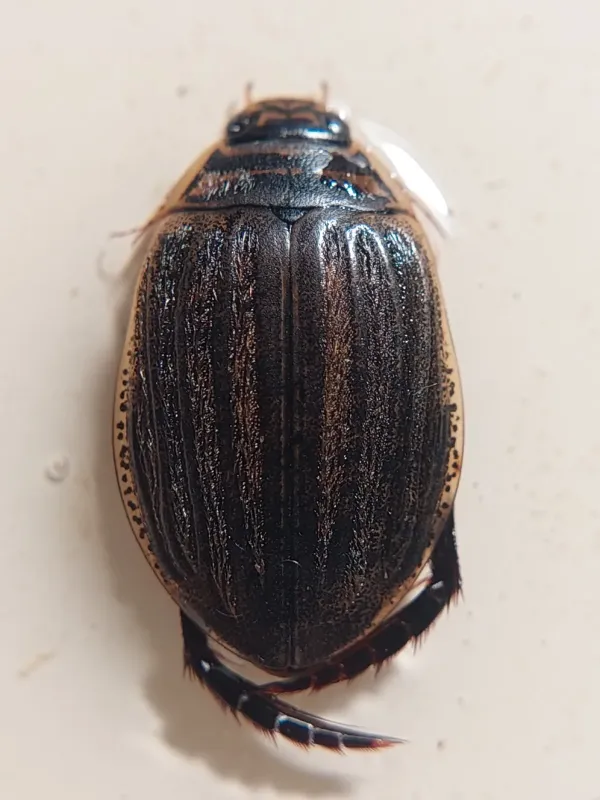
Adult beetles typically measure between 15 and 18 millimeters in length, possessing an oval, streamlined body suited for efficient underwater movement.
Sexual dimorphism is evident: males have smooth, shiny elytra, while females feature deeply furrowed elytra covered in fine, dense hairs.
The larvae, known for their predatory nature, possess elongated, spindle-shaped bodies and large, sickle-shaped mandibles used for piercing their prey.
They are highly adapted to aquatic life, requiring periodic trips to the water's surface to replenish their oxygen supply stored beneath their elytra.
##damage##This species is considered a significant pest in aquaculture, particularly within fish nurseries and fry-rearing ponds where they can cause substantial losses.
Larvae are extremely voracious predators capable of attacking and consuming fish fry that are similar in size or sometimes even larger than themselves.
Heavy infestations can lead to a drastic reduction in fish stocking survival rates, causing economic strain on fish farming operations.
Beyond direct predation, larvae compete with fish for food, feeding heavily on zooplankton and other aquatic organisms essential for fish growth.
The predatory pressure is most intense when fish fry are small and vulnerable, making the beetle a serious concern for managed aquatic environments.
When it appears
The activity cycle begins in early spring, as adult beetles emerge from hibernation to mate and seek suitable spawning sites.
Females insert their eggs into the tissues of aquatic plants, providing protection for the developing embryos against environmental stressors.
Larval development peaks during the summer months, coinciding with the growth stages of many freshwater fish species in temperate climates.
As temperatures begin to drop in autumn, larvae complete their development and pupate in the moist soil along the pond banks.
Adults transition to a dormant state, overwintering in the silt at the bottom of ponds or in protected areas near the water.
Signs of infestation
A sudden decline in fish fry populations without symptoms of illness or parasite infection is a primary indicator of predation by these beetles.
Visual confirmation of larvae hanging from vegetation or moving through the water column is a clear sign of an established population.
Evidence of eggs embedded in the stems of aquatic plants during seasonal inspections confirms that the beetles are actively breeding in the area.
Physical injuries on fish fry, such as puncture marks or torn tissue, are telltale signs of attacks by the predatory larvae.
Reduced water clarity and a lack of zooplankton, despite an absence of significant phytoplankton blooms, may also suggest high insect predatory activity.
Control measures
The most effective management practice is the complete draining and drying of ponds during the winter season to eliminate overwintering sites.
Regular maintenance, including the removal of dense aquatic vegetation, significantly reduces available surfaces for egg-laying and larval shelter.
Installing mesh screens on inlet channels prevents adult beetles from migrating into fish ponds from surrounding natural water bodies.
Mechanical trapping of adult beetles can be employed during peak activity periods to suppress population numbers in smaller enclosures.
- Drain and dry ponds annually.
- Remove excess aquatic weeds to destroy breeding sites.
- Use inlet filters to prevent beetle migration.
- Deploy mechanical traps during the spring mating flight.
Taxonomy
- Latin name
- Acilius sulcatus
- Order
- Coleoptera (beetles)
- Family
- Dytiscidae
- EPPO code
- ACILSU
Discussion
No discussions yet — be the first.