
Xylothrips religiosus
Xylothrips religiosus
Description
How to identify
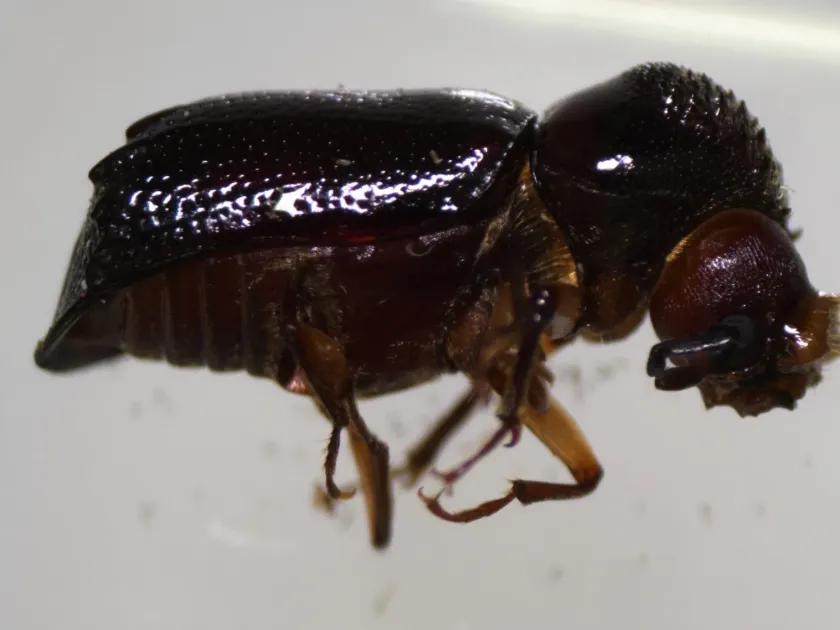
Xylothrips religiosus is a beetle species belonging to the family Bostrichidae, commonly known as auger beetles or false powderpost beetles. Adult beetles have a cylindrical body measuring 3 to 5 mm, typically dark brown or black.
The pronotum of this beetle is highly arched and hood-like, covering the head, which is a characteristic morphological feature of the Bostrichidae family.
The body surface is covered with dense, fine punctations, giving the insect a matte appearance. These beetles are highly mobile and are capable of flight to find suitable hosts for oviposition.
The larvae are white and have a C-shaped body, which is common for wood-boring beetle larvae. They live hidden within the wood, making them difficult to detect during their growth phase.
Taxonomically classified within the order Coleoptera, this species is prevalent in warm climates where it finds optimal conditions for its life cycle and development.
What it damages
This pest primarily infests the wood of various tree species. It is particularly known for attacking various Ficus species, hence the specific name religiosus (referring to the sacred fig, Ficus religiosa).
The beetle attacks both stressed living trees and seasoned wood, making it a significant pest in both orchards, landscapes, and timber storage facilities.
Larvae feed by boring deep galleries within the wood, which disrupts the vascular system and structural integrity of the branches or stems.
Mass infestations can lead to the decline and death of host plants, especially when trees are already under physiological stress from drought or other pathogens.
Furthermore, the damage caused by Xylothrips religiosus predisposes trees to secondary infections by fungi and bacteria, which can accelerate the decay of the host.
When it appears
The adult activity period generally occurs during the warm months, when temperature conditions are optimal for flight and the search for egg-laying sites.
The life cycle of Xylothrips religiosus is dependent on environmental temperature and moisture content of the wood, which is crucial for larval development.
Females bore into the wood surface or bark cracks to lay eggs, creating maternal galleries where the progeny will develop protected from the outside world.
In warm regions, multiple generations may occur within a single year, which significantly increases the risk of rapid population growth and wider infestation.
Overwintering usually takes place in the larval stage, deep within the wood tissues, which provides an effective shelter against cold weather and predators.
Signs of infestation
The most visible sign of infestation is the presence of small, perfectly round exit holes on the bark or wood surface, typically 1.5–2 mm in diameter.
Fine wood dust, known as frass, often accumulates near these holes or at the base of the tree, indicating active boring activity by the larvae inside.
Affected branches or stems may show signs of wilting, premature yellowing of leaves, or foliage dieback due to the destruction of the water-conducting tissues.
Upon removing the bark or cutting into the wood, one can observe a complex network of larval galleries filled with boring dust, often running parallel to the wood grain.
In severe cases, structural damage becomes apparent, as the wood loses its strength and may snap or break during high winds or under the weight of the tree canopy.
Control measures
Controlling Xylothrips religiosus is challenging due to the insect's cryptic nature; therefore, sanitation is the most effective management tool.
- Regular monitoring of susceptible trees for signs of infestation.
- Prompt removal and burning of infested wood to eliminate the breeding source.
- Application of systemic insecticides to the trunk to prevent new egg-laying.
- Maintaining tree health through proper irrigation and fertilization.
- Avoiding the storage of cut wood or timber near living tree plantations.
Chemical control efforts should be timed to coincide with the emergence period of adults to prevent them from successfully boring into the wood.
Enhancing the overall vigor of the host plant remains the best preventive measure, as Xylothrips religiosus disproportionately targets trees that are weak or nutrient-deficient.
Taxonomy
- Latin name
- Xylothrips religiosus
- Order
- Coleoptera (beetles)
- Family
- Bostrichidae
- EPPO code
- XYTHRE
Discussion
No discussions yet — be the first.