
Texas borer
Xylobiops texanus
Description
How to identify
The Texas borer Xylobiops texanus is a member of the order Coleoptera and the family Bostrichidae, commonly known as auger beetles or powderpost beetles.
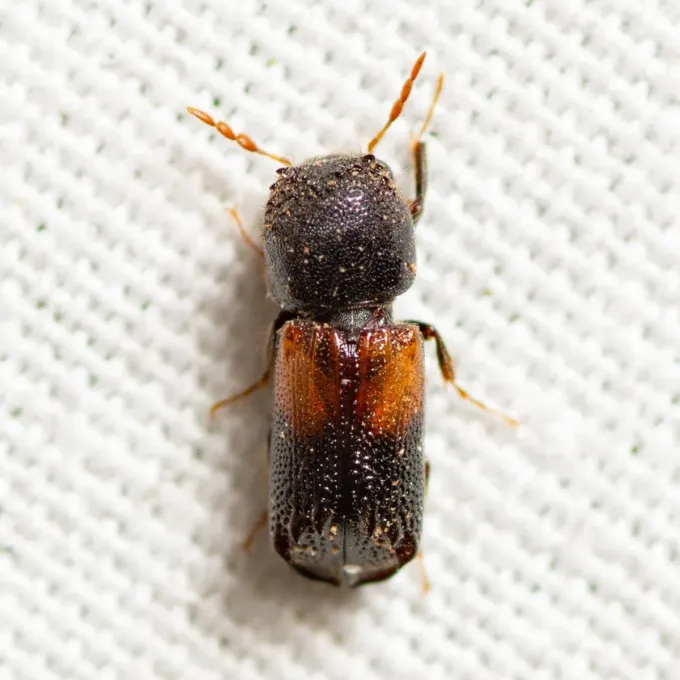
Adult beetles are typically small, cylindrical, and dark brown or black. The pronotum covers the head like a hood and features small teeth or tubercles, a diagnostic trait for the family.
The larvae have a characteristic C-shaped, creamy white body with strong mandibles designed for excavating deep galleries within wood tissues.
The life cycle involves complete metamorphosis. Adults emerge in warmer seasons to find suitable hosts for mating and egg-laying, often preferring stressed or damaged trees.
This species is well-adapted to surviving in dry, woody environments, making them persistent pests in both natural landscapes and managed orchards.
What it damages
The Texas borer primarily attacks various hardwood species, including fruit trees like apples, pears, and stone fruits, especially when the trees are weakened.
Damage is caused by the larvae boring into the sapwood and heartwood, which disrupts the tree’s vascular system and prevents the transport of water and nutrients.
Infested trees often exhibit signs of stress, such as wilted foliage, branch dieback, and reduced annual growth, which can lead to premature tree mortality.
In addition to physical damage, the tunnels created by the larvae provide entry points for pathogens, fungi, and other opportunistic wood-boring insects.
A severe infestation can compromise the structural integrity of branches, causing them to break under their own weight or during adverse weather conditions.
Signs of infestation
The most common sign of an infestation is the presence of small, circular exit holes on the surface of the bark, often found on branches or the main trunk.
Fine wood dust or frass is frequently found accumulating near these holes or at the base of the tree, indicating active boring inside the wood.
Trees may show localized wilting or dead limbs, which serve as visual indicators that the internal tissues have been heavily compromised by larval tunneling.
Careful inspection of the bark might reveal staining or weeping from the points of entry, as the tree attempts to push out sap due to the internal damage.
When peeling back the bark of a heavily infested tree, you will find a complex network of tunnels tightly packed with frass and wood shavings.
Control measures
The most effective strategy is proactive sanitation, which involves pruning and destroying infested limbs by burning them to kill larvae within the wood.
Maintain tree health through proper irrigation, fertilization, and soil management, as healthy trees are less attractive to this pest compared to stressed ones.
During peak adult flight periods, applying systemic or contact insecticides to the trunk and main branches can help prevent adult beetles from laying eggs.
Avoid mechanical injuries to the tree trunk during cultivation, as wounds provide the initial access points that beetles use to begin their infestation.
Regular monitoring of the orchard is essential. If infestation levels are low, physical removal of affected parts may be sufficient to manage the population without extensive chemical use.
Taxonomy
- Latin name
- Xylobiops texanus
- Order
- Coleoptera (beetles)
- Family
- Bostrichidae
- EPPO code
- XYLPTE
Discussion
No discussions yet — be the first.