
Xylobiops parilis
Xylobiops parilis
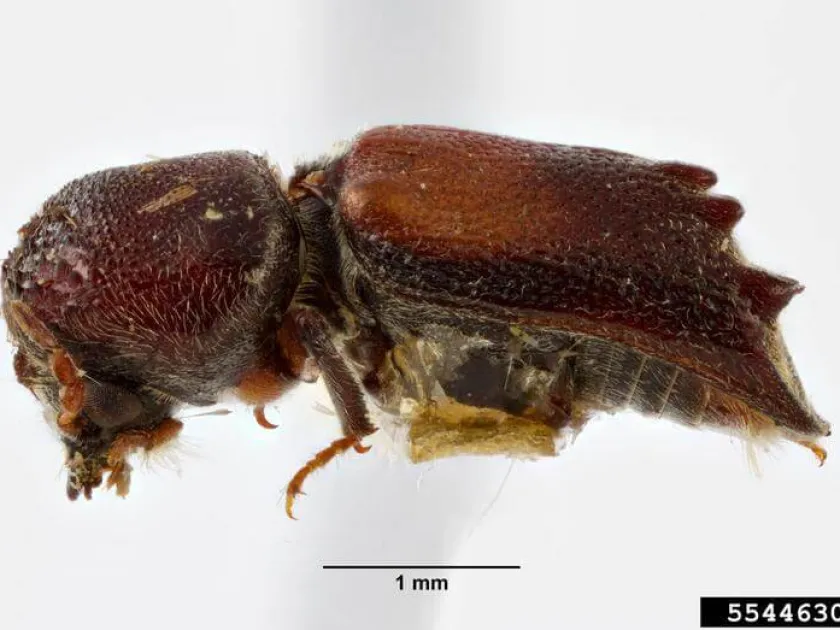
Description
How to identify
Xylobiops parilis is a member of the Bostrichidae family, commonly known as auger beetles or false powderpost beetles due to their wood-boring habits.
The adult beetle has a cylindrical, elongated body, typically dark brown to black in color, which is characteristic of the Bostrichidae family.
The pronotum is heavily developed and hood-like, covering the head completely; it features small tubercles and spines that serve as a key identification trait.
These beetles are well-adapted for burrowing into hard wood, with their head hidden beneath the pronotum to facilitate a wedging motion during excavation.
The larvae are typically creamy-white, curved, and possess strong mandibles capable of grinding through dense woody tissues throughout their development.
What it damages
This pest is a specialist xylophage that targets a variety of deciduous trees, particularly those that are already stressed or weakened by environmental factors.
Infested trees often include common orchard species, such as fruit-bearing trees, as well as various ornamental and native hardwood species.
Both adults and larvae contribute to the damage, with adults boring into the stems and larvae creating complex internal galleries within the branches.
The primary harm is the disruption of vascular tissues, which restricts the flow of water and nutrients, leading to progressive decline in tree health.
Severe infestations can result in the dieback of major branches and may eventually kill the tree if the population density is not managed effectively.
When it appears
Adult emergence typically occurs during the spring and summer months, as these insects seek out suitable host trees to initiate their reproductive cycle.
The life cycle duration of Xylobiops parilis is highly variable, depending on ambient temperatures and the moisture content of the wood they occupy.
In most temperate climates, the beetle completes one generation per year, although warmer regions may facilitate more frequent life cycles.
Overwintering usually takes place in the larval stage, protected deep within the woody structures of the host tree from external environmental stressors.
Development resumes as temperatures rise in the spring, leading to pupation and the subsequent emergence of the next generation of adults.
Signs of infestation
The most prominent indicator of an infestation is the presence of small, perfectly round entrance holes in the bark of branches and main stems.
Frass, which consists of fine wood particles and excrement, often accumulates at the base of the tree or within bark crevices beneath the entry holes.
Visual symptoms of a failing tree include premature leaf yellowing, wilting, and thinning of the canopy as the internal damage progresses.
Bark may appear brittle or cracked, and in some species, sap bleeding can indicate an attempt by the tree to defend against the invading beetles.
When an infested branch is cut, the interior will show extensive gallery networks filled with pulverized wood, confirming the presence of larvae.
Control measures
The most effective management strategy involves rigorous sanitation, which includes removing and burning all infested branches to eliminate larvae.
Maintaining tree vigor through proper irrigation, fertilization, and site management is essential to reduce the susceptibility of trees to attack.
Contact insecticides can be applied during the adult flight period to provide a protective barrier on the bark surface and prevent new entries.
Proper wound care following pruning, using sealing agents, helps to prevent beetles from using fresh cuts as points of entry into the tree.
- Regular monitoring of tree health.
- Prompt removal of infested or dead wood.
- Use of pheromone lures to track beetle activity.
- Application of preventative bark treatments.
Taxonomy
- Latin name
- Xylobiops parilis
- Order
- Coleoptera (beetles)
- Family
- Bostrichidae
- EPPO code
- XYLPPA
Discussion
No discussions yet — be the first.