
Hooded wood borer
Sinoxylon unidentatum
Description
How to identify
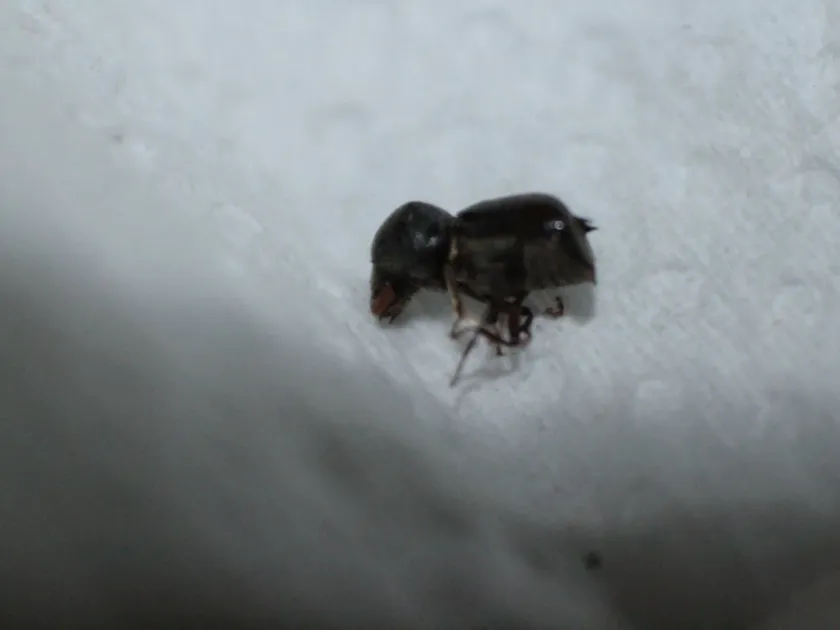
The Hooded wood borer (Sinoxylon unidentatum) is a member of the family Bostrichidae within the order Coleoptera. Adult beetles are small, cylindrical insects, usually 3 to 6 millimeters in length, with a coloration ranging from dark brown to black.
The most distinctive feature of this species is its pronotum, which extends forward like a hood over the head, characteristic of the entire family. Furthermore, the posterior end of the elytra bears two prominent teeth, which serve as a key diagnostic feature for species identification.
Larvae are white, C-shaped, and possess strong mandibles adapted for burrowing through dense wood. They live entirely within the host plant, emerging only once they have matured into adults, which makes early detection quite challenging for growers.
The development cycle is a complete metamorphosis, including egg, larva, pupa, and adult stages. In warm climates, these beetles can complete multiple generations per year, leading to a rapid population buildup in infested areas.
These insects are primarily active during the twilight hours or at night, seeking shelter during the day. An optimal ambient temperature for their development is between 25 and 30 degrees Celsius, paired with appropriate wood moisture content.
What it damages
The Hooded wood borer is a polyphagous pest, meaning it attacks a wide variety of fruit trees, including apples, pears, peaches, apricots, and cherries. It is also frequently found in ornamental trees and various forest species.
The primary damage is caused by larvae that tunnel through the wood, disrupting the plant's vascular system. This disruption severely affects the flow of nutrients and water, often causing branch dieback and overall tree decline.
In commercial orchards, severe infestations can lead to significant economic losses, including reduced crop yields and the death of young saplings. Wood that is heavily infested with tunnels becomes brittle and is prone to breakage under wind pressure.
Besides living trees, these beetles are notorious for infesting freshly cut timber and stored lumber. They can quickly degrade the quality of wood products, rendering them useless for commercial and construction purposes.
Infestation typically begins at bark wounds or branch junctions where female beetles bore holes to lay their eggs. These initial sites often become entry points for secondary fungal infections that further weaken the tree's health.
Signs of infestation
The first visual signs of infestation are small, circular holes on the bark, approximately 1.5 to 2 millimeters in diameter. These are exit holes created by the emerging adult beetles, often accompanied by fine wood dust or frass.
A clear symptom is the premature yellowing and wilting of leaves on individual branches. Eventually, these affected branches may dry out completely and die, as the beetle tunnels block the sap flow inside the wood.
Inspecting the bark often reveals localized swellings or cracking. Peeling back the bark in suspected areas will expose a complex network of galleries filled with larval excrement and pulverized wood tissue.
Branch breakage is another common sign, especially in young twigs. Larvae often hollow out the center of the wood, leaving only a thin outer shell that cannot support the weight of the branch, leading to sudden snaps.
Necrotic patches on the bark may also appear near the galleries, indicating that the tree is struggling to combat the physical trauma and potential secondary infections introduced by the borer's feeding activities.
Control measures
Effective management begins with strict sanitation, involving the regular pruning and removal of all infested branches. It is essential to burn or destroy the infested wood promptly to kill the larvae living within.
Promoting tree health through proper agricultural practices is a critical preventative measure. Adequate irrigation, balanced fertilization, and good soil management help ensure that trees remain vigorous and resistant to beetle attacks.
Chemical control may be necessary during peak infestation periods. Insecticide applications are most effective when timed with the emergence of adult beetles, targeting them before they can successfully lay eggs on the tree.
Utilizing pheromone traps is an excellent method for monitoring population levels. This data allows for precise timing of interventions, which optimizes the efficacy of control measures while reducing overall pesticide usage.
For stored wood or timber products, industrial fumigation or heat treatment is recommended. These processes ensure that all life stages of the borer are eliminated, protecting valuable lumber from further destruction.
Taxonomy
- Latin name
- Sinoxylon unidentatum
- Order
- Coleoptera (beetles)
- Family
- Bostrichidae
- EPPO code
- SINOCO
Discussion
No discussions yet — be the first.