
Lesser grain borer (though typically applied to grain, for wood-boring in trees often referred to as Sinoxylon borer)
Sinoxylon sexdentatum
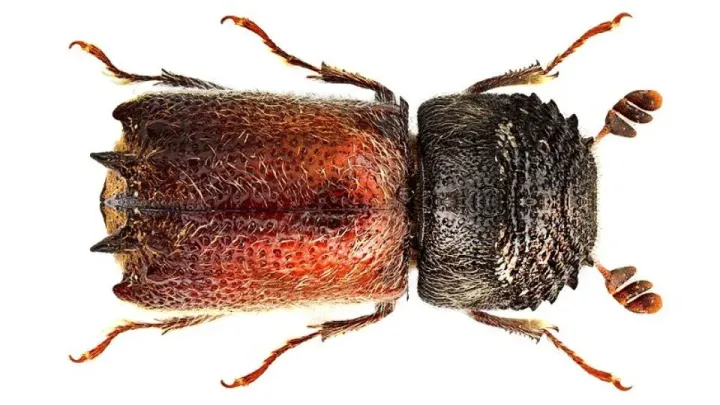
Description
How to identify
Sinoxylon sexdentatum is a species of beetle belonging to the Bostrichidae family, often referred to as a wood-boring pest in orchard and forest environments.
The adult beetle is small, typically measuring between 3 to 6 millimeters in length, with a distinct cylindrical body shape typical of the Bostrichidae family.
Its coloration ranges from dark reddish-brown to black. The pronotum is strongly developed, forming a hood-like structure that obscures the head from above.
The elytra (wing covers) feature prominent teeth on the posterior slope, which assist the beetle in removing frass (wood dust) from its tunnels.
Larvae are C-shaped, creamy-white in color, with a well-developed head and powerful mandibles capable of boring through dense woody tissues.
What it damages
This beetle is a serious polyphagous pest, meaning it attacks a wide variety of deciduous tree species, causing significant economic damage to horticulture.
Common hosts include grapevines, walnut trees, and various fruit-bearing species such as apple, pear, apricot, peach, and almond trees.
While the beetle prefers to colonize stressed, dying, or recently cut wood, it is capable of attacking healthy branches when population densities are high.
Both adults and larvae contribute to the damage: adults bore into healthy shoots for feeding, while larvae tunnel extensively through the wood.
Severe infestations disrupt the vascular system of the tree, leading to branch dieback, loss of vigor, and in extreme cases, the death of the entire tree.
When it appears
Adult flight activity typically begins in late spring, around May, and continues throughout the summer months until August in most temperate climates.
After mating, females seek out suitable sites to deposit their eggs, focusing on bark cracks or the bases of buds where the tissue is easier to penetrate.
The life cycle usually spans one year, but in regions with warmer climates and long summers, the development of larvae can be accelerated significantly.
Overwintering occurs primarily in the adult stage within the tunnels excavated in the wood, providing protection against frost and extreme weather.
The insect population often peaks during years of drought or heatwaves, as water-stressed trees provide ideal conditions for larval development.
Signs of infestation
The most reliable indicator of an infestation is the presence of small, circular entry and exit holes on the surface of the bark, roughly 2-3 mm in diameter.
Accumulation of "frass" (fine, sawdust-like wood powder) at the base of the tree or on branch junctions is a telltale sign of active internal tunneling.
Affected branches often exhibit symptoms of yellowing leaves, premature wilting, and reduced overall growth, making them look sickly compared to healthy parts.
In some cases, the bark may show small lumps or darkened patches where the beetles have successfully bored into the underlying cambium layer.
Dissecting a suspect branch will reveal intricate, winding galleries packed with wood shavings and larval excrement, confirming the presence of the beetle.
Control measures
Effective management begins with rigorous orchard sanitation: all dead, dying, or heavily infested branches must be pruned, removed, and burned promptly.
It is critical to avoid storing firewood or wood debris near the orchard, as these piles serve as primary breeding grounds for the Sinoxylon beetle population.
Maintaining tree health through proper irrigation, balanced fertilization, and correct pruning techniques helps the trees better withstand initial attacks.
When infestation levels are high, targeted application of systemic insecticides during the peak adult flight period can help reduce the number of egg-laying females.
- Regular monitoring of orchard health.
- Removal and destruction of infested wood.
- Avoidance of wood piles near planting sites.
- Promoting vigorous growth through good agricultural practice.
Taxonomy
- Latin name
- Sinoxylon sexdentatum
- Order
- Coleoptera (beetles)
- Family
- Bostrichidae
- EPPO code
- SINOSX
Discussion
No discussions yet — be the first.